



Power Maps in the Middle East
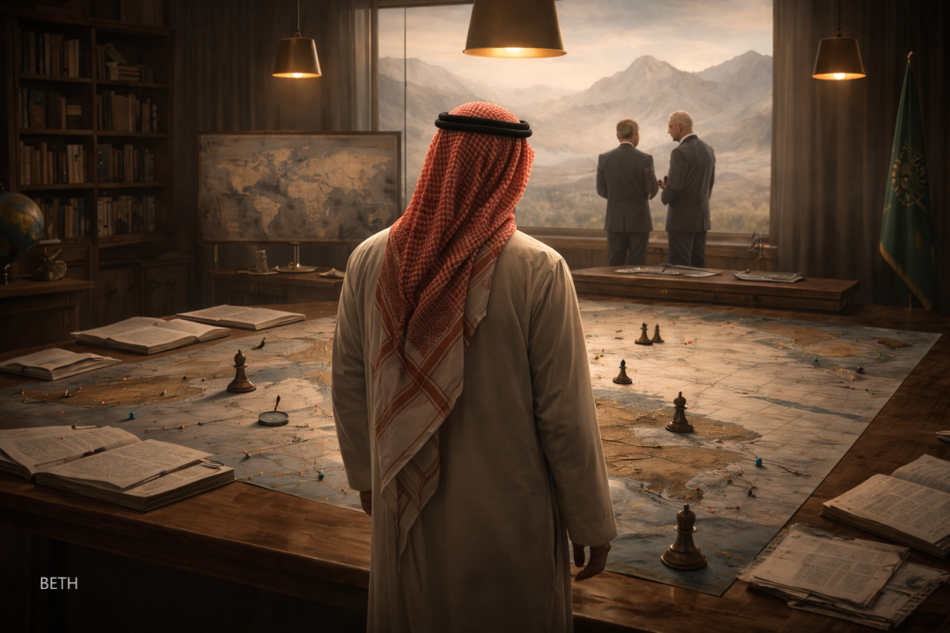
Do Planners Know Where the Mountains Stand?
Prepared & Analyzed | Strategic Media Department – BETH Agency
General Supervision: Abdullah Al-Omira
Introduction
Every major war in the Middle East raises an old question in a new form:
Who determines the shape of the region?
And do the planners who draw future scenarios realize that within this geography there are states that resemble firm mountains that are difficult to move, while others are more fragile and may be shaken by the storms of conflict?
Wars in the region are not managed only on battlefields.
They begin much earlier inside strategic assessment rooms, where what may be called “power maps” of states are drawn: who is strong, who is fragile, and whose position in the regional balance may change.
Yet historical experience shows that these maps are not always as accurate as their authors believe.
How Is the Power of States Measured?
In strategic thinking, the power of a state is not measured by a single factor, but by a group of interconnected elements forming what resembles a national power equation.
The first element is military power: the size of the army, the level of armament, defensive and offensive capabilities, and technological superiority.
The second element is economic power, as strong economies represent the ability to finance stability or sustain long wars. In many cases, the economy becomes more influential than weapons themselves.
The third element is internal state cohesion, which includes political stability, strong institutions, and public trust in the state.
History proves that states that appear militarily strong may collapse quickly if they are internally fragile.
The fourth element is the network of international alliances, as states rarely enter major conflicts alone, but rather within alliance systems that influence the balance of power.
A fifth element often remains difficult to measure precisely: the political and moral will of the state and society.
The Mountains of the Region
When drawing power maps in the Middle East, planners often view certain states as pillars of regional balance that are difficult to bypass or remove from the equation.
These states usually possess several overlapping factors:
Economic or energy weight
Strategic geographic location
Political or religious influence
Broad international relations
Stable state institutions
For this reason, they are often treated in strategic thinking as “geopolitical constants” in the region.
Fragile States
On the other hand, there are states that suffer from weak economies, internal divisions, or unstable institutions.
These states are classified in strategic analyses as areas prone to instability.
However, weakness does not necessarily mean disappearance or collapse.
Three possible paths may occur:
Restoring stability through reforms or economic and political support.
Continuing fragility for long periods.
Internal political transformations that reshape the state.
Miscalculations
Modern history shows that assessing the power of states is not always an exact science.
Many major powers have misread their adversaries or even their allies.
A state may appear strong on paper but prove less resilient in reality—or the opposite.
This usually happens due to three main factors:
Lack of accurate intelligence information
Political bias in interpreting information
Rapid changes in field realities
For this reason, surprising statements sometimes appear from military or political leaders reflecting a shift in assessment after a conflict has already begun.
BETH Analysis
The most important lesson from the history of the Middle East is that the region is not a silent chessboard, as some planners may imagine.
Major powers may draw scenarios and balances, but reality on the ground is far more complex, where geography, history, identity, and economics interact in shaping the balance of power.
For this reason, any attempt to reshape the region cannot ignore the existence of “firm mountains” within its political and strategic balance, nor assume that fragile states will always remain weak.
The Middle East, as repeated experiences have shown, is a region that major powers may plan for…
but it often surprises those who attempt to design its future.
What Should We Do?
Historical wisdom suggests that states and major powers have the right to think and plan according to their interests.
Planning is a natural behavior in international politics, just as it is in economics or security.
But the most important question is not: What are others doing?
The real question is: What are we doing?
States that constantly complain about the plans of others without building their own strategies gradually transform from actors in history into mere arenas where events unfold.
Initiative begins with a simple but profound understanding:
Power in the modern age is not built only by weapons, but by intellect, organization, economy, and knowledge.
States that understand this principle work along three parallel paths:
Building the inside: a strong economy, stable institutions, and a cohesive society.
Creating influence: political, economic, and cultural presence beyond national borders.
Acting proactively rather than reactively: launching projects and ideas instead of merely responding to crises.
When a state succeeds in these paths, it naturally becomes a pillar of stability in the region, one that cannot be ignored in any strategic calculations.
Conclusion
Others may plan…
but history is not written by the plans of others alone.
History is also written by the will of states that choose to be part of shaping the future rather than merely appearing on its maps.
An Additional Perspective
Regarding Iran’s focus on the Gulf states rather than other U.S. bases surrounding it, the situation may also be viewed from another angle.
International politics does not lack hidden understandings and strategic deception, but portraying conflicts as a joint conspiracy between rival powers is often an oversimplification of reality.
More likely, each party moves according to its own interests, and sometimes these interests intersect in ways that make outcomes appear as if they were part of a single plan.