



The Psychology of War
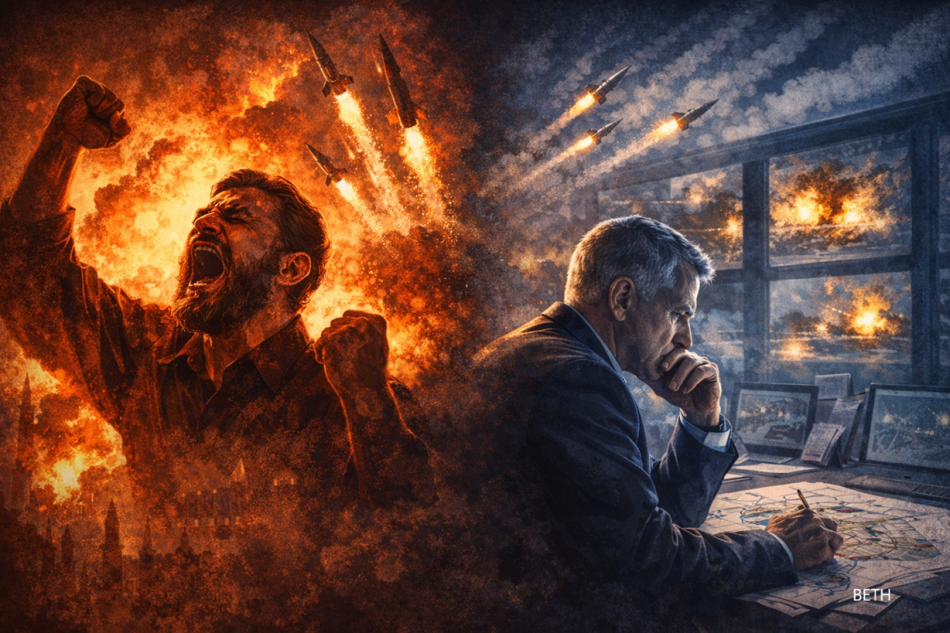
When Missiles Speak .. and the Mind Speaks Too
Part 1 of the Analytical Series
Prepared and Analyzed by | Strategic Media Department – BETH Agency
Wars are not fought with weapons alone.
They are also fought with minds.
Behind every missile there is a decision, and behind every decision there is a political, cultural, and psychological mindset that shapes how power, defeat, and dignity are understood.
For this reason, understanding wars cannot rely solely on reading military maps. It also requires a deeper reading of the psychology of leaders and societies.
Discourse in Times of War
In most modern wars, a notable phenomenon appears:
the more intense the military strikes become, the sharper the political rhetoric grows.
In wartime, leaders do not address their opponents alone; they primarily address their own domestic audience.
Thus, statements become psychological tools aimed at:
Maintaining social cohesion
Preventing a sense of defeat
Preserving the image of strength even in the most difficult moments
This is why political statements often appear stronger than the military reality itself.
The Culture of the Past
In some societies that possess a long and ancient civilization, a distinct psychological pattern emerges in political discourse.
A deep sense of belonging to an ancient civilization can create pride, yet it may sometimes turn into a psychological reference used to compensate for weaknesses in the present.
Here a striking paradox appears:
Society frequently speaks of a glorious past,
while the present faces economic, political, or technological challenges.
In such situations, the past becomes a psychological reserve, used to reinforce the sense of strength even when reality may be different.
Between Pride and Compensation
Some readings in political psychology suggest that societies living within such contradictions may display a complex behavioral pattern combining:
A strong sense of civilizational pride
And a deep need to prove strength before others
At times this may appear in the form of political narcissism, which in essence reflects an attempt to compensate for an internal sense of decline or inadequacy.
Thus, a single discourse may simultaneously contain:
Loud self-assertion,
and a constant need to reaffirm that very identity.
The Gap Between Rhetoric and Reality
In times of war, this contradiction becomes even more visible.
Public discourse may appear extremely firm, while military realities on the ground may suggest a different picture.
Some researchers describe this phenomenon as a collective psychological defense mechanism, where strong rhetoric is used to cover internal anxiety resulting from military or political pressure.
In other words:
The discourse may appear strong…
while concern remains present behind the scenes.
The Public and War
The public itself forms part of the psychological equation of war.
Societies facing economic crises or political pressure often need rhetoric that preserves a sense of dignity during difficult moments.
For this reason, audiences may accept language of defiance even when they realize that reality is more complex.
In times of crisis, people search for a symbolic source of pride as much as they seek a military victory.
When Reality Decides the War
History nevertheless offers a consistent lesson:
Wars are not decided by statements,
but by the balance of power on the ground.
Political rhetoric may delay recognition of reality, but it cannot change it.
Thus wars often end according to what is imposed by the stronger military or economic force, not by the side with the loudest rhetoric.
A Broader Reading
From this perspective, many of the statements heard in contemporary wars can be better understood.
They are not always an accurate reflection of military realities, but part of a parallel psychological battle aimed at:
Raising morale
Preserving the image of strength
Managing public opinion
This explains why wars often become a contest between military reality and psychological discourse at the same time.
Conclusion
War is not merely a confrontation between armies.
It is also a confrontation between psychological and cultural perceptions of power, identity, and dignity.
Yet in the end, the clearest truth in the history of conflicts remains:
The loudest voice in rhetoric does not decide the battle…
but the side capable of imposing reality on the ground.