



The War on Iran .. Cracks in the Western Camp
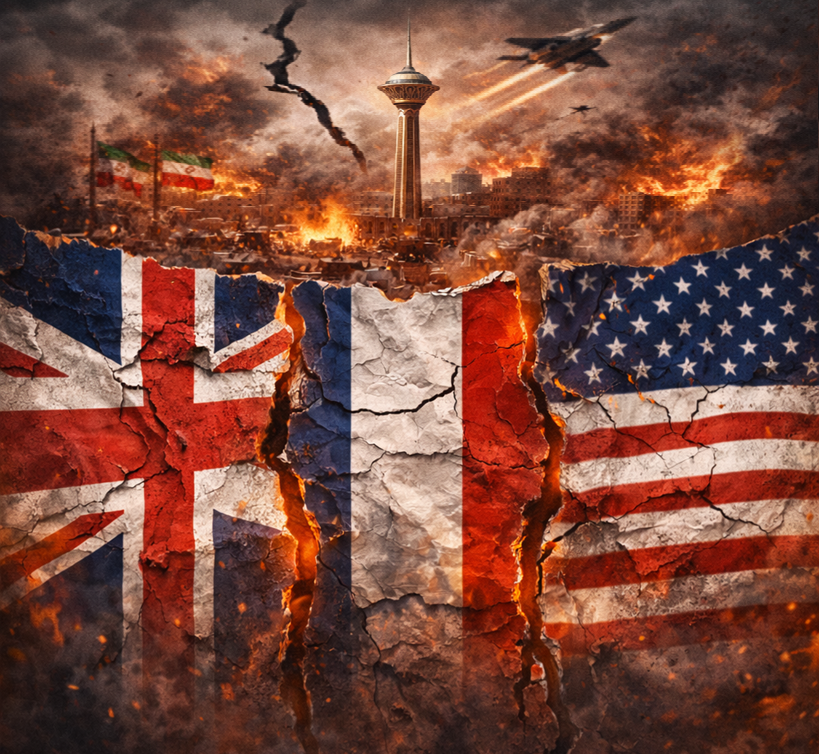
Follow-up & Analysis | Strategic Media Department – BETH News Agency
Introduction
As the war unfolding in the region continues to expand, clear signs of divergence have begun to emerge within the Western camp itself. Indicators are appearing that suggest differing approaches to managing the conflict between the United States on one side, and both the United Kingdom and France on the other.
Although the three countries belong to a long-standing strategic alliance, developments in the current war have revealed differences in the assessment of priorities and escalation thresholds—between a U.S. vision that tends toward establishing a broad military deterrence equation, and more cautious European approaches seeking to contain the conflict and prevent it from turning into a wider regional confrontation.
This divergence does not necessarily indicate a fracture within the Western alliance, but it reflects differences in political and strategic calculations, as well as differing readings of what the war could become if it moves beyond its current limits.
From this perspective, key questions arise: What do Washington, London, and Paris actually want from the course of the war? And do these differences represent merely tactical disagreements, or do they reflect deeper visions about the shape of the regional order that could emerge after the conflict ends?
Why Does the “Disagreement” Appear Now?
Because the current war is not merely a series of military operations; it is also a war of legitimacy and narrative.
Washington operates with the logic of rapid military achievement and imposing strategic momentum.
Europeans, meanwhile, tend to move with the logic of de-escalation, stability protection, and preventing uncontrolled spillover.
This explains why the divergence becomes visible around three main issues: international law, the scope of escalation, and the question of “regime change.”
What Does the United States Want?
The Declared Objectives
(as reflected in official political and security discourse)
Limiting or destroying Iran’s military capabilities that threaten allied forces and interests.
Strengthening deterrence and preventing the war from turning into a prolonged war of attrition against Washington and its partners.
Rebalancing the regional power equation in a way that forces Tehran to step back—or to negotiate from a weaker position.
The Undeclared Objectives
(politically plausible interpretations)
Reinforcing the image of American leadership at a moment of global uncertainty.
Blocking any settlement that could return Iran to the international system as a “normal actor” without strategic concessions.
Keeping the door open to scenarios of “behavioral or regime change,” without formally declaring it as the official objective—an issue that forms the core of friction with Europe.
What Does Britain Want?
The United Kingdom typically operates within a delicate space: strategically close to Washington, yet legally and politically cautious domestically.
London’s Practical Objectives
Protecting its forces, interests, and bases, while maintaining intelligence integration with the United States.
Preventing the conflict from spreading into the Gulf and disrupting global energy routes.
Appearing as a contributor to deterrence without being accused of pushing toward an open-ended war.
Preserving European diplomatic channels—particularly the E3 framework—through which Britain historically plays the role of a firm mediator.
London’s summary approach:
Deterrence… without chaos.
What Does France Want?
France often moves with a stronger sense of strategic autonomy than Britain, and with greater sensitivity toward:
International law
The prestige of diplomacy
Security in the Mediterranean and Middle East
The war’s potential repercussions for Europe (economy, migration, terrorism)
Paris’s Practical Objectives
Preventing the conflict from sliding into a prolonged war that could destabilize the region and spill over into Europe.
Consolidating France’s role as a European leader in crisis management, rather than appearing aligned automatically with Washington.
Keeping diplomatic settlement options open and avoiding the public adoption of “regime change” as a strategic objective—because, from Paris’s perspective, such an approach could open the door to a new wave of instability similar to Iraq or Libya.
Paris’s summary approach:
Strikes may occur… but the strategy after the strike matters more than the strike itself.
The Real Fault Lines
The issue is not necessarily a “hidden hostility,” but rather three structural points of divergence.
1. Legal Legitimacy
Europeans—especially France—are more insistent on asking whether military actions can be defended legally under international law.
Washington, by contrast, tends to treat legal legitimacy as secondary so long as deterrence and operational objectives are achieved.
2. The Ceiling of War
The United States can tolerate higher levels of escalation because it is geographically distant from the battlefield.
Europe, however, bears the immediate consequences of instability: energy shocks, market disruptions, domestic security concerns, and potential migration waves.
3. The “Regime Change” Question
This remains the deepest dividing line.
Washington sometimes signals openness to the idea of reshaping the Iranian political order.
Paris—and occasionally London to a lesser degree—fears that such a path could unleash a new historical wave of regional chaos.
What Is Said Quietly
If the hidden dimension is to be described professionally, it is not a conspiracy—but rather a collision of strategic interests.
The United States seeks a controlled end to the war that reinforces deterrence.
France seeks a politically managed end that prevents regional chaos.
Britain seeks an outcome that blends both approaches: deterrence combined with a diplomatic exit that preserves its special relationship with Washington while protecting European stability.
BETH Conclusion
The European–American divergence here is not a struggle over who supports whom.
Rather, it is a struggle over a far more consequential question:
Who will write the end of the war… and who will ultimately pay its price?