



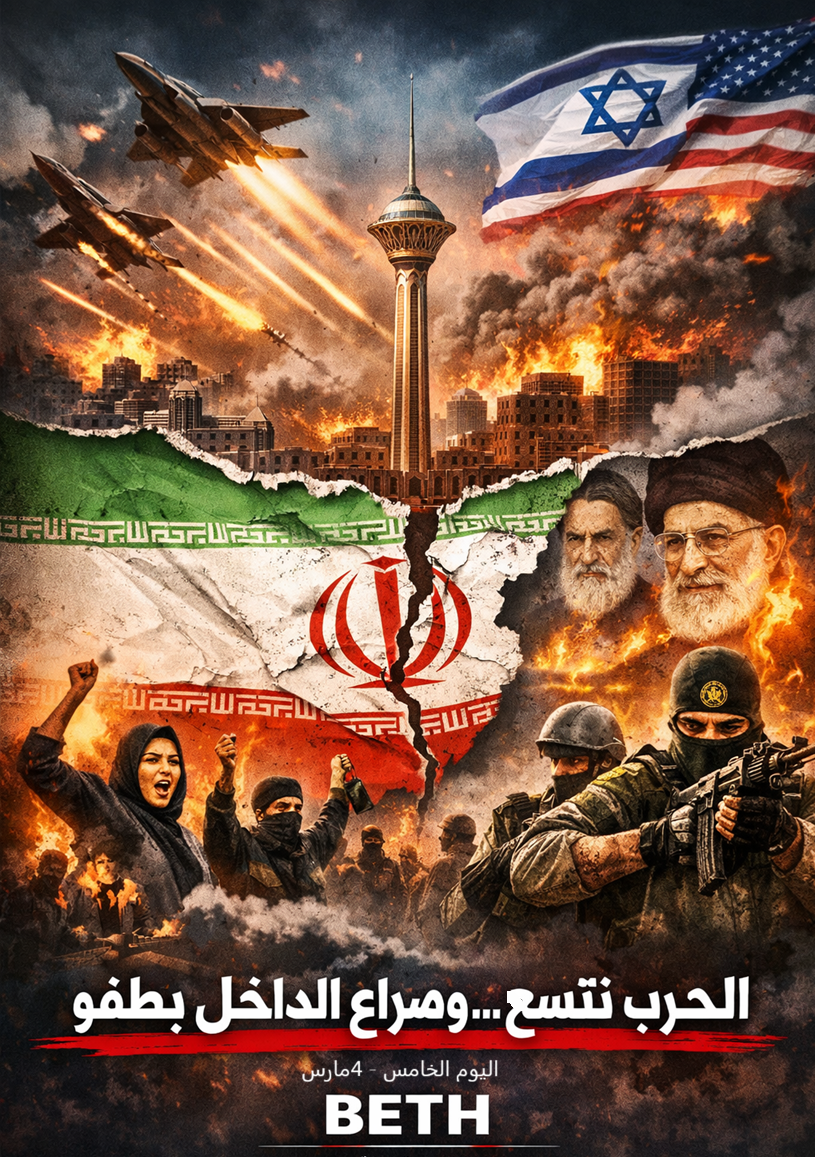
Day Five: The War Expands… and Iran’s Internal Struggle Surfaces
Follow-up and Analysis
Strategic Media Department – BETH News Agency
Introduction
As the U.S.–Israeli war on Iran enters its fifth day, airstrikes continue on multiple sites across Iranian territory, while Tehran responds by launching missiles and drones toward targets in the region.
As the scope of the military confrontation widens, other indicators have begun to emerge in parallel with the battlefield developments, related to dynamics within Iran itself—whether through opposition activities against the regime or political readings pointing to the possibility of deeper changes in the structure of power.
This overlap between military strikes and internal political struggle adds a new dimension to the ongoing war and makes monitoring its developments extend beyond the limits of the battlefield.
Field Developments
At dawn today, a series of powerful explosions struck the Iranian capital, Tehran, followed by a violent blast in the eastern part of the city that, according to media reports, caused extensive damage in several neighborhoods.
Iranian media also reported that military sites in the Damavand area east of the capital were targeted.
Meanwhile, the Israeli army announced that the air force had begun a broad wave of airstrikes against targets belonging to the Iranian regime in Tehran.
This escalation comes after four days of war, while Iran has not yet announced any official details regarding the funeral of Supreme Leader Ali Khamenei, whom Israel said it had assassinated on the first day of the war.
In this context, Israeli Defense Minister Israel Katz renewed threats to carry out further assassinations, confirming that he had instructed the military to prepare for additional operations against Iranian leadership figures.
Expansion of the Confrontation
Military operations have not been limited to Iranian territory. The Israeli army launched airstrikes this morning on Beirut’s southern suburbs—Hezbollah’s stronghold—after issuing evacuation warnings for several buildings.
Media reports stated that the strikes targeted the areas of Haret Hreik, Hadath, and Laylaki, while Lebanon’s National News Agency reported at least four strikes on several neighborhoods in the southern suburbs.
At the same time, the Kuwaiti army announced that it is dealing with a wave of missiles and drones that crossed Kuwaiti airspace.
As the escalation continues, officials in U.S. President Donald Trump’s administration informed lawmakers during classified briefings that the coming days could witness a larger and more intense wave of military strikes against Tehran.
Republican Senator Lindsey Graham said that “the amount of firepower that will be directed in the coming days will be overwhelming.”
The Israeli army also announced a noticeable decline in the number of rockets launched from Iran.
This announcement reflects one of two possibilities: either a temporary decline in operational capability as a result of intensive airstrikes, or a tactical shift toward repositioning and conserving forces for a later phase.
At the same time, the Israeli army spokesperson’s call for Iran’s proxies in Lebanon to leave carries a clear deterrent message, indicating that the scope of operations could expand if the confrontation continues.
Movements of the Iranian Opposition
Parallel to the military developments, opposition groups to the Iranian regime announced that they had carried out a series of operations inside the country.
According to a statement issued by the National Council of Resistance of Iran, what it calls “resistance units” carried out 31 operations in Tehran and 19 other cities targeting sites linked to the Revolutionary Guard, the Basij forces, and government institutions.
According to the statement—of which a copy was received by BETH—the operations included limited explosions, attacks, and the burning of symbols and images of regime leaders in several cities including Mashhad, Tabriz, Isfahan, Ahvaz, and Kermanshah.
The opposition says these operations come in support of what it calls the Provisional Government of the Democratic Republic of Iran, announced by the National Council of Resistance.
Iranian authorities have not issued any official comment regarding these operations so far.
Announcement of the Provisional Government
The Iranian opposition proposes the formation of a transitional government to lead the post-regime phase, with the transitional period ending in free elections to form a constituent assembly that would draft a new constitution.
This initiative is based on what is known as the Ten-Point Plan proposed by opposition leader Maryam Rajavi, which includes principles such as the separation of religion and state, guaranteeing public freedoms, abolishing the death penalty, equality between men and women, and establishing a political system based on popular sovereignty.
Supporters of this initiative see it as an attempt to present an organized political alternative in the event of a shift in power inside Iran.
Analyses and Opinions
Some researchers and writers believe that the coincidence of external military operations with internal opposition movements may indicate that the Iranian conflict is entering a more complex stage.
Academic Dr. Sami Khater told BETH that Tehran’s threats to target its opponents abroad—including hints about striking the Ashraf 3 complex in Albania—reflect what he describes as anxiety within the structure of the regime.
According to this reading, expanding confrontation beyond national borders may represent an attempt to rebuild deterrence after increasing internal pressures.
However, observers warn that any external operations could lead to a broader international confrontation, especially if they target the territory of European states.
BETH Reading
As the war enters its fifth day, the conflict no longer appears limited to the exchange of military strikes.
Alongside the aerial and missile battle, a parallel struggle is beginning to emerge within the Iranian political scene itself—between a regime seeking to preserve its cohesion and an opposition attempting to exploit the political moment.
With military operations continuing and internal and external pressures increasing, the question remains open as to whether the war will remain a limited military confrontation or evolve into a broader phase of reshaping the balance of power within Iran and the region.
Striking the Heart of the Security Apparatus
The Israeli military announced on Wednesday that it had struck a major military complex housing the main headquarters of Iran’s security agencies, in what appears to be one of the deepest attacks targeting the core security structure of the Iranian system.
Israeli military spokesperson Avichay Adraee stated that the targeted compound includes the headquarters of several key institutions, among them:
Headquarters of the Islamic Revolutionary Guard Corps
Intelligence headquarters
Headquarters of the Basij forces
Headquarters of the Quds Force
Special Internal Security Forces headquarters
Cyber operations centers
Headquarters of the internal security unit responsible for protest suppression
The nature of the targets indicates that the strike was not aimed merely at conventional military facilities, but rather at the core nodes of the Iranian regime’s security command structure.
Additional Pressure on the Northern Front
Parallel to the strikes inside Iran, the Israeli military announced progress on the southern front, while issuing warnings about potential strikes on facilities inside Lebanon.
The move may reflect preparations for a broader expansion of operations should additional parties enter the conflict.
U.S. Announcement on Targeted Leadership
Meanwhile, the White House announced that the ongoing military operations resulted in the killing of 49 senior Iranian leaders, including Iran’s Supreme Leader Ali Khamenei.
If confirmed, this development would represent one of the most significant blows to Iran’s political and military leadership since the establishment of the Islamic Republic.
A New Weapon Enters the Battlefield
In a notable military development, U.S. Central Command announced the first combat use of the long-range Precision Strike Missile (PrSM) during the operation known as Epic Fury.
According to the U.S. statement, the missile provides unprecedented deep-strike capabilities with high precision, allowing strategic targets to be hit from long distances without exposing launch platforms to direct risk.
BETH Reading
These developments suggest that the conflict is shifting from traditional military pressure to direct targeting of the Iranian regime’s leadership and security architecture.
Strikes on security headquarters combined with the deployment of long-range precision weapons indicate that the objective is no longer limited to degrading military capabilities, but rather disrupting the command-and-control structure of the Iranian state itself.
If this pattern of strikes continues, the coming days could witness major shifts in the regional balance of power.