



Was Khamenei Really Killed.. or Are We Living Inside Cognitive Warfare?
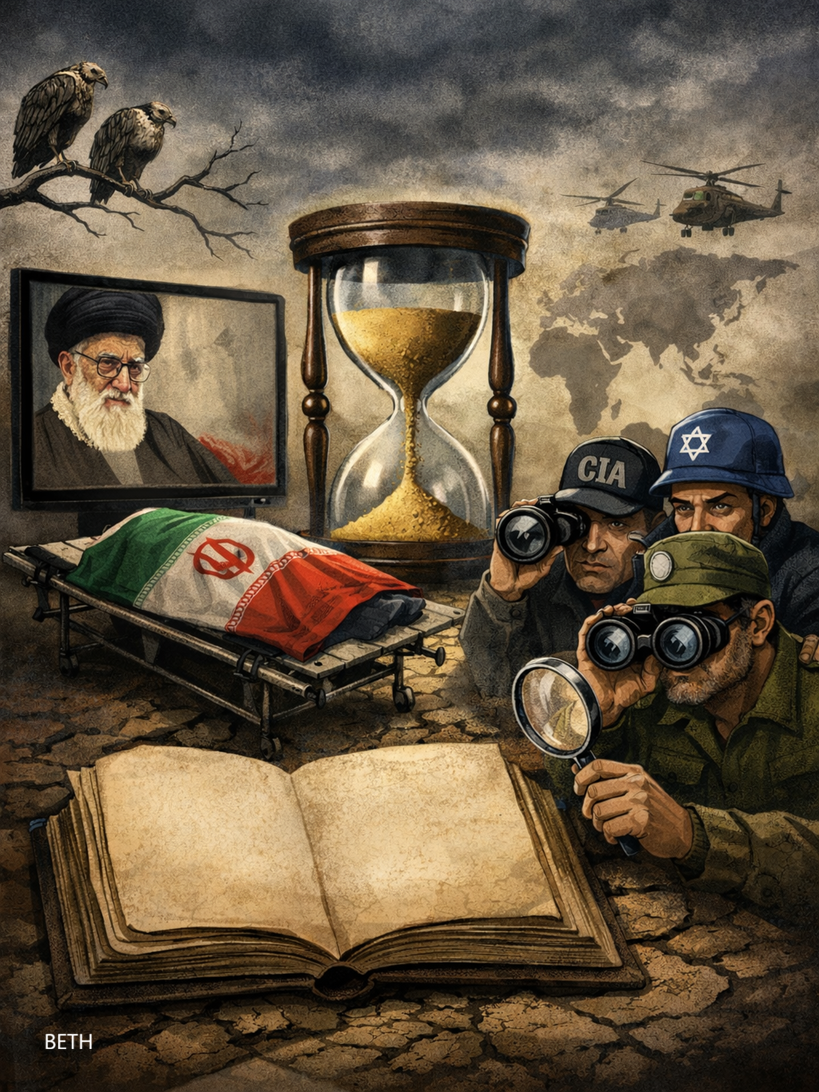
Between Announcement and Confirmation
Analysis | Strategic Media Department – BETH News Agency
Supervision | Abdullah Al-Omira
News Introduction
In major wars, battles do not begin with missiles alone… but with information.
Following the simultaneous announcement by U.S. President Donald Trump and the Israeli Prime Minister — alongside reports circulated by Iranian media regarding the death of Iranian Supreme Leader Ali Khamenei — the world entered one of the most complex media moments in modern conflict history.
The question is no longer purely political:
Was the Iranian Supreme Leader actually killed?
It has become a deeper media question related to the very nature of truth in wartime.
When the Death of a Leader Is Announced… Yet the World Waits
How can the death of a figure as significant as Iran’s Supreme Leader Ali Khamenei — regardless of political characterization — be announced through high-level political statements and overlapping media coverage, while global verification systems remain cautious and military operations continue without immediate change in tempo?
The issue here is not disbelief in official statements, but rather the mechanics of verification in sovereign, high-impact events.
Modern experience — from Saddam Hussein to Osama bin Laden and other state and non-state leaders — shows that news of a leader’s death does not stabilize in global awareness until visual or material proof emerges.
The world no longer relies solely on political declarations.
It waits for what journalists professionally call:
The Moment of Final Verification.
Therefore, the time gap between announcement and confirmation does not necessarily imply contradiction or deception. It may instead fall within post-operation strategic management.
Withholding certain details may serve several objectives:
Managing domestic and international reactions
Preventing institutional instability inside the targeted system
Protecting intelligence sources and operational methods
Controlling the political and military timing of impact
At the same time, the targeted state may respond with calculated silence to avoid internal disruption or to reorganize decision-making structures before formal acknowledgment.
Thus, the continuation of military operations after such an announcement reflects not regime strength or weakness, but the ability of state apparatuses — regardless of political structure — to continue functioning even amid temporary leadership ambiguity.
Analytical Conclusion at This Stage
In major wars, certainty does not begin at the moment of announcement…
but at the moment the world becomes convinced beyond dispute.
A leader’s death may be declared politically,
but its confirmation occurs later — in global perception.
Can Official Announcements Simply Be Dismissed?
Professionally, statements issued by heads of state cannot be treated as rumors.
Declarations from leaders such as the U.S. President or Israel’s Prime Minister are calculated political messages — not casual claims.
Yet international journalism maintains a constant rule:
Political announcement does not equal final journalistic confirmation.
Operational reality may still be unfolding when statements are made, or announcements may function as psychological pressure within an ongoing conflict.
In simpler terms:
A statement may be accurate in essence…
while incomplete in outcome.
Why Do Global Agencies Wait for Confirmation?
The death of a figure like Iran’s Supreme Leader represents more than a military event — it signals potential systemic transformation.
Global media therefore relies on strict standards known as:
Multi-Source Independent Verification
A development becomes globally accepted fact only when indicators appear simultaneously, such as:
Clear transfer of authority
Institutional or constitutional procedures
Observable shifts in political or military command
Absent these indicators, the story remains in verification — not denial.
Has This Happened Before?
Yes — repeatedly.
Saddam Hussein: confirmation followed visual presentation after capture.
Osama bin Laden: political announcement preceded intelligence confirmation.
Muammar Gaddafi: debate persisted until visual proof ended speculation.
The pattern is consistent:
The gap between announcement and confirmation has always existed.
Does This Mean the War Is Propaganda?
Decisively: No.
Military strikes are real.
Losses are real.
Escalation is real.
However, conflict has expanded into another battlefield known as:
Cognitive Warfare
Where information itself becomes a weapon.
Announcing the death of a leader may achieve strategic objectives even before verification, including:
Raising domestic morale
Disrupting the adversary
Testing institutional resilience
Forcing security adjustments
The information may not be false —
but operational before becoming fully verified truth.
Why the World Does Not Immediately Believe a Leader’s Death
A global cognitive pattern has formed:
The world does not believe a leader is dead… until it sees undeniable proof.
A wartime announcement becomes historical fact only when supported by evidence beyond interpretation.
The Secret After the Announcement… Part of the Battle
Delayed evidence does not necessarily mean the event did not occur.
It may represent deliberate strategy by:
The executing side, protecting intelligence capabilities or maximizing psychological impact
The targeted side, managing succession and preventing internal instability
Silence itself can become a crisis-management tool.
Strategic Note
Three stages must be distinguished:
Announcement of the event
Circulation of the news
Activation of political and institutional consequences
If a leader has indeed been killed, the decisive measure is not the strike itself — but the visible effects of absence.
BETH Reading
In modern warfare,
the body may be hidden…
but the consequences of absence cannot remain hidden for long.
Truth does not prevail through speed of announcement,
but through the stability of what follows.
In times of crisis,
information is not what is first said…
but what ultimately survives verification.
In war, truth is proven not by words — but by what happens next.
Final Provocative Question
After the reported killing of a leader in Tehran…
is Iran heading toward a fate similar to Iraq or Libya?
BETH Comment
History does not ask who was killed…
but who managed to endure afterward.
Post-Absence Indicators
What was published by Fars News Agency is not a marginal development…
Rather, it represents the moment when the transition begins from a war of narratives… to the engineering of the post-event phase.
The indication of a possible selection of a new Supreme Leader does not merely reinforce the event at the media level,
but reveals that the entities currently managing Iran have already begun to act as though the absence has become an established reality.