



Friendly Fire? .. Confusion in Kuwait’s Skies
Monitoring & Analysis | Strategic Media Department – BETH News Agency
News Introduction
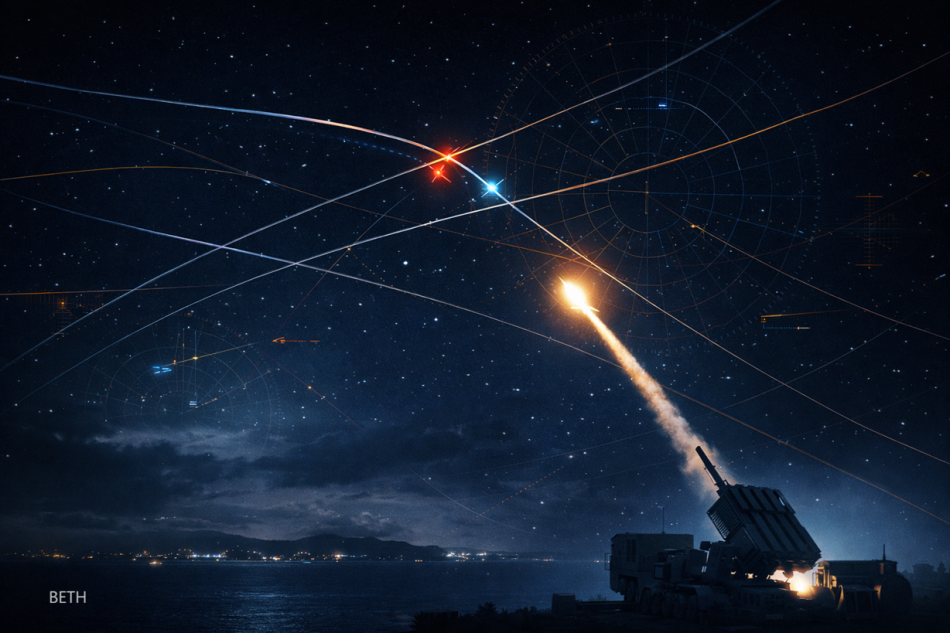
The United States Central Command announced that Kuwaiti air defense systems mistakenly shot down U.S. fighter aircraft during ongoing military operations in regional airspace, describing the incident as the result of a “misidentification during operations.”
The announcement comes at an extremely sensitive moment, coinciding with escalating military confrontation across the region and heightened air alerts and defensive readiness in several Gulf states.
BETH Reading | What Does This Mean?
Despite its seemingly technical nature, the incident carries strategic implications that go far beyond an isolated military accident.
It reflects an exceptionally high operational pressure within regional airspace.
The Sky Has Become Crowded with War
Under normal conditions,
Identification Friend or Foe (IFF) systems are designed to prevent such incidents.
When a friendly aircraft is mistakenly engaged, it suggests:
Unprecedented airspace congestion
Multiple missile and drone trajectories
Interception decisions made within seconds
In other words, air defenses are operating in immediate reaction mode rather than full verification mode.
Simply put:
The region has entered a state of permanent alert.
War Has Moved Beyond Traditional Boundaries
Modern warfare no longer follows clear frontlines.
Aircraft, drones, and missiles now move across:
Neutral corridors
Allied airspace
Energy and maritime protection zones
Under such conditions, the line between a real threat and a friendly asset becomes dangerously blurred.
The incident reveals that the Gulf has effectively become part of an active defensive theater — even without formally entering the war.
An Unintended Message About Tension Levels
The downing of a friendly aircraft does not necessarily indicate defensive weakness.
Often, it signals the opposite:
Maximum defensive sensitivity
Tightened rules of engagement
Fear of sudden penetration
The operational priority becomes:
Neutralize the threat first… verify later.
This reflects an extremely tense security environment.
What Concerns Military Planners?
The most dangerous aspect is not the material loss, but the risk of:
Repeated miscalculations
Unintended escalation
Friction between allies operating in the same battlespace
In complex wars, escalation often begins with error — not intention.
Strategic Impact
Security-wise
Immediate reinforcement of coordination between Gulf air defenses and U.S. forces.
Militarily
Likely reassessment of aerial identification protocols and engagement rules.
Politically
Confirmation that Gulf states now represent the frontline defense for global energy stability and protected air corridors.
BETH Conclusion
What occurred is not merely a technical accident.
It signals that the speed of modern warfare is beginning to exceed systems’ ability to fully distinguish targets.
In such environments, the greatest danger is not always the incoming missile…
but the mistake born under pressure.
BETH:
When the skies become crowded with war… even allies may appear as targets.