



The War on Iran | BETH Analysis
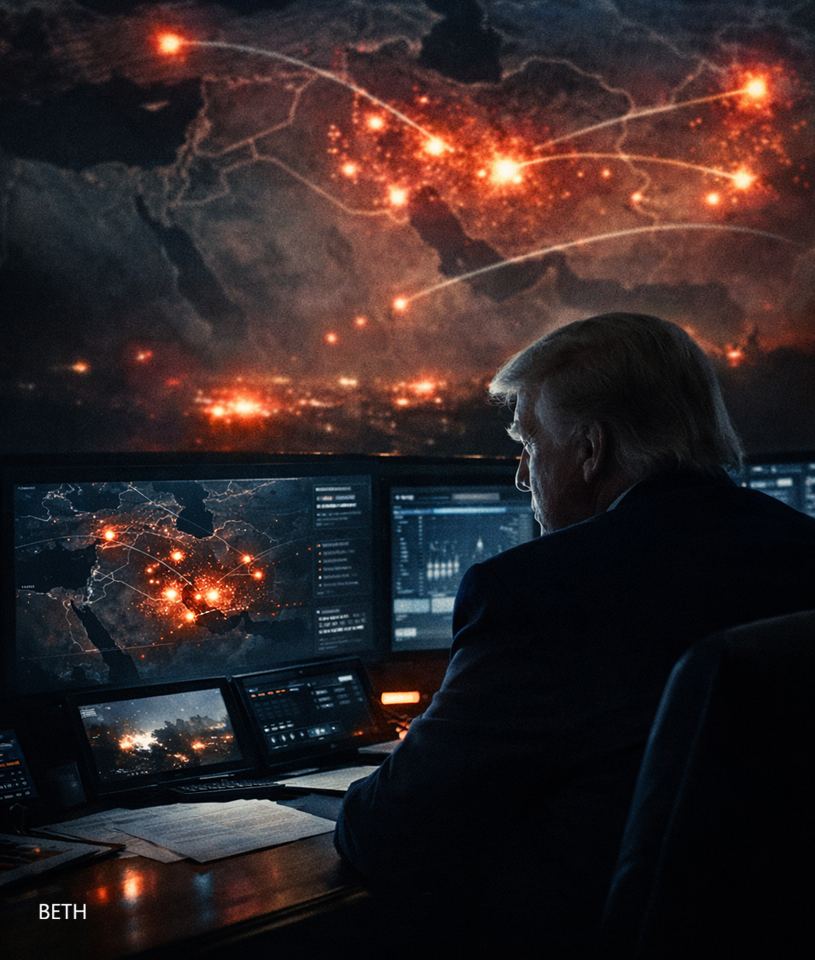
A Table Opens Under Fire
Follow-up & Analysis | Strategic Media Department – BETH News Agency
News Introduction
U.S. President Donald Trump said on Sunday that American military operations against Iran are “moving faster than the planned timeline,” confirming that Washington knows the number of remaining targets. He indicated that 48 Iranian officials have been killed so far as part of the U.S.–Israeli offensive, which he described as advancing rapidly.
In a notable shift in tone, Trump stated that the “new leadership in Iran” is seeking talks with him and that he intends to respond positively, adding that some Iranian figures involved in negotiations in recent weeks “are no longer alive,” describing the strike as “major” and saying Tehran could have “made a deal earlier.”
In a previously released video message, Trump called on the Iranian people to rise against the current system “after the bombing campaign ends,” saying that “now is the time to take control of your destiny and launch a prosperous future.”
Meanwhile, Iranian President Masoud Pezeshkian announced on Sunday that a temporary leadership council has begun its work.
BETH Reading | What Does This Sequence Mean Within Two Days?
What we are witnessing is not merely military escalation — but the arrangement of a new phase.
Within 48 hours, a rare modern-war equation has emerged:
Accelerated strikes (time pressure)
Opening the door to negotiations (meaning pressure)
Calls for internal uprising (legitimacy pressure)
Announcement of a temporary leadership council (survival pressure)
These are not separate developments, but four synchronized tools working toward one outcome:
Breaking the old decision-making center and opening a window for a new one.
Strategic Meaning: A War on Time, Not Territory
When Trump says operations are “ahead of schedule,” the message goes beyond military superiority:
Reducing Iran’s time to reorganize internally
Preventing leadership regrouping
Concluding the confrontation before it turns into prolonged regional attrition
The signal is clear:
This is not an open-ended war — but a time-bound campaign.
Why Talks Now? And Why “New Leadership”?
The most significant phrase is not “we will respond to talks,” but rather:
“The new leadership.”
This indicates that Washington is already treating Iran as a state entering a transitional phase — even without formal acknowledgment.
The broader implication:
The strikes are not only meant to weaken Iran,
but to produce an internal or alternative negotiating actor.
Thus, negotiations themselves become part of the battlefield — not an exit from it.
Temporary Leadership Council: Managing a Vacuum or Preventing Collapse?
If sustained, this announcement carries two possible meanings:
Managing a power vacuum to prevent state collapse
or
Institutionalizing a transition before streets or internal divisions impose it
In both cases:
The system is no longer acting from control, but from crisis containment.
Media Landscape | How the Situation Is Being Framed
U.S. Media
Leans toward a narrative of:
Decisive strike + negotiation opportunity + internal change support
— military pressure opening a preferable political outcome.
Israeli Media
Focuses on:
Leadership dismantling + continued operations until outcome assurance.
For Israel, the objective is not ceasefire, but altering Iran’s internal strategic balance.
Iranian Media
Operating along two parallel tracks:
Reinforcing images of sovereignty and resilience
Managing domestic stability through institutional transition narratives
The goal: preventing shock from turning into disorder.
Arab Media
Divided between:
Concern over regional escalation
Viewing potential Iranian systemic weakening as a historic shift
The shared concern remains regional security and economic repercussions.
Impact & Implications | What This Means for the Region and Markets
Security
Expanded risks to airspace and critical infrastructure
Higher probability of asymmetric responses (cyber operations, proxies, symbolic strikes)
Political
Iran’s internal legitimacy entering unprecedented scrutiny
Tehran facing a strategic crossroads: rapid settlement or gradual erosion of authority
Economic
Immediate sensitivity across energy and shipping markets
Rising geopolitical risk premium driven more by psychological uncertainty than supply disruption
Outlook (Concise) | What Comes Next?
Continued high-tempo strikes aimed at reaching a decisive threshold
Calibrated Iranian responses to preserve deterrence without triggering collapse
Backchannel negotiations potentially advancing alongside military pressure
Internal stability tests within Iran through mobilization and control measures
Risk of regional expansion if retreat becomes synonymous with regime survival
BETH Conclusion | What Happened — and What Comes Next
Within two days, the confrontation shifted from strike-and-response to a broader project of restructuring:
Reshaping Iran’s decision-making center —
and reshaping how the world perceives Iran itself.
BETH:
The real battle today is not only about who strikes…
but about who succeeds in shaping global perception —
and who survives politically once the strikes end.