



Psychology of War
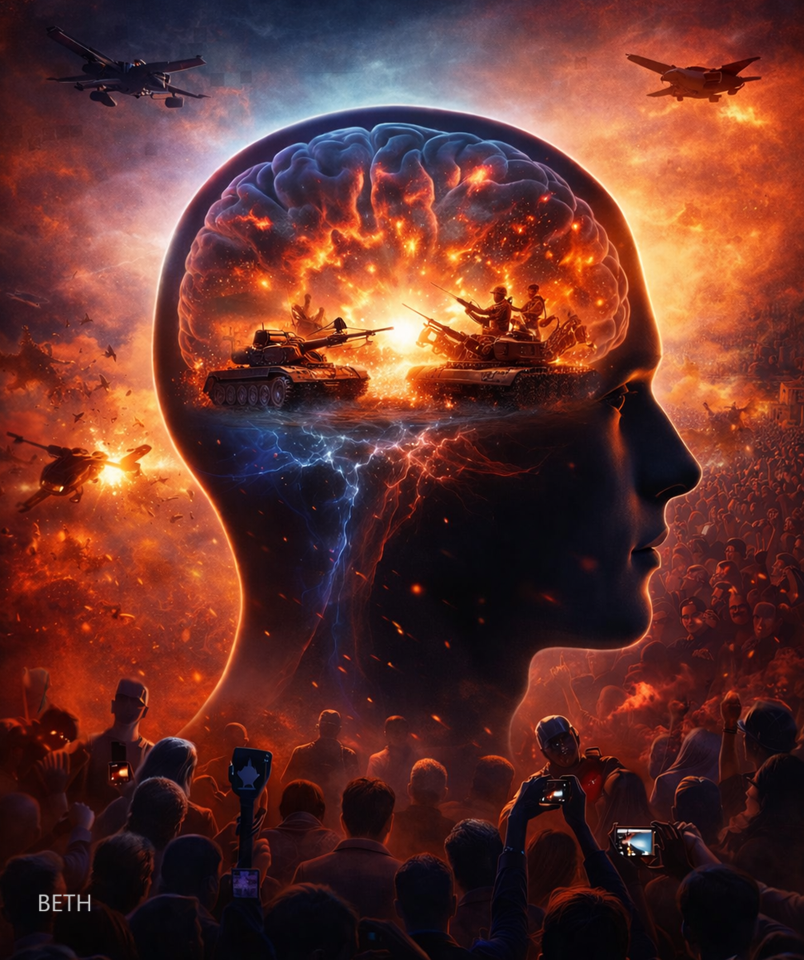
Prepared & Analyzed by | Strategic Media Department – BETH News Agency
In modern conflicts, battle lines are no longer drawn solely by missiles and aircraft, but by minds, perceptions, and images. Long before fighting begins on the ground, the battle has already started within the collective consciousness of societies.
This marks the greatest transformation in contemporary conflict:
War is no longer purely military — it has become fundamentally psychological and media-driven.
Media and Psychology: The Journalist Before the Weapon
The skilled journalist is no longer merely a transmitter of information, but an interpreter of the collective mind.
A central rule of modern media states:
The outstanding journalist is a skilled psychologist.
Understanding public fears, hopes, and emotional instincts has become more influential than possessing information itself.
Media does not merely tell people what is happening —
it shapes how they feel about what is happening.
Media and War: From Battlefield to Screen
Modern warfare now unfolds across three parallel stages:
Military strike
Media narrative
Psychological impact
A nation may lose a military engagement, yet still win psychologically if it convinces its people — and the world — that it remains resilient.
The screen has therefore become a direct extension of the battlefield.
Hollywood and Bollywood Policies: Manufacturing Perception
Image production is no longer accidental.
What may be described as Hollywood and Bollywood policies relies on:
Creating heroes and enemies
Morally simplifying conflicts
Turning war into a story audiences can understand and emotionally support
Hollywood was never merely entertainment; it became a global school of perception management, while other media models developed emotionally driven mobilization strategies targeting domestic audiences.
The objective remains the same:
Shape emotions before shaping political positions.
Who Prepares Whom?
In modern conflicts, adversaries do not wait for battlefield outcomes; instead, they attempt to psychologically prepare one another by:
Boosting domestic morale
Undermining confidence in opposing leadership
Creating an inevitable sense of victory or defeat
Psychological warfare thus becomes an ongoing effort to convince the opponent that resistance is futile.
Psychological Warfare: The Weapon Available to All
Some nations may possess superiority in hard power — weapons, technology, and military capability.
Yet propaganda and psychological warfare remain the most accessible weapons in any conflict.
Their influence often begins internally, because:
Those within a society understand its psychological terrain best.
Every nation knows its own social sensitivities and vulnerabilities better than any external actor.
Penetrating the Human Mind: The New Phase
Advances in psychology, data science, and artificial intelligence have elevated psychological warfare to unprecedented levels:
Behavioral analysis of societies
Algorithm-driven emotional targeting
Precision manipulation of fear and hope
Creation of alternative perceptual realities
The objective is no longer simply persuasion —
but reshaping how people think without their awareness.
Lessons Learned
Military superiority does not guarantee psychological dominance.
Controlling the narrative can equal controlling the battlefield.
Media has become part of national deterrence systems.
Aware societies are less vulnerable to psychological penetration.
The most dangerous wars are those people do not realize they are part of.
BETH Flash |
The Relationship Between Psychology of War and Soft Power
Hard power forces you.
Soft power persuades you.
Psychology of war…
makes you believe the decision was your own.
BETH Conclusion
In the age of political psychology, war is no longer defined by who possesses stronger weapons, but by who understands human behavior more deeply.
The real battle today is not only who strikes — but who succeeds in shaping what the world sees.