


Image from Iran… Mourning or a Test of the Street?
Monitoring & Analysis | Strategic Media Department – BETH News Agency
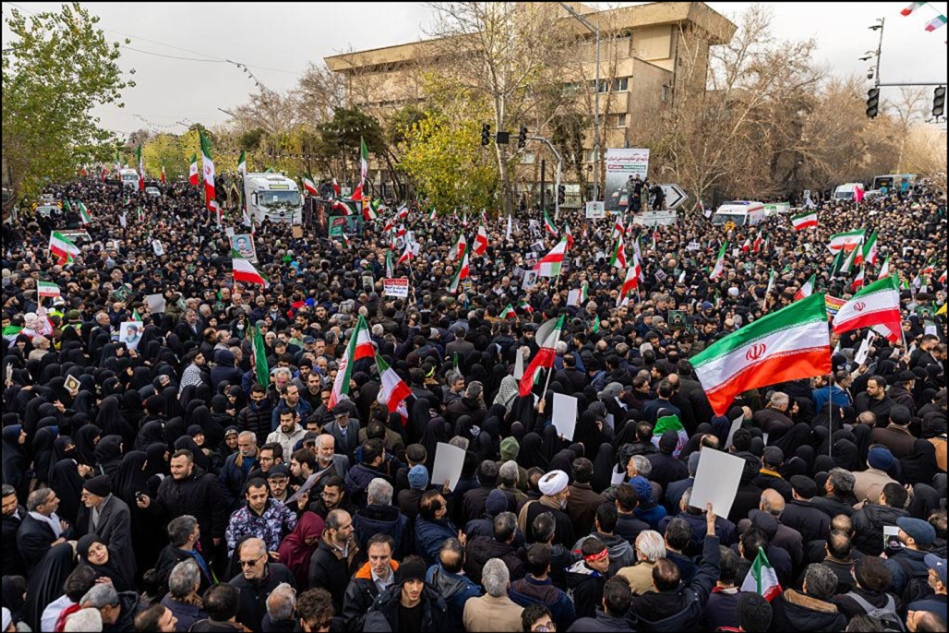
In the day following the announcement of the death of Iran’s Supreme Leader Ali Khamenei, Iranian media broadcast wide images of large crowds gathering in the streets of Tehran and other cities, officially presented as expressions of public mourning.
Yet, as is often the case in pivotal historical moments, an image rarely tells a single story. Instead, it opens the door to deeper interpretation beyond the visible scene. In moments of major transition, political meaning is often born from the details within an image before the wording of official statements.
What Does the Image Say on the Surface?
The scene carries all the traditional symbols of official mourning:
Predominant black colors across the crowds.
Iranian flags raised in large numbers.
Funeral platforms and leadership portraits.
Organized, disciplined gatherings rather than chaotic crowds.
Structured movement paths with discreet but evident security control.
This suggests a managed institutional mourning ceremony, rather than a purely spontaneous public gathering.
What Does It Say Psychologically? (The Key Reading)
In ideological systems — including the Iranian model — there is a fundamental distinction between:
genuine grief
and
compulsory or precautionary political presence.
Closer observation reveals notable indicators:
Many faces do not reflect visible emotional collapse.
Mutual observation among participants outweighs collective emotional interaction.
Crowd density appears organized and disciplined rather than emotionally driven.
This pattern is known in political sociology as:
Ritual Loyalty Display
Meaning the underlying message becomes:
"We are present" —
not necessarily "We are mourning."
The Most Critical Possibility: A Transitional Power Moment
Here emerges an angle largely absent from current media narratives:
These crowds may serve primarily to stabilize the system during a leadership transition, rather than merely express grief.
In effect, the state may be sending three simultaneous messages:
The domestic situation remains under control.
The street has not erupted.
The state continues despite the loss of its supreme symbol.
Is This a Response to Calls for Regime Change?
Most likely, not directly.
However, history presents an important paradox: when external actors call for public mobilization against a regime, governments often move first to fill the streets with loyalist or institutional presence.
What may therefore be unfolding is:
A race to control the street before the transitional phase begins.
Psychological Warfare… The Invisible Battlefield
Modern wars are no longer fought by weapons alone, but through imagery, narratives, and perception. Psychological warfare has become a central instrument of conflict, as each side seeks to influence morale before military capability.
Mass gatherings, televised mourning scenes, and displays of national unity are messages directed not only inward but outward — intended to demonstrate that the state remains cohesive despite a leadership strike.
Conversely, opposing actors attempt to frame the same moment as one of vacuum and instability — the potential beginning of systemic collapse.
Thus, the image itself becomes a parallel battlefield, where control over perception becomes part of the war’s outcome rather than merely its reflection.
BETH: In modern conflicts, some battles are decided in minds… before they are decided on the ground.
The real battle today is not only who strikes — but who succeeds in shaping what the world sees.
BETH Conclusion
The image does not conclusively prove collective mourning…
nor does it confirm the beginning of a revolution.
It may instead represent something far more complex:
A system attempting to prove it remains alive after losing its defining symbol.
History repeatedly reveals a difficult truth:
At times, the largest mourning crowds
mark the quiet beginning of an era’s end.