



The Battle of Control and Deterrence.. Inside Iran and Beyond
Prepared & Analyzed by | Strategic Media Department – BETH News Agency
Introduction: A War Seen Abroad… and Concealed Within
As U.S.–Israeli strikes expand deep inside Iran, accompanied by retaliatory missile responses whose effects have reached the Gulf, Israel, and regional air corridors, the confrontation has entered a phase fundamentally different from the traditional “strike-and-response” pattern.
The current scene reveals a striking paradox:
The world clearly sees what is happening around Iran…
yet it sees very little of what is happening inside it.
Here begins the deeper reading of the conflict.
What Is Actually Happening Inside Iran?
Deep Strikes… A Blurred Picture
Western reports confirm continued explosions in Tehran and multiple Iranian cities following operations targeting:
Military facilities,
Command centers,
Missile-program infrastructure,
Sensitive security perimeters.
Yet notably:
No precise casualty figures,
Limited visual documentation from inside Iran,
Highly restricted domestic media coverage.
In the age of smartphones and instant imagery, this situation is highly unusual.
Why Is Information Scarce from Inside Iran?
Near-Total Media Restriction
International assessments تشير إلى:
Relocation of senior leadership to secure locations,
Evacuation of sensitive areas,
Tight control over internet and communications.
Operational meaning:
Iran has entered an internal wartime security posture.
Nature of the Targets
The strikes appear to have gone beyond infrastructure, targeting:
Decision-making structures,
Command networks,
Areas linked to senior leadership circles.
Visual exposure is therefore minimized to avoid:
Revealing the scale of penetration,
Displaying defensive vulnerabilities.
Mutual Psychological Warfare
U.S. and Israeli media describe ongoing:
“Major Combat Operations.”
Meanwhile, Tehran seeks to:
Prevent domestic panic,
Contain public reaction,
Preserve the image of control.
Western Intelligence Reading
Western analytical circles increasingly point toward a sensitive conclusion:
The strikes are targeting decision-making systems,
not merely military capabilities.
Reports reference:
Possible leadership targeting,
Relocation of senior figures,
Attacks near sensitive governmental zones.
The Most Critical Internal Indicator (Unannounced)
What Western observers are monitoring is not destruction—but stability:
Are protests emerging?
Is internal security disrupted?
Is Iran’s response tempo slowing?
So far:
External retaliation continues
Internal visibility remains largely silent
This suggests one of two scenarios:
Full control… or shock being carefully contained.
Why Is Iran Targeting Gulf States Despite De-Escalation Messages?
The Strategic Answer
The strikes are not politically directed against Gulf states,
but functionally embedded within a deterrence equation.
Iran Does Not Strike the Strongest Enemy—But the Clearest Message Point
U.S. facilities in:
Iraq,
Turkey,
Azerbaijan,
exist within complex geopolitical balances:
Iraq remains partially within Iran’s influence sphere,
Turkey is a NATO member,
Azerbaijan sits within sensitive Russian-Turkish dynamics.
By contrast, the Gulf represents:
Visible U.S. military presence
The heart of global energy markets
Immediate economic impact
Instant global media resonance
A strike there is heard worldwide immediately.
Transforming War into Economic Pressure
Iran recognizes a fundamental reality:
It cannot defeat the United States militarily—
but it can raise the global cost of war.
Thus, the target extends beyond bases themselves to:
Energy markets,
Maritime routes,
Financial stability,
Global economic confidence.
Immediate reactions were visible in:
Oil prices,
Maritime insurance costs,
International aviation routes.
Retaliation Within a Controllable Threshold
Iran appears to select arenas that are:
Globally sensitive,
Yet unlikely to trigger immediate full-scale war.
The calculation assumes Gulf states will respond with strategic restraint rather than escalation, allowing Iran to:
Demonstrate retaliation,
Avoid existential confrontation.
The Link Between Internal Silence and External Escalation
The broader equation becomes clear:
Inside Iran
Shock containment,
Prevention of perceived weakness,
Preservation of regime cohesion.
Outside Iran
Visible retaliation,
Projection of strength toward domestic audiences.
The fewer images emerging from inside Iran…
the greater the need to display fire beyond its borders.
BETH Strategic Reading
The situation should not be interpreted as a direct Gulf-Iran conflict, but rather as a wider strategic chain:
U.S. strikes inside Iran
⬇
Iran demonstrates retaliation externally
⬇
The true audience: global markets and Iran’s domestic front
Hence the paradox:
States advocating de-escalation become targets—
not due to hostility, but because they sit at the center of global influence.
Conclusion: Three Wars at Once
Iran is now engaged simultaneously on three fronts:
A military confrontation against external strikes.
A psychological battle to preserve internal stability.
An economic confrontation aimed at increasing global costs.
The Decisive Question
The central question is no longer:
Is Iran trying to expand the war?
But rather:
Is escalation intended to prevent the battle from shifting inside Iran itself?
Because the most dangerous reality may be this:
The war may have begun outside Iran
precisely so that it is not decided within it.
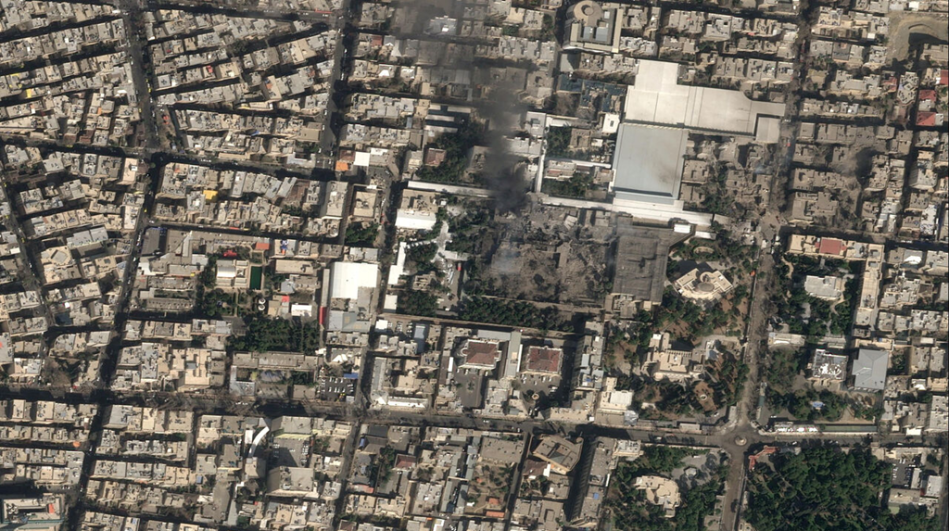
The image:
Satellite imagery shows direct damage to heavily fortified leadership compounds near governing centers in Tehran — one of the boldest targeted strikes in decades.