



How the World Reads War… and How Markets Price It
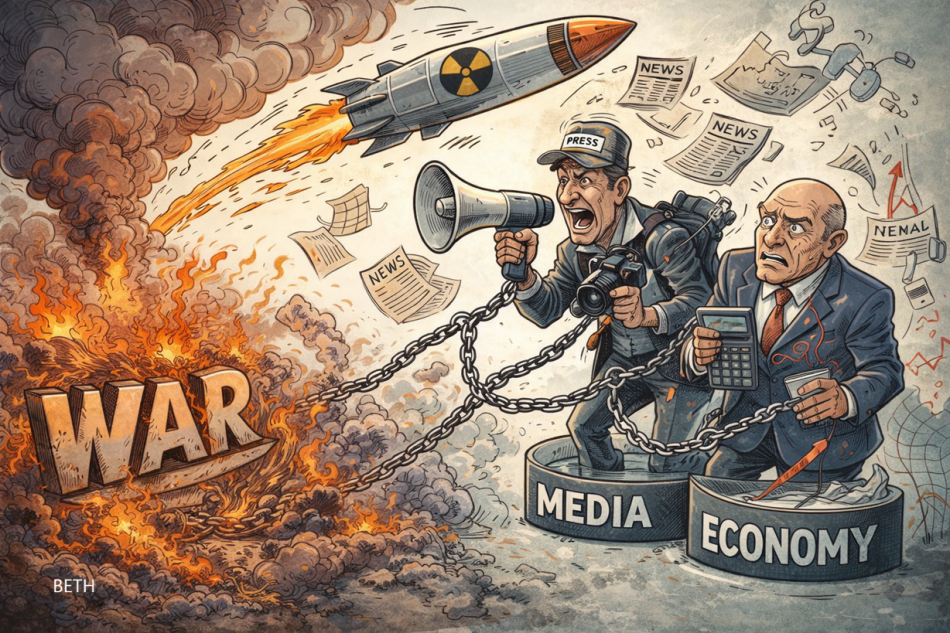
The Media Lens… and the Economics of Escalation
Monitoring & Analysis | Strategic Media Department – BETH News Agency
Introduction: When War Becomes a Global Economic Event
As confrontation expands between the United States, Israel, and Iran, military strikes are no longer interpreted solely as security developments, but as events reshaping global economic expectations in real time.
What stands out in international coverage is that Western media quickly moved beyond the question “Who struck first?” toward a far more consequential one:
What will happen to the markets?
Here lies a fundamental distinction in Western analytical thinking:
modern wars are increasingly measured not by battlefield outcomes alone, but by their ability to alter flows of capital, energy, and global trade.
The Western Media Lens: War as a System of Impact
American and European coverage has framed the escalation as a multilayered crisis:
A regional security confrontation,
A test of the international order,
And a direct threat to energy stability and global supply chains.
Western media typically monitors three indicators before political declarations emerge:
International law,
Energy markets,
Global trade stability.
BETH Insight:
In Western strategic thinking, war does not truly begin when missiles are launched —
but when markets begin changing behavior.
American Media: Managing War Without Declaring It
The dominant U.S. narrative emphasizes:
An “extended operational campaign,”
Protection of forces and military bases,
Targeting missile and nuclear capabilities.
Notably, however, media discourse avoids clearly defining a political end goal.
BETH Reading:
American media deliberately maintains political ambiguity, because clarity of objectives implies long-term commitments — domestically and economically.
Israeli Media: Turning Strikes into a Narrative of Destiny
Israeli coverage adopts a different tone:
Existential threat framing,
Reshaping the regional security environment,
A historic turning point.
BETH Reading:
Once military action becomes a narrative of survival, political retreat grows more costly than continued escalation.
The Turning Point: The Gulf Enters the Equation
As repercussions reach Gulf airspace and international aviation routes, the crisis shifts from:
a trilateral confrontation
to
a global economic security equation.
The Gulf is not merely a conflict geography —
it is a central artery of global energy and trade.
How Will Markets React?
Long-Range BETH Assessment
(Oil – Shipping – Insurance – Aviation… and Financial Contagion)
First: The Initial 24 Hours
“War Premium” Moves Before Facts
Oil and Gas
Markets do not wait for confirmed supply disruption.
Simply placing:
military bases,
the Red Sea,
and the Gulf
within the same escalation narrative is sufficient to raise risk premiums instantly.
BETH Insight:
Oil does not price war itself —
it prices the probability of losing control over it.
Shipping & Supply Chains
Sea lanes rarely close immediately, but markets react through:
slower vessel movement,
rerouted shipping paths,
longer delivery times.
Trade continues —
but becomes more expensive.
Marine Insurance: The First Believer in War
Rising War Risk Premiums signal that insurers have already translated geopolitical risk into financial cost.
BETH Insight:
Insurance markets financially acknowledge war before stock exchanges do.
Aviation: The Immediate Temperature Gauge
Airspace closures and flight rerouting increase:
transportation costs,
travel duration,
operational risks.
Aviation becomes the earliest measurable indicator of escalation breadth.
From 3 Days to 4 Weeks
Markets Separate Shock from Reality
Containment Scenario
Sharp rises followed by gradual stabilization.
Extended Campaign Scenario
The “war premium” becomes structural pricing:
Shipping ↑
Insurance ↑
Aviation ↑
Commodity prices ↑
BETH Insight:
Markets fear not the strike —
but the persistence of military rhythm.
From 3 Months to One Year
Potential Structural Transformations
1. Repricing Global Energy Security
Countries and corporations reduce exposure to vulnerable transit routes.
2. The Return of Geographic Cost
Location once again becomes a decisive economic factor.
3. The Rise of the Security Economy
Major investment expansion in:
defense industries,
cybersecurity,
counter-drone systems.
How the West Thinks During War
Western economic logic operates through a consistent equation:
War → Risk
Risk → Cost
Cost → Capital Redistribution
Capital moves globally long before battles conclude.
Conclusion | BETH
Current developments reveal a defining reality:
Media interprets war…
Markets translate interpretation into numbers.
Military strikes may begin with missiles —
but their true consequences start when the world reprices the future.
The central question is no longer:
Who wins militarily?
But rather:
Which economy adapts fastest to a more unstable world?
🔴 BETH Continues Monitoring
Because understanding modern war requires not only watching the battlefield —
but reading the mindset that explains it and the markets that ultimately pay its price.