



El Mencho Killed .. Fall of a Kingpin: End of Chaos or the Beginning?
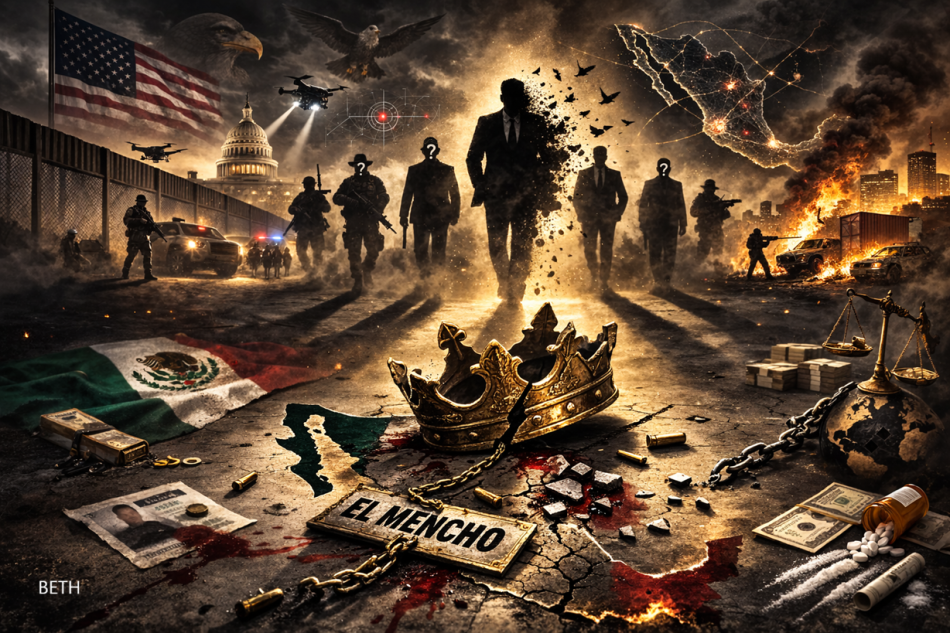
Monitoring & Analysis | Strategic Media Department – BETH News Agency
Breaking Context: A Security Strike Shakes the Criminal World
Mexican authorities announced the killing of El Mencho, leader of the Jalisco New Generation Cartel (CJNG), in a special security operation targeting one of the world’s most dangerous transnational drug trafficking figures.
El Mencho was widely regarded as a central figure in the global narcotics economy, responsible for expanding fentanyl and cocaine trafficking networks into the United States, making him a long-standing joint security target for Washington and Mexico City.
Yet the death of the cartel leader did not end the story — it opened a far larger question.
When the Head Falls… Does the Body Collapse?
Past experience with drug cartels reveals a complex reality:
Eliminating a leader does not necessarily dismantle the organization.
In many cases, the absence of centralized leadership leads to:
internal struggles for power,
armed fragmentation,
and escalating waves of unpredictable violence.
Indeed, several Mexican regions witnessed road blockades, arson incidents, and unrest following the announcement of his death — signaling a potentially more unstable transitional phase.
Trump, Migration, and Security Before Politics
The development intersects with rising security discourse in the United States, particularly under President Donald Trump’s approach emphasizing the fight against what his administration describes as cross-border criminal threats.
The fentanyl crisis has shifted within the United States from a criminal issue into a matter of national security.
Political circles increasingly argue that organized crime infiltration through irregular migration networks poses a direct threat to American society, returning the southern border issue to the center of political debate.
This raises a fundamental question:
Does El Mencho’s death represent a success of deterrence policy — or evidence of a deeper problem that has already surpassed geographical borders?
Organized Crime: A Parallel Economy
Cartels are no longer traditional criminal gangs.
They have evolved into parallel economic systems possessing:
vast financial resources,
advanced military-style capabilities,
and social influence within vulnerable communities.
For this reason, removing a single leader rarely dismantles a system driven by global supply and demand in narcotics markets.
World Cup 2026: A Regional Security Test
The event comes at a sensitive time ahead of the 2026 FIFA World Cup, scheduled to be jointly hosted by the United States, Mexico, and Canada.
Periods of leadership transition within cartels often coincide with rising instability, prompting legitimate security concerns:
Can Mexico contain internal reactions within organized crime networks?
Could cartel rivalries evolve into unforeseen threats to major global sporting events?
Authorities maintain that security preparations remain robust, yet international experience shows that unconventional risks often emerge during phases of instability.
End of a Crime Boss… or Beginning of a New Phase?
Strategic assessment points toward two parallel scenarios:
First:
Temporary weakening of the cartel following leadership loss.
Second — more complex:
A violent succession struggle that may reproduce instability on a broader scale.
The question therefore shifts from the fate of one individual to the future of an entire system.
Analytical Conclusion
The killing of El Mencho represents a significant security achievement — but it does not guarantee the end of chaos.
Organized crime depends less on individuals than on the environments that enable its growth.
In an interconnected security and economic world, the real challenge may not be removing leaders…
but preventing the emergence of those who replace them.
BETH | Future Outlook
Developments surrounding transnational organized crime demonstrate that global security is no longer shaped solely by conventional wars, but increasingly by shadow conflicts operating beyond state structures — a domain BETH continues to monitor through its strategic analytical reporting.
Shadow Leadership
Closing Commentary | BETH
Are cartel leaders true commanders?
Often not — they serve as operational fronts rather than decision centers.
Does crime end with the fall of a kingpin?
Rarely. Networks survive the loss of leadership.
Is negotiation different from maneuvering?
At times, negotiation itself becomes a tool of pressure.
Why is crime fought locally yet managed politically at a distance?
Because nearby threats are security concerns — distant ones are strategic calculations.
In both crime and politics,
the real leaders rarely appear in the spotlight.