



Wars Lost by Reason
Prepared & Analyzed by | Strategic Media Department – BETH News Agency
Introduction: When the Error Begins Before the War
Not all wars emerge from inevitable conflict between nations, nor are they always born from genuine existential threats.
Some wars simply begin because those who planned them believed power could shorten time — and that political decisions could force reality to submit to will.
A review of modern history repeatedly reveals one truth:
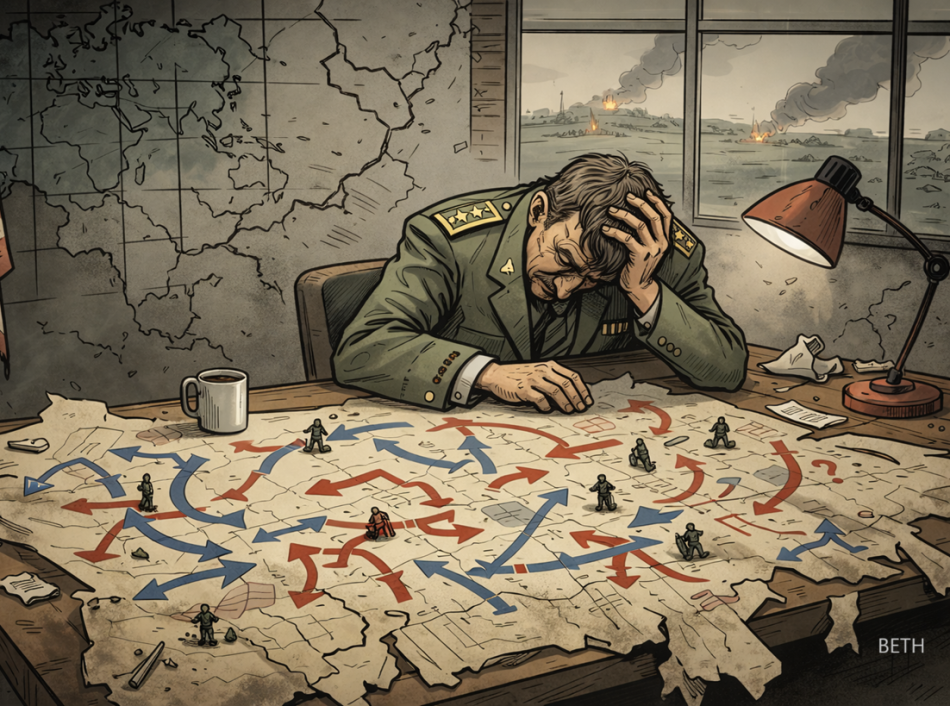
wars do not always fail on battlefields… they often fail first in planning rooms.
The Illusion of Control
At the moment decisions are made, the picture often appears clear to planners:
Military superiority
Economic advantage
Rapid assumptions about the opponent’s collapse
Yet what is frequently overlooked is the most complex variable of all:
human behavior, time, and unpredictable reactions.
At this point, strategic calculation shifts from rational assessment into a high-risk political gamble.
When Strategy Becomes a Bet
Historical experience reveals recurring patterns in wars that ultimately produced outcomes opposite to their intended goals:
Overestimation of internal strength
Underestimation of the opponent’s resilience
Neglect of international dynamics and balances
Assumption that conflict would be short and controllable
Over time, war transforms from a political instrument into a burden that exhausts the very state that initiated it.
Planners… and Unintended Outcomes
History records results — not intentions.
Many wars designed to expand influence instead produced:
International isolation
Economic depletion
Internal fragmentation
Unexpected shifts in global power balances
The paradox remains that societies bear the cost of decisions, while decision-makers often exit the political stage before consequences fully unfold.
The Pattern That Never Changes
Across conflicts separated by geography and time, one consistent pattern emerges:
Every generation believes its circumstances are unique,
and that past mistakes do not apply to it.
History proves otherwise.
The greatest strategic defeats were rarely caused by weakness —
but by excessive confidence in strength.
The True Cost of War
War is not measured solely by territory gained or influence lost.
Its deeper costs appear later:
Exhausted economies
Divided societies
Generations living with consequences they never chose
The most dangerous wars are not those that begin with force —
but those that begin with a misunderstanding of reality.
The Civilizational Lesson
History does not always punish leaders directly,
but it inevitably rearranges their legacy over time.
Plans once presented as moments of glory often become case studies in strategic miscalculation.
Ultimately, wars reveal not only the power of nations…
but the level of awareness of those who chose to wage them.
When Reason Failed… Wars History Never Forgot
History did not need centuries to realize that some wars began not out of unavoidable necessity, but from deeply flawed strategic calculations.
Among the most frequently cited examples in military and political strategic studies:
World War I (1914)
Major powers entered a conflict they believed would be short and decisive, yet it ended by redrawing the global map, collapsing empires, and laying the foundations for even greater conflicts that followed.
The Vietnam War
Overwhelming military superiority failed to secure strategic success, as planning collided with complex social and cultural realities that had not been properly understood.
The Soviet Invasion of Afghanistan (1979)
A strategic decision intended to consolidate influence turned into a prolonged war of attrition that exhausted a superpower and accelerated its eventual decline.
The Iraq War (2003)
A rapid military operation achieved its immediate tactical objective but unleashed a chain of regional and security transformations whose consequences continue to shape the Middle East today.
The problem was never the possession of power… but the belief that power alone was sufficient.
Conclusion
In a rapidly escalating world of crises, the decisive question is not who possesses power —
but who understands the limits of using it.
Wars that history ultimately judged as failures did not begin with weak weapons…
but with flawed reasoning.
Future Outlook | BETH
Understanding the strategic mistakes of the past remains a key gateway to interpreting present conflicts — a field in which BETH News Agency continues expanding through forthcoming strategic reports exploring the deeper forces behind decisions that reshaped the world.