



Why Does America Fail in the End?
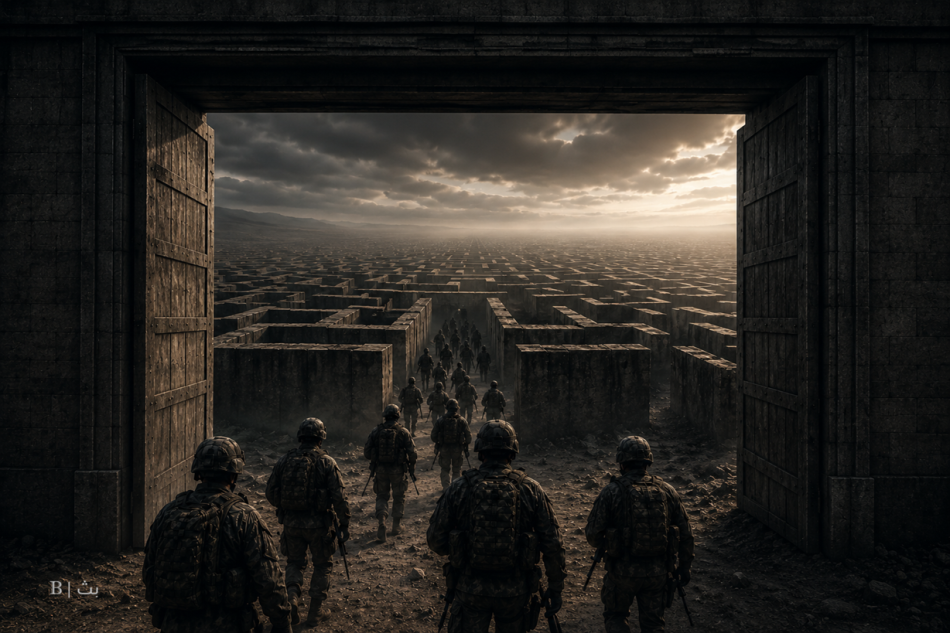
When Starting a War Is Easier Than Ending One
Prepared and Analyzed by | Strategic Media Department – BETH News Agency | B
Supervised by: Abdullah Al-Omairah
Whenever a war or crisis led by the United States runs into difficulties, a seemingly simple yet profoundly important question resurfaces:
If America possesses all this power, why does it so often struggle in the end?
It is a legitimate question.
Many observers take it even further:
If the United States understood the nature of Afghan society, why did the war end the way it did?
If the Iraqi military collapsed within weeks, where was the real battle?
What about Somalia?
And what about other regions where Washington intervened only to leave without a clear resolution?
These questions cannot be ignored.
Traditional answers that focus solely on military power are no longer sufficient to explain what has unfolded over the past decades.
Is the Problem American Power?
In reality, no.
The United States remains the world's most powerful military force.
It can reach most of its military objectives.
It leads broad international alliances.
It imposes influential sanctions.
And it possesses enormous technological and intelligence advantages.
Yet the real question is not:
Can America start a war?
Rather:
Can it end one?
This is where the distinction between military victory and political success begins.
Afghanistan, Iraq, and Somalia
In Afghanistan, the challenge was not removing the Taliban from power, but building a system capable of surviving afterward.
In Iraq, the problem was not defeating Saddam Hussein and his military, but managing the vacuum that emerged after their collapse.
In Somalia, the challenge was less about the strength of the adversary and more about the complexity of the environment itself.
Despite their differences, these cases produced a similar outcome:
Success in entering does not necessarily mean success in leaving.
The most difficult phase was not the battle itself, but what came after it.
Why Does the Problem Repeat Itself?
Because modern wars no longer resemble the wars of the past.
Once, the fall of a capital city signaled that the end was near.
Today, a regime may collapse while the following remain:
Ideas.
Identities.
Divisions.
Armed networks.
Historical grievances.
At that point, war transforms from a military confrontation into a prolonged struggle with political and social realities.
The Biggest Mistake
Perhaps the mistake was not the overthrow of regimes itself.
History is full of wars that toppled governments and later gave rise to stronger and more stable states.
The problem emerges when the fall of a regime is viewed as the end of the mission rather than its beginning.
Reality has repeatedly shown that removing an existing authority is not enough to build a new state.
The post-war phase requires a clear political vision, institutions capable of managing the transition, and sufficient internal consensus to prevent a power vacuum from turning into a new conflict.
The distance between toppling a regime and building a successful state is often far greater than it appears in the moment of military victory.
What Does the Public Think?
BETH posed a simple question to its audience as part of a public survey:
Why does America fail in the end?
The responses were remarkably consistent.
The most common view was this:
Washington knows how to begin a conflict, but often struggles to create a stable ending.
According to many participants, the United States possesses a strong ability to plan rapid action and capitalize on opportunities created by crises.
However, it does not always succeed in turning short-term military or political gains into lasting stability.
From this perspective, some American interventions achieved immediate objectives but left behind challenges and complications that generated instability exceeding the benefits Washington had hoped to secure.
Many respondents argued that the United States often focuses more on achieving immediate goals than on shaping the reality it leaves behind.
As a result, difficult withdrawals recur, while disorder continues to define what remains of the landscape.
Is It Time for a Reassessment?
Experience suggests that allowing disorder to reshape the landscape has often failed to produce the desired outcomes.
In many cases, instability did not evolve into a more stable order.
Instead, it produced prolonged conflicts and accumulating crises.
The uncomfortable reality is that some of the zones of instability left behind by wars have not only burdened their own populations but have gradually become direct challenges for the United States itself.
Afghanistan remains one of the most debated examples.
After nearly two decades of American military and political involvement, the Taliban returned to power, and the conflict ended with a chaotic U.S. withdrawal that raised more questions than answers.
This leads to a legitimate question:
What strategic gains did the United States ultimately achieve after years of war, spending, and sacrifice?
Today, Afghanistan is gradually rebuilding relations with regional and international powers, including Russia, China, and neighboring countries, in a development that some observers view as far removed from Washington’s original objectives.
Experts may disagree on how to measure gains and losses.
What is difficult to ignore, however, is that the outcome of the war appeared disproportionate to the resources and effort invested over two decades.
American interests were challenged.
Regional stability suffered.
And confidence in U.S. promises and declarations sustained repeated blows.
Iraq remains one of the clearest examples of the gap between expectations and outcomes.
Conclusion
The question is no longer:
Does America possess power?
Few still dispute that.
The real question is:
Will it reconsider how that power is used?
Will it move beyond ambiguous policies, shifting calculations, and mixed messages toward a level of political clarity that matches the clarity of its military strength?
Weapons can topple regimes.
But they cannot build trust on their own.
Power can open doors.
But it does not guarantee knowledge of the path out.
Reflection
Perhaps the United States is not facing a crisis of power.
Perhaps it is facing a crisis of persuasion.
The world is no longer asking only:
What can America do?
It is increasingly asking:
What happens after it does it?
In many cases, that question has become more difficult than the war itself.
The world does not fear American power as much as it seeks clarity about its purpose.
When power is used to promote stability, it gains allies.
But when it becomes associated with instability or narrowly defined interests, it weakens trust before it weakens adversaries.
A Final Reflection
Have the “seesaw negotiations” given us a deeper understanding of the United States and Iran?
Or have they simply confirmed that technology evolves faster than politics, while the tools change and the underlying strategic calculations remain the same?
Faces change.
Methods evolve.
But interests continue to speak the same language.
Although history leads many to doubt the likelihood of a fundamental change, some believe that Trump may seek to redraw America's strategic compass through policies that are bolder, clearer, and more consistent toward allies and core strategic interests.
Beyond the Image
Some may ask:
If the United States possesses enough power to destroy this maze entirely, why does it not do so?
But the more important question may be:
What comes after destruction?
Eliminating a group, an organization, or a conflict zone may achieve an immediate military objective.
Yet true success is measured not by the number of targets destroyed, but by what is built afterward.
Is the goal to defeat terrorism and create an environment for stability, reconstruction, and investment?
Or do some crises, over time, become arenas where local, regional, and international interests intersect, making their continuation more beneficial to certain actors than their resolution, and making their end more difficult than the decision that ignited them in the first place?
At that point, the discussion moves from the battlefield to the realm of interests.
The image itself poses a different question:
The issue is not the ability to enter the maze.
Nor is it the ability to tear down its walls.
The real challenge is knowing where the road ends—and what awaits beyond the exit.
BETH (B Press) – All rights reserved