



United States and Iran .. Negotiations or Maneuvers?
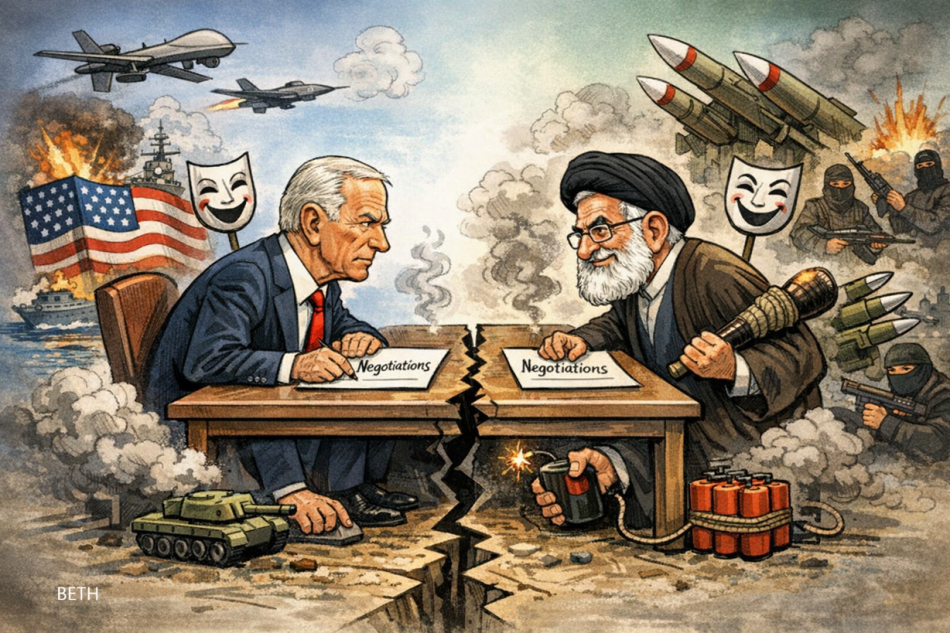
Prepared & Analyzed by | Strategic Media Department – BETH News Agency
A Contradictory Landscape
Indirect contacts and negotiations between the United States and Iran continue amid conflicting statements that reflect political ambiguity more than a clearly defined diplomatic trajectory.
While Washington stresses the necessity of reaching an agreement preventing Tehran from developing military nuclear capabilities, Iran reiterates its willingness to engage in dialogue without compromising what it considers its sovereign rights. At the same time, diplomatic messaging coincides with military deterrence signals and increased security deployments across the region, creating a scene in which negotiation and escalation appear to move along the same track.
This contradiction raises a fundamental question:
Is the world witnessing genuine negotiations… or the management of a prolonged crisis?
Does Washington Misunderstand Iran — or Understand It Well?
The common assumption that the United States has yet to grasp the nature of Iranian policy oversimplifies the situation.
The real dispute lies not in understanding intentions, but in translating that understanding into an enforceable agreement. Iran seeks recognition of its enrichment rights and relief from sanctions, while Washington aims to impose long-term restrictions and guarantees extending beyond the nuclear file to regional influence and missile capabilities.
Between these competing objectives, negotiations evolve into a delicate balancing act between deterrence and accommodation — not merely between war and peace.
Clumsy Negotiations… or Calculated Pressure?
The synchronization of diplomatic dialogue with military escalation appears far from accidental. Instead, it reflects a negotiation model based on managing pressure rather than eliminating it.
Military threats become part of negotiation architecture, while Tehran leverages regional influence to demonstrate that no agreement can be isolated from the broader Middle Eastern security equation.
Thus emerges a growing perception that the crisis is not being resolved — but carefully managed.
Why Does the End of the Crisis Remain Globally Unclear?
Because what is commonly labeled the “Iranian crisis” has evolved beyond a nuclear issue into an interconnected web of challenges, including:
Gulf and Red Sea security,
Tensions in Yemen,
Strategic balances in the Horn of Africa,
Israeli security calculations,
and emerging regional alliance dynamics.
As these files intersect, defining a clear endpoint to the crisis becomes increasingly difficult.
Israel: The Unannounced Presence
Despite not participating directly in negotiations, Israel remains a decisive factor influencing both the trajectory and potential outcomes of any agreement — particularly regarding deterrence thresholds and the acceptable limits of Iranian capabilities.
This reality binds any U.S.–Iran understanding to calculations far broader than a technical nuclear arrangement.
The Abrahamic Peace: Between Aspiration and Regional Reality
Amid ongoing discussions about expanding regional peace frameworks, a critical question emerges:
Can a sustainable peace architecture be built while multiple flashpoints across the region remain active?
Peace cannot rely solely on diplomatic agreements; it requires reducing the structural sources of conflict — making persistent regional tensions a continuing strain on long-term stability initiatives.
Questions Raising Public Doubt
Are negotiations genuinely aimed at reaching a final settlement — or merely postponing a larger confrontation?
Is the crisis real, or a mechanism for reshaping regional balances?
Does the world truly understand when this phase might end — or has it become a permanent state of controlled tension?
Are crises being contained… or continuously reproduced in new forms?
Where Is the Situation Heading?
Strategic assessment suggests three possible scenarios:
1. Interim Agreement
Partial freezing of nuclear activities in exchange for limited sanctions relief, while more complex issues are deferred.
2. Prolonged Crisis Management
Continued negotiations without decisive resolution, leaving the region under sustained deterrence and calculated tension.
3. Limited High-Risk Escalation
Breakdown of negotiations leading to localized confrontations that may prove difficult to contain.
Analytical Conclusion
The current landscape does not indicate a conflict moving toward resolution, but rather one whose rhythm is being carefully regulated.
The United States does not appear intent on rapidly ending the crisis, while Iran shows little readiness for a full strategic concession. Between them, the region increasingly becomes a testing ground for evolving international balances.
The central question therefore remains:
Is the world witnessing a genuine effort to build peace…
or a sophisticated management of crises designed to prevent explosion without truly ending them?
Conclusion
Successful policy does not begin by confronting the stick…
but by removing it first.