



Clean Energy: The Turning Point
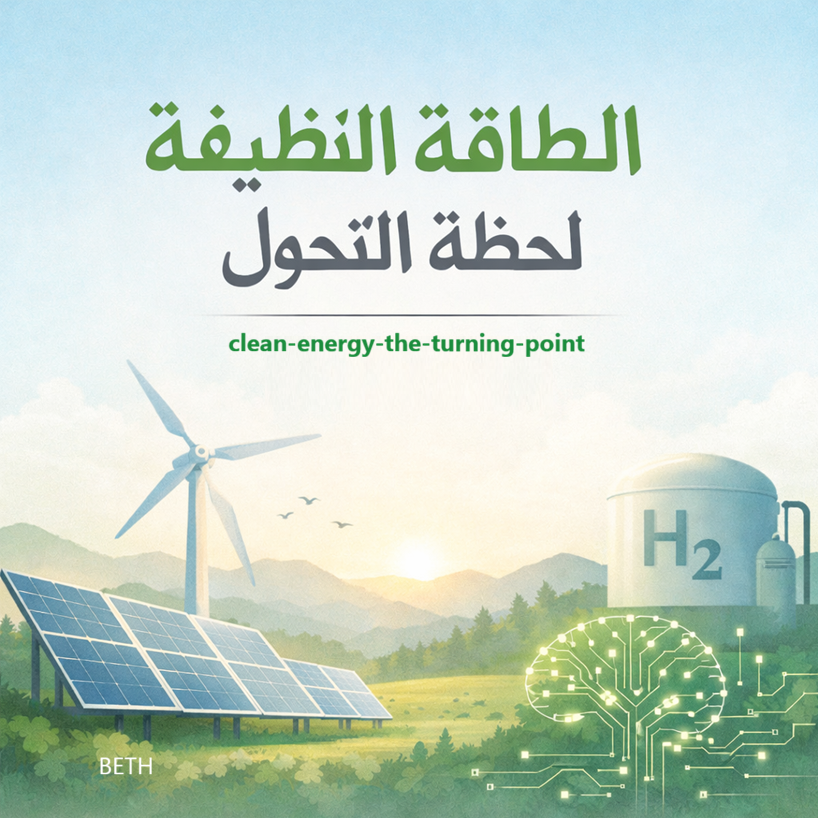
Prepared & Analyzed | BETH
In a world crowded with conflict and heavy headlines, it is rare for a piece of news to carry the tone of “rational optimism” — an optimism that does not anesthetize reality, but reminds us that humanity remains capable of producing shared solutions when it sets conflict aside.
The accelerating global shift toward clean energy is not merely an environmental headline; it is a moment of collective awareness:
a transition from depletion to sustainability,
from competition for dominance to partnerships in knowledge,
and from short-term fixes to the engineering of a long-term future.
In this context, advanced technology is no longer a scientific luxury; it has become an instrument of civilizational rescue.
Here, the central question emerges:
What has changed in technology? And how has it become — in practical terms — capable of turning the “green dream” into an implementable reality?
Scientific Review: Advanced Technologies in Clean Energy
From the Laboratory to Reality
Next-Generation Solar Cells: When Efficiency Jumps
Technology: Hybrid solar cells (Perovskite–Silicon Tandem)
What’s new?
Conversion efficiency has risen from around 22% in conventional cells to over 30% in hybrid models.
Lower production costs due to the ability to fabricate perovskite layers at lower temperatures using simpler processes.
Implication:
This is not an incremental improvement; it is a technological leap that brings solar energy closer to competing with fossil fuels in both cost and viability.
Energy Storage: The Knot That Is Beginning to Loosen
Technology: Solid-state batteries + Sodium-ion batteries
What’s new?
Solid-state batteries offer higher safety, greater energy density, and longer lifespan.
Sodium-ion batteries provide a cheaper, more abundant alternative to lithium, making them suitable for developing economies.
Implication:
The main challenge of renewable energy has never been generation, but storage.
Progress in this field means clean energy is no longer hostage to weather conditions or daylight hours.
Green Hydrogen: The Fuel Redefining Industry
Technology: Advanced electrolysis powered by renewable electricity
What’s new?
Production of hydrogen with zero carbon emissions.
Application in heavy industries (steel, cement, maritime and aviation transport).
Implication:
Green hydrogen is not merely an energy alternative; it is a bridge for transforming polluting industries into low-carbon sectors without sacrificing productivity.
Artificial Intelligence in Energy Management: When Grids Think
Technology: AI-powered smart grids
What’s new?
Demand forecasting.
Automated energy routing based on real-time needs.
Loss reduction and distribution efficiency optimization.
Implication:
Clean energy does not succeed through generation alone, but through intelligent network management.
Here, artificial intelligence evolves from a digital tool into the “brain of infrastructure.”
Carbon Capture: Cleaning the Past While Building the Future
Technology: Direct Air Capture (DAC)
What’s new?
Extraction of carbon dioxide directly from the atmosphere, with storage or industrial reuse.
Integration of clean energy systems with environmental remediation technologies.
Implication:
The world is no longer content with reducing harm; it has begun to consider repairing what was damaged in the past.
Analytical Reading
The current transition is not a “green trend,” but a deep structural shift in the global economic architecture.
Those who possess clean-energy technologies today will hold tomorrow’s leverage.
Nations investing in research and development now are not merely protecting their environment; they are securing a seat in the leadership of the future industrial order.
Conclusion
For many years, the future of clean energy appeared as a postponed promise.
Today, that promise has turned into tools,
the tools into projects,
and the projects into a reality taking shape before our eyes.
The optimism here is not emotional,
but rational:
to witness humanity — finally — investing in what sustains it, rather than in what depletes it.