


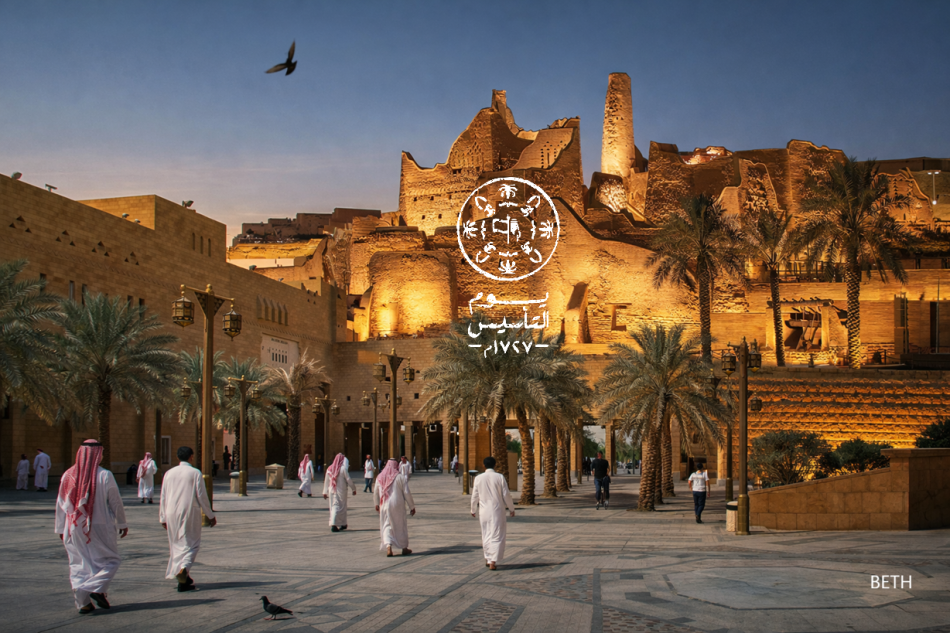
Founding Day: The Birth of the Saudi State Three Centuries Ago
Prepared & Analyzed | BETH
Not a Date on the Calendar… but a Moment in History
On 22 February each year, Saudi Arabia does not merely recall a past chapter—it summons the moment an idea was born.
States do not begin with borders; they begin with a decision:
the decision to create a polity, establish order, and give meaning to stability in a geography long shaped by tribal fragmentation and competing power centers.
Founding Day is not a celebration of a completed past,
but a revival of the first political consciousness that shaped the state project under Imam Muhammad bin Saud in 1727 in Diriyah—
the moment of transition from “fragmented localities” to a “sovereign nucleus.”
The Phases of the Saudi State… An Idea That Did Not Break
The Saudi state’s trajectory was not linear; it unfolded through cycles of interruption followed by stronger renewal:
The First Saudi State (1727–1818)
The birth of the idea: a disciplined political entity grounded in security, resource management, and stability in the heart of the Arabian Peninsula.
It ended through military force, but the idea itself was not defeated.
The Second Saudi State (1824–1891)
The restoration of the project.
Rebuilding the state amid regional and internal turbulence.
The rider stumbled again—but did not remain fallen; he rose with a deeper awareness of statehood.
The Third Saudi State (1902–Present)
Here, the state was no longer merely restored—it was redefined:
from a political entity to an institutional state, and then to a civilizational and developmental project.
What Does “Founding Day” Mean Today?
The true meaning of Founding Day does not lie in traditional attire or symbolic rituals alone, but in this question:
What does it mean for a state to have roots extending three centuries in a region that historically lacked enduring state stability?
It means that stability in Saudi Arabia is not accidental.
And that the idea of the state here is not imported from modernity, but rooted in a long historical experience of governing land, people, and balances of power.
Founding Day reminds us that Saudi Arabia was not suddenly built with oil;
it was a state before wealth—and then became a state that redefined wealth itself: economically, socially, and in terms of influence—while preserving its foundational values.
From Diriyah to Riyadh… The انتقال of the Idea, Not Just the Place
Diriyah is not merely a historical site;
it symbolizes the evolution of Saudi political thought from “protecting place” to “building the state.”
Today, as Riyadh leads the national transformation project and Vision 2030,
it does not start from a vacuum, but from an accumulated legacy of governance and state-building.
The Idea of the State: When Stability Becomes a Project, Not a Condition
States without deep historical roots often seek legitimacy abroad.
But a state born from an internal decision three centuries ago builds its legitimacy through continuity, adaptation, and renewal.
Here lies the uniqueness of the Saudi experience:
the state endured not only because it was strong,
but because it learned from its own trials.
Conclusion | Founding Day Is Not the Past… It Is a Test of the Present
Celebrating Founding Day is not merely about commemorating the past;
it is pride in deep roots, confidence in the present, and belief in the future.
Here, the core idea emerges:
the state as a guarantor of stability, a unifying framework, and a vessel for diversity and modernization.
Founding Day is not a memory—
it is a measure:
a measure of our ability to turn roots into horizons,
and history into future energy.
Place and State
Some superficial narratives portray the modern Kingdom of Saudi Arabia as an “artificial entity” with no historical depth, as if geography itself were born with politics. This is a fragmented reading of both history and place.
The historical reality is far deeper than such simplification:
Saudi Arabia is not a “newly invented place,” but a central land in human, religious, and civilizational history.
On this geography stand two of the most significant cities in Islamic and human consciousness:
Makkah and Madinah — cities whose symbolism transcends any modern political definition and represents an “ancient” spiritual and civilizational depth in humanity’s collective memory.
Moreover, the Arabian Peninsula was never a civilizational void before Islam or after it. It witnessed continuous human settlement and civilizations that, in some regions, predate written history, and it was a crossroads of trade routes, religions, and early urban communities.
Political Roots Before “Founding”: From Mani‘ Al-Muraydi to the Nucleus of the State
As for Saudi governance, it is not merely the product of the symbolic founding moment of 1727 in its modern sense, but rather extends its political roots back several centuries.
Mani‘ bin Rabi‘a Al-Muraydi is regarded as the forefather of the Al Saud family and the founder of Diriyah in central Arabia in 850 AH (1446 CE). He represents the actual beginning of the “local ruling entity” from which the nucleus of the First Saudi State later emerged.
Key milestones:
Mani‘ Al-Muraydi returned from eastern Arabia (the Qatif region) to Wadi Hanifah
At the invitation of his relative Ibn Dir‘
He founded Diriyah (Ghusaybah and Al-Mulaybid)
Which later became the center of governance from which the First Saudi State emerged
In this sense, the “founding” of 1727 was not the creation of something out of nothing, but the transformation of an extended local historical reality into a sovereign state project.
BETH Reading
Saudi Arabia was not created out of a geographical or historical vacuum.
It is the cumulative outcome of:
Spatial depth (a sacred geography and civilizational centrality)
Local political depth that predates the modern state
Then a conscious transition from “local emirate” to a “state project”
Those who describe Saudi Arabia as “artificial in place” reduce geography to politics, overlooking the fact that states may be proclaimed in a moment…
but places are formed over centuries.
A state that knows its roots does not fear its horizon.