



Crown Prince Meets Senator Lindsey Graham in Riyadh
Riyadh | BETH – 02 Ramadan 1447 AH, corresponding to February 19, 2026
News
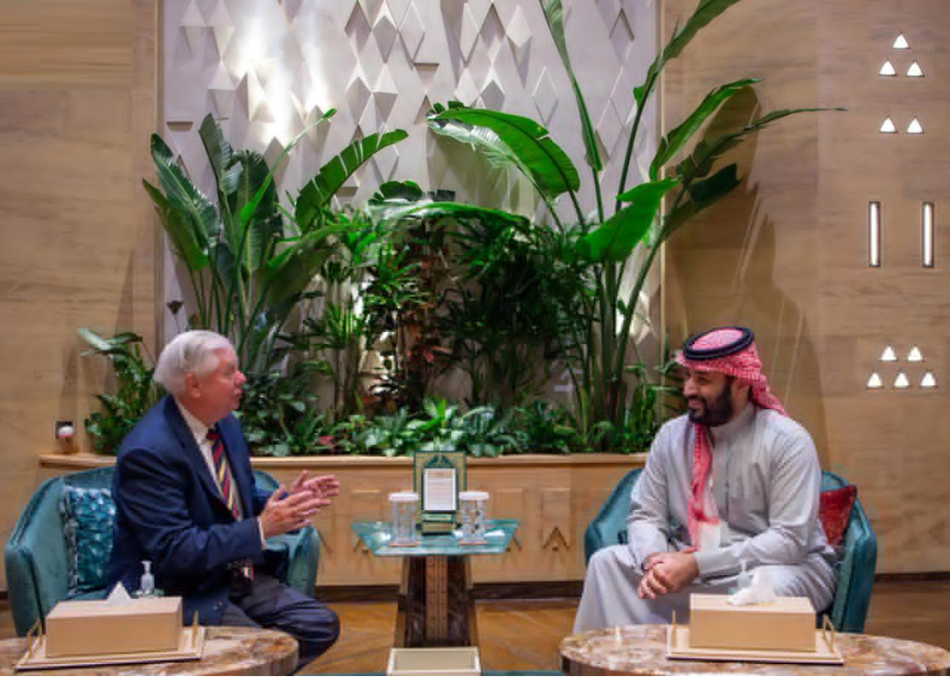
His Royal Highness Prince Mohammed bin Salman bin Abdulaziz Al Saud, Crown Prince and Prime Minister, met today at his office at Al-Yamamah Palace in Riyadh with U.S. Senator Lindsey Graham and the accompanying delegation.
During the meeting, the Saudi–U.S. relations of friendship were reviewed, along with regional and international developments and a number of issues of mutual interest.
The meeting was attended by His Royal Highness Prince Khalid bin Salman bin Abdulaziz, Minister of Defense; His Highness Prince Faisal bin Farhan bin Abdullah, Minister of Foreign Affairs; and Minister of State, Member of the Council of Ministers and National Security Advisor Dr. Musaed bin Mohammed Al-Aiban.
BETH Analysis
The timing of the meeting carries implications that go beyond diplomatic protocol. The region is moving to the rhythm of a managed U.S.–Iran escalation, an open negotiation track, and intersecting deterrence messages. Graham’s presence—one of the influential voices in Congress and among circles close to Republican decision-making—reflects the Kingdom’s standing, significant influence and importance, and underscores Washington’s desire to keep consultation channels with Riyadh open at a sensitive moment.
For Riyadh, the meeting aligns with a policy of “managing balance”: consolidating the strategic partnership with Washington while maintaining influence over regional stability and energy files.
Who is U.S. Senator Lindsey Graham?
A senior member of the U.S. Senate, known for firm positions on national security and foreign policy.
Politically close to Republican Party circles, and portrayed in U.S. media aligned with President Trump as a “pressure voice” advocating tough stances on Iran, while keeping the door open to a deal if “serious guarantees” are provided.
His influence goes beyond voting; he is often used as a channel for political signaling ahead of executive decisions or shifts in U.S. rhetoric.
What is expected from the meeting according to U.S. media aligned with Trump?
Message coordination: Aligning deterrence rhetoric while maintaining a negotiation window.
Reassuring allies: Reaffirming Washington’s commitment to the security of Gulf partners amid any potential escalation.
Operational files: Maritime and energy security, containing escalation through proxies, and calibrating media messaging to avoid miscalculation.