



Between Disclosure and Awareness: Shock Without Insight
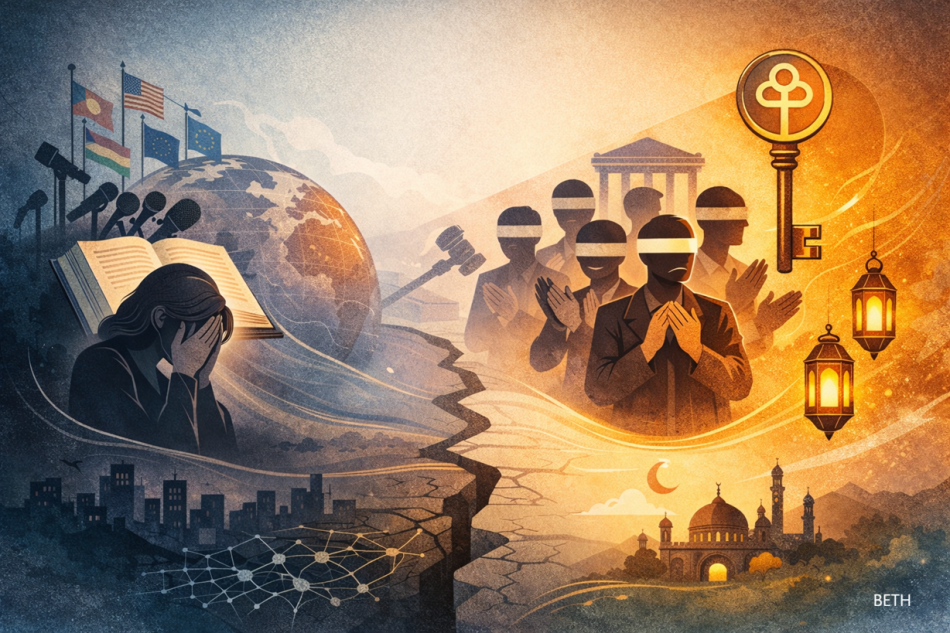
Analysis | BETH
Open societies are not necessarily aware societies,
just as conservative societies are not necessarily immune from error.
The real difference is not measured by the degree of openness or restraint,
but by a society’s ability to prevent tragedy before it applauds the courage of narrating it.
No society is immune…
and no scandal, in itself, signifies awareness.
This report examines stories that are shocking in their facts,
cross-border in their impact,
yet read here as lessons—rather than spectacles.
Introduction
In a world that no longer conceals its flaws as much as it puts them on display,
personal confessions turn into headlines that travel across borders,
memoirs are translated into dozens of languages,
and scandals are narrated as “acts of courage” or “necessary revelations.”
The question that imposes itself is not:
Is disclosure an act of bravery?
But rather: does disclosure evolve into awareness… or merely into consumption?
In a month in which ethical values are revisited,
and societies re-examine their relationship with error, repentance, and meaning,
this cultural wave becomes a genuine test of the reader’s moral compass:
Do we read these stories to understand how deviations take shape?
Or do we consume pain as “moving stories” and move on?
When Testimony Becomes a Global Shock
In recent weeks, a European memoir—written in the aftermath of a deeply disturbing domestic abuse case—has triggered wide debate in Western media over the meaning of “public confession.”
Is it an act of courage that restores dignity to the victim?
Or a cultural moment that reveals the scale of moral disintegration when private tragedy turns into a public spectacle?
The memoir written by Gisèle Pelicot is not merely a personal account of individual suffering.
It is a testimony to an entire decade of systematic sexual violence within a closed domestic setting.
A husband who lured dozens of men to assault his wife while she was unconscious under sedation.
Violence that did not occur only in secrecy,
but continued for years within a social environment that either failed to see—or saw and failed to stop.
The author’s decision to reveal her identity and appear in court led to the conviction of her husband and nearly fifty other men.
This is not a “scandal” in the media sense.
It is a stark mirror reflecting a more unsettling question:
How can a tragedy of this magnitude persist for a full decade within a society that prides itself on legal systems and civil rights?
The Deeper Shock: When We Applaud Disclosure and Normalize the Flaw
The shock is not confined to the crime itself.
Crimes have occurred throughout history and across cultures.
The deeper shock lies in the transformation of crime into a consumable cultural event:
discussed in talk shows,
recounted in cafés,
recycled across platforms,
while the preventive question remains postponed:
How did societies reach a point where exposing ugliness is easier than preventing its emergence?
When we applaud disclosure today,
we must acknowledge that society itself failed yesterday to build protective systems capable of preventing the tragedy in the first place.
Here, confession shifts from an act of liberation
into an implicit admission of prior ethical failure.
Between Freedom and Breakdown: Where Does Awareness Stand?
Freedom, in its essence, is a supreme human value.
Yet when detached from moral responsibility,
it transforms from a guarantor of dignity into a fragile environment in which violations proliferate.
Open societies are not necessarily aware societies,
just as conservative societies are not necessarily immune from error.
Every society contains both what is commendable and what is flawed.
The real distinction is not the level of openness or restraint,
but the capacity to prevent tragedy before applauding the courage of narrating it.
Ramadan: Recalling the Ethical Compass
In a month that revives the meaning of self-accountability,
and elevates values above noise,
reading such stories becomes a dual test:
a test of the sincerity of civil discourse in unrestrained societies,
and a test of our own awareness:
Do we read in order to judge others?
Or to re-examine our own ethical and social systems before the normalization of moral decay seeps into them?
The Islamic experience is not presented here as an “ideal model without flaws,”
but as a moral framework deeply rooted in the pursuit of good—offered as a reminder.
Human error is inevitable.
What is dangerous is for error to become familiar,
and for its scandal to replace efforts to prevent its occurrence.
BETH’s Perspective: From Event to Awareness
At BETH, we do not approach such stories as “shocking content,”
but as indicators of a profound imbalance in the relationship between freedom and ethics, between disclosure and prevention, between confession and responsibility.
Reporting the event is not enough.
Deconstructing the event is necessary.
Connecting it to the broader question of awareness is the essence of responsible journalism.
Conclusion
The value does not lie in exposing tragedies,
but in learning how to prevent their repetition.
Courage is not in confessing after a decade of suffering,
but in building systems that prevent a decade of suffering from forming in the first place.
From disclosure to awareness…
here alone does real reform begin.