



Why Do Muslims Differ in Determining the Start of Ramadan?
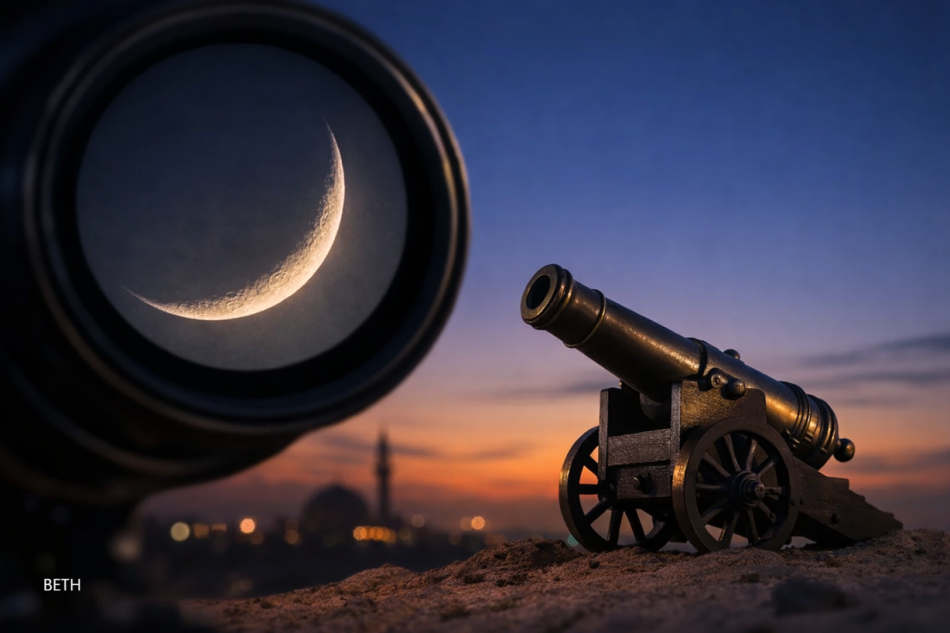
Unity of the ritual… not unity of the clock
Follow-up & Explanation | BETH
Riyadh – 29 Sha’ban 1447 AH | February 17, 2026
Every year, the Islamic world witnesses variations in the announcement of the start of Ramadan.
This year, several countries began fasting on Wednesday, while others started on Thursday—
a recurring scene that raises questions among Muslims, and also draws the attention of non-Muslim societies to why the timing of a single act of worship differs within one global faith community.
How Is the Beginning of Ramadan Determined?
Most Islamic countries rely on the confirmation of the crescent moon sighting to announce the start of Ramadan, in adherence to the Prophetic hadith:
“Fast when you sight it and break your fast when you sight it. If it is obscured, then complete the count of thirty days.”
While the crescent is sighted in some countries, it may not be confirmed in others on the same night—
either due to differing observation conditions or variations in adopted criteria between direct visual sighting and supportive astronomical calculations.
Islamic Jurisprudence: A Framework for Disciplined Ijtihad
This variation may appear, outside the Islamic legal context, as inconsistency.
In reality, it reflects a structured juristic diversity within a unified legal framework.
The majority of scholars agree that sighting is the legal basis for determining the start of the month.
However, jurists have differed on procedural details related to what is known as the “Day of Doubt,” according to established schools of Islamic jurisprudence:
Some associate it with unverified reports of sighting.
Others restrict it to cases where sighting is obstructed by clouds or atmospheric conditions.
Some link it to widespread claims of sighting without legal confirmation.
Others consider the 30th of Sha’ban a day of doubt if the sighting is not confirmed.
This diversity is regarded as legitimate juristic plurality that does not affect the essence of worship, but rather reflects the flexibility of Islamic law in accommodating differing environments and horizons.
Unity of Timing in Hajj… Why Not in Fasting?
Islam unifies time and place in the pilgrimage (Hajj), because the ritual is inherently tied to a single geographic location (Makkah and the sacred sites).
Therefore, the act of worship becomes globally synchronized in time and place.
Fasting, however, is a time-based act of worship performed across all regions of the world.
Its commencement depends on the lunar horizon as observed from different geographic locations,
making variation in the beginnings of lunar months consistent with the nature of the ritual and the methodology of Islamic legislation.
Can the Start of Ramadan Be Unified Globally?
Technically, modern astronomy can determine the birth of the crescent moon with high precision worldwide.
However, from a legal perspective, the prevailing approach across the Islamic world continues to tie the ruling to confirmed sighting,
with astronomical calculations used to negate errors or assist in assessment—rather than replace sighting altogether.
Thus, global unification of the start of fasting is technically possible,
but not religiously binding, as long as the Prophetic guidance places sighting at the center of the ruling.
BETH Angle | Unity of Meaning Before Unity of Timing
The unity of Muslims is not measured by identical dates, but by unity of purpose and meaning.
Fasting is a collective spiritual experience lived by Muslims across diverse geographies and cultures,
within one shared legal framework—even if the calendar dates differ.
The deeper message:
The unity of Muslims is not in starting the fast on the same day,
but in fasting for the same purpose:
purifying the soul, cultivating piety, and reinforcing values of compassion and solidarity.
In Summary
Hajj is unified in timing because the place is one.
Fasting varies in timing because lunar horizons differ.
Islam defined the method (sighting) and left the practical application to scholarly judgment and geographic reality.
Unity of the ritual… not unity of the clock.
Islam and the Hijri Calendar
Islam bases its time-bound acts of worship on the Hijri (lunar) calendar, which follows the cycle of the moon around the Earth, with each month beginning upon the sighting of the crescent.
Unlike the Gregorian (solar) calendar used globally for civil and economic affairs, the Hijri calendar is directly linked to major acts of worship such as prayer, zakat at the end of Ramadan, fasting, and pilgrimage (Hajj).
This connection is not merely technical; it carries religious and cultural significance.
In Islam, time is not just a numerical framework, but part of the broader structure of worship and identity. As religious observances move across seasons and years, Muslims experience Ramadan and Hajj under varying climatic conditions over time, reinforcing the shared human dimension of the religious experience.
Moreover, reliance on the lunar calendar—based on sighting or its confirmation—ties the beginning of months to natural observation rather than purely abstract calculation. This explains why the issue of crescent sighting continues to feature in contemporary religious discourse, even in an age of high astronomical precision.