



Riyadh… A Pillar of Global Stability
World | BETH – Strategic Analysis
News Lead
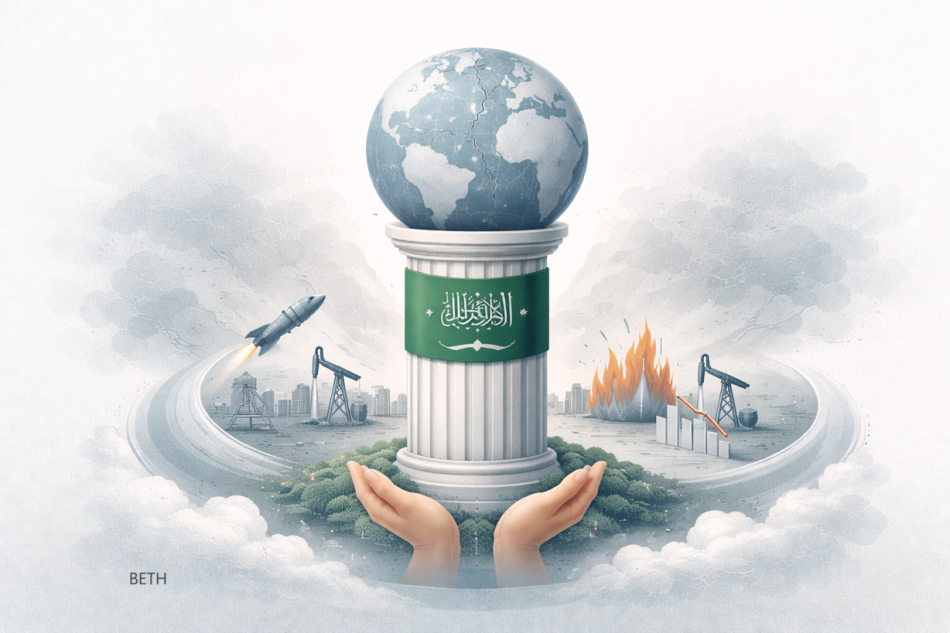
In a world of accelerating crises and declining capacity among major powers to contain them, Saudi Arabia stands out as a central actor in the equation of regional and global stability. Its role is not reactive, but grounded in a balanced approach that combines political wisdom, economic weight, diplomatic credibility, and the ability to act at moments of international deadlock.
BETH Analysis: Why Saudi Arabia Can Play a Stabilizing Role
1) Leadership Wisdom Rooted in History and Civilizational Depth
Saudi Arabia’s capacity to manage crises is anchored in a historical accumulation of experience in navigating major transformations, and in its Arab and Islamic standing, which grants it moral and political legitimacy in files that transcend geography.
2) Political Statecraft that Prioritizes Solutions over Polarization
Riyadh adopts a de-escalation approach rather than investing in escalation. This is not passive neutrality, but pragmatic conflict management through flexible negotiation tracks that safeguard interests and prevent the slide into the costs of open confrontation.
3) International Credibility in an Era of Eroding Trust
At a time when trust among international actors is thinning, Saudi Arabia has built a reserve of credibility through tangible commitments: mediation efforts, stable economic partnerships, and de-escalation initiatives that translate into outcomes on the ground—not merely statements.
4) Balanced Economic, Political, and Military Power
Influence does not rest on a single pillar. The blend of economic power (energy, investment, partnerships), political reach (a diversified, multi-polar network of relations), and military capability (deterrence and protection of stability) provides Saudi Arabia with flexible tools to act without drifting into adventurism.
BETH Signal: Between Those Who Extinguish Fires… and Those Who Ignite Them
Conversely, successive crises reveal that some states—due to a deficit of wisdom, weak self-restraint, and vulnerabilities exploited by destabilizing forces—contribute to igniting conflicts or widening their scope, without possessing the capacity or political will to extinguish them later.
The fundamental difference is not the possession of power, but the management of power:
Those who discipline their tools reduce the global cost of crises;
Those who misuse them add new sparks to an already burning fire.
BETH Indicators (At a Glance)
Credibility of Saudi Arabia’s crisis role: High
Mediation and de-escalation capacity: High
Ability to convert economic weight into stabilizing influence: High
Risk of crisis spillover driven by undisciplined actors: High
BETH Conclusion
At a time when the international system’s capacity to prevent crises is waning, the value of states capable of de-escalation and pathway-building exceeds that of states that accumulate instruments of confrontation. Saudi Arabia today is not a party to the equation of chaos, but part of the equation of stability. The difference between the two paths is the difference between a world managed through crises—and a world guided by wisdom.
Wisdom, at its core, is placing things in their proper context: a synthesis of accumulated knowledge, historical experience, discernment in aligning word and deed with what is right, foresight in assessing consequences, and prudence in managing power without recklessness. These qualities are forged through time and rooted in the civilizational depth of nations.
In this context, the Kingdom will mark on 22 February 2026 the 300th anniversary of its founding—a historical milestone reflecting the depth of the state and the continuity of its political project. This historical continuity, grounded in Arab and Islamic heritage, has enabled the Kingdom and its leadership over decades to confront crises, prevail over them, and contribute to addressing regional and global challenges in pursuit of stability for nations and peoples.