



Munich 2026… The World at a Security Crossroads
Munich | BETH – 13 Feb 2026
Follow-up & Analysis
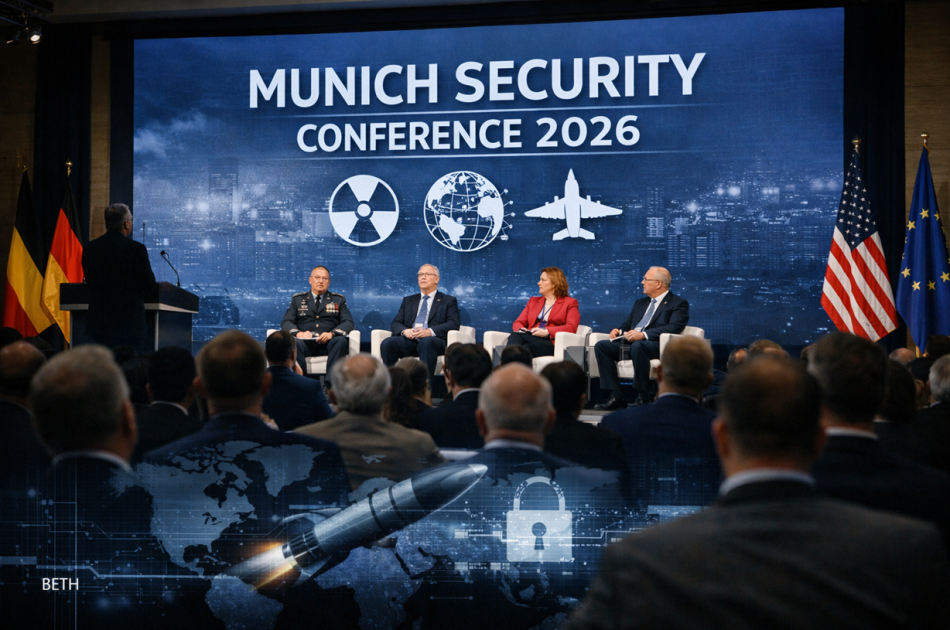
The Munich Security Conference 2026 opened today in Germany, bringing together senior political, diplomatic, and military leaders to debate the major shifts reshaping the global security order. This year’s agenda centers on the erosion of the “rules-based order,” the escalation of major conflicts, strains across the transatlantic relationship, and the rising cyber and nuclear threats in an increasingly multipolar and volatile world.
Analysis: Why Munich Feels Different This Time
1) The End of Certainty Around the “International Order”
The language dominating the conference reflects a shift from managing discrete crises to confronting the fragmentation of the very framework governing global security. Rules are no longer universally binding reference points; they are increasingly negotiated, selectively applied, or contested.
2) Europe Between Strategic Autonomy and the Transatlantic Umbrella
Growing calls for “European strategic autonomy” are matched by concerns over potential security gaps. Munich has become a stress test: can Europe build credible deterrence and decision-making capacity without full dependence on the U.S. security umbrella?
3) Germany: From Economic Powerhouse to Security Stakeholder
Berlin is being repositioned as a security actor—not merely a broker. The focus on defense supply chains, cyber resilience, and protection of critical infrastructure signals a shift from Germany’s traditional caution toward a more conditional leadership role within Europe.
4) Cyber and Nuclear Risks: Warfare Without Frontlines
Cyberspace has become a low-cost, high-impact battlefield, while nuclear deterrence is returning to the forefront as a tool of political pressure. The emerging equation: attribution-free attacks + deterrence without stable red lines.
The Strategic Question
Is Germany moving to lead Europe in “cleaning up” the security landscape from conflict instigators and transnational disruptive actors?
The answer lies not in declarations, but in capabilities:
Unifying European decision-making (reducing internal fragmentation)
Anchoring deterrence in international law rather than ad-hoc exceptions
Deploying smart pressure tools (targeted sanctions, defensive cyber capabilities, protection of energy and logistics chains)
Investing in preventive diplomacy, not only post-crisis management
BETH Indicators (Snapshot)
Shift in European security discourse: High
Likelihood of an emerging German leadership role: Medium–High
Risk of cyber/nuclear escalation: High
Short-term global impact: Medium
Long-term structural implications: High
What We’re Watching in the Next 72 Hours
The final communiqué: will it move from diagnosis to executable instruments?
The degree of EU–U.S. alignment on deterrence and energy security
Any concrete initiatives on cyber defense and critical-infrastructure protection
Signals toward new mechanisms to contain proxy conflicts
BETH Conclusion
Munich 2026 is not merely a security conference; it is a mirror of a global order redefining itself. If Europe—leveraging a German anchor—can translate anxiety into organizational capability, a new equilibrium may emerge. If not, the world drifts toward fragmented security—where rules bind less, and instability spreads faster.