


2025 TV₁₀… A “Co-Orbital” Asteroid with Venus Prompts a Reassessment of Space Risks
Follow-up & Analysis | BETH News Agency
News Lead
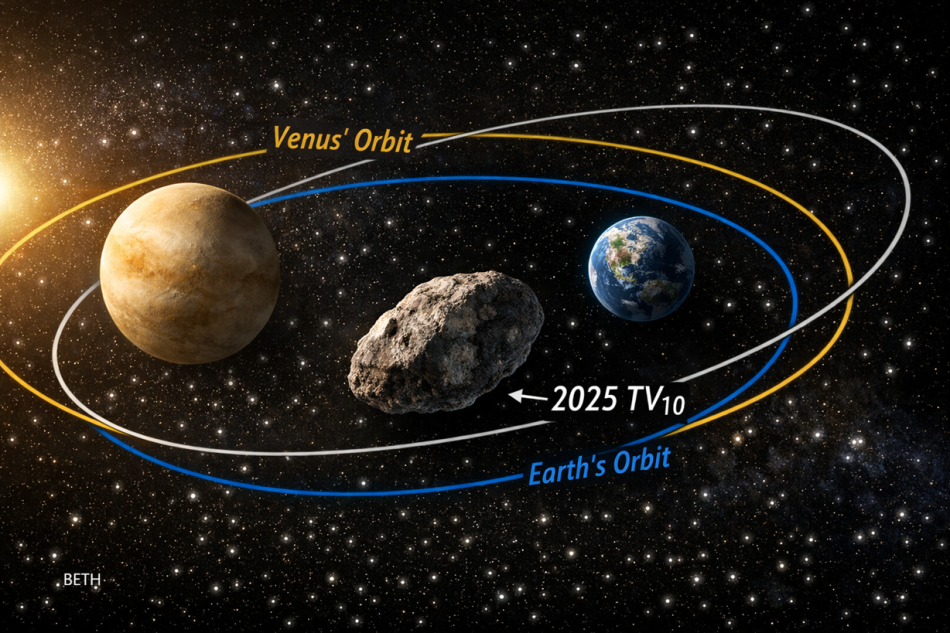
On January 29, 2026, an international team of astronomers announced the discovery and first dynamic classification of a newly identified asteroid, designated 2025 TV₁₀. The object belongs to a rare class known as co-orbital asteroids with Venus—bodies that orbit the Sun within the same orbital zone as Venus and exhibit a 1:1 orbital relationship with the planet.
This class of objects has received little media attention. Yet the peer-reviewed study indicates that 2025 TV₁₀ may be among the most dynamically “risky” known Venus co-orbitals, given the relative proximity of its potential orbital intersections with Earth compared to similar objects identified so far. The asteroid remained faint and was observed only in limited datasets due to its low brightness and the difficulty of detecting it when positioned close to the Sun—factors that help explain why the discovery has not spread widely in mainstream media.
The designation 2025 TV₁₀ reflects the year of the asteroid’s first recorded observation in 2025 under the International Astronomical Union’s naming conventions, while its scientific classification and analysis were announced in 2026—accounting for the discrepancy between the name and the year the news circulated.
In simple terms:
2025 = the year of the asteroid’s first recorded observation
T = the half-month code indicating the period of discovery
V₁₀ = the sequential identifier for the order of discovery within that period
Analysis | BETH Reading of the Scientific and Strategic Significance
1) A rare class—and long-term risk potential
Co-orbital asteroids with a planet—such as 2025 TV₁₀ with Venus—share the planet’s orbital speed and zone around the Sun. This little-studied class does not belong to the main asteroid belt and is subject to long-term dynamical shifts that could, over extended timescales, steer some objects toward trajectories closer to Earth’s orbit.
2) Why has this not gained media traction?
The limited coverage is driven less by editorial neglect than by observational constraints:
The asteroid’s very low brightness makes detection challenging even for advanced ground-based telescopes.
Its proximity to the Sun in the sky during key observation windows significantly narrows detection opportunities.
As a result, discoveries of this kind often remain confined to scientific literature before crossing into mainstream media.
3) Orbital dynamics and risk readings
Dynamic modeling suggests that 2025 TV₁₀ exhibits one of the smaller minimum orbital intersection distances (MOID) with Earth among known Venus co-orbitals, implying that close approaches over thousands of years are dynamically plausible. While current probabilistic estimates remain low and spread across long time horizons, the findings underscore the importance of continued monitoring to refine orbital parameters and risk assessments.
4) Why does this study matter?
Identifying and classifying such an object does not imply an imminent threat. Rather, it opens a new window into understanding previously under-observed populations of near-Sun objects and exposes gaps in current near-Earth object (NEO) detection capabilities—particularly for bodies that approach from directions near the Sun, where ground-based surveys are least effective.
5) From science to planetary defense strategies
The results raise a strategic question for space agencies: How can early-warning and detection systems be expanded to better track faint, near-Sun objects? While largely absent from public discourse, this challenge is central to the next phase of planetary defense planning and to updating risk-assessment models for near-Earth objects.
BETH Conclusion
The discovery of 2025 TV₁₀ is not another “asteroid approaching Earth tomorrow” headline. It is a scientific wake-up call that underscores how much of our near-space environment remains only partially mapped. What appears to be a narrow technical finding is, in fact, a step toward deeper understanding of orbital dynamics—and toward preparing the global scientific community for future planetary defense questions.
Space risks are neither an absolute cosmic fate nor the responsibility of any single nation.
They are a new test of humanity’s ability to move from a logic of nation-states to a logic of the planet:
either proactive global cooperation to reduce risks,
or a continued reliance on reactive responses when threats emerge beyond politics and geography.