



Planetary Parade… A Rare Alignment in February Skies
Follow-up & Analysis | BETH
News Lead
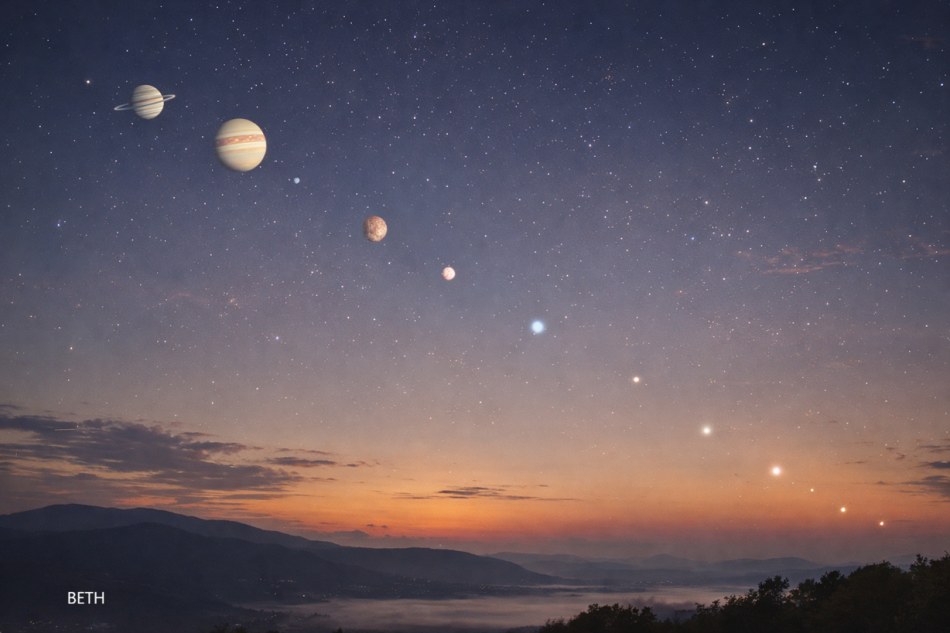
In late February 2026, Earth’s skies will witness a rare astronomical phenomenon as six planets appear aligned in a single visual formation, commonly referred to as the “planetary parade.” Such alignments, visible with this level of clarity only at widely spaced intervals, offer millions of observers around the world a chance to witness a cosmic synchronization that reflects the vastness and harmony of the solar system.
The phenomenon is a visual scientific event with no direct physical impact on Earth. Yet it draws strong interest from observatories, astronomers, and skywatchers alike, serving as an educational and cultural moment that reconnects humanity with the broader cosmic scene.
Analysis | BETH Reading of the Event
1) The phenomenon: science, not astrology
A planetary alignment does not imply that planets converge in space. Rather, it is a visual alignment from Earth’s perspective, resulting from the planets’ positions along nearby orbital paths in the sky. The distinction matters: this is an observational scientific event, not a canvas for popular or mystical interpretations that project meanings onto the heavens beyond the scope of science.
2) Why does the world care about such a sight?
Amid political and economic noise, a cosmic event redirects attention to another dimension of human existence. The conflicts, borders, and power struggles that dominate daily headlines appear small against the order and vastness of the universe. Global interest in such phenomena reflects a deep human need for moments of reflection beyond the pressures of the news cycle.
3) A scientific opportunity—and a window for awareness
The alignment offers a gateway to strengthening scientific literacy, especially among younger generations, by restoring astronomy as a pathway to understanding humanity’s place in the universe—not as a luxury of knowledge, but as a foundational perspective. Here, responsible science journalism can transform the event from a “beautiful sight” into a meaningful question:
Where do we stand in this universe? And how do we read the sky with a scientific mind rather than inherited myth?
4) Media between simplification and sensationalism
Some media narratives tend to dramatize astronomical phenomena or frame them in mystical terms. The real challenge is to present the event as a scientific moment that enriches awareness rather than distorts it. Smart coverage neither exaggerates nor empties the event of meaning; it places it in context: cosmic beauty, an educational opportunity, and a moment of human contemplation.
BETH Conclusion
The “planetary parade” will not alter Earth’s fate. But it reminds humanity of its place within a broader cosmic system that far exceeds daily calculations. In a world where political and economic headlines swell, the sky occasionally speaks in silence:
There is something larger than all our noise.