


In the Presence of a King
Edited and curated by: Abdullah Al-Omira
Director, BETH Agency
The Custodian of the Two Holy Mosques, King Salman bin Abdulaziz Al Saud – King of the Kingdom of Saudi Arabia
The image speaks:
“You ruled and exerted great effort; you secured the future, and you governed with justice and thus ensured safety… so you found repose, and your people found repose through your Crown Prince.”
A portrait of a head of state within his own symbolic space.
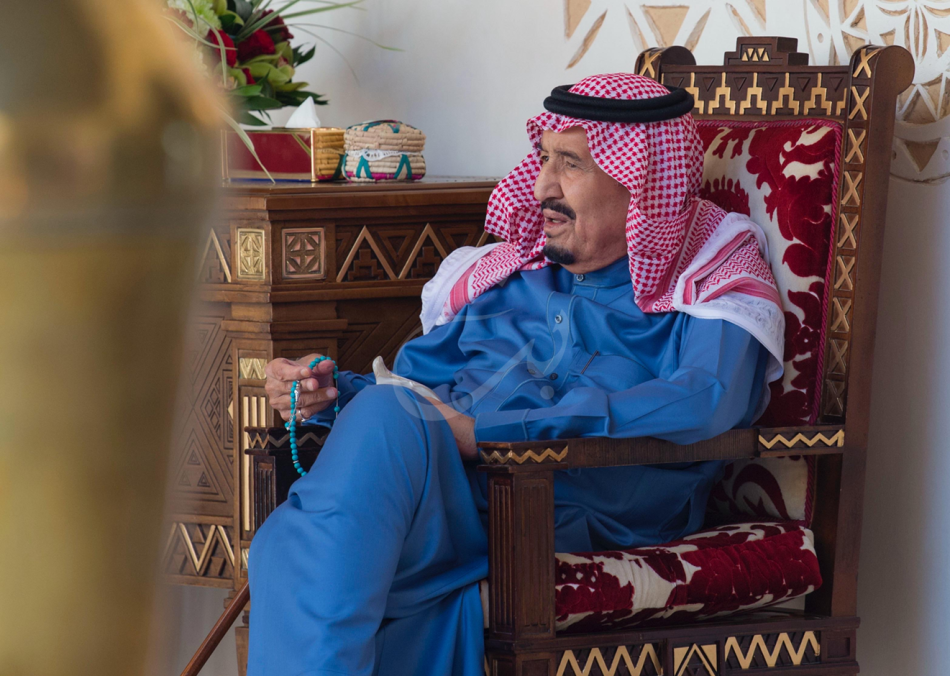
The image of the Custodian of the Two Holy Mosques, King Salman bin Abdulaziz, at Al-Auja Palace in Diriyah, carries three profound layers of meaning:
Place: Diriyah is not merely a backdrop
Diriyah is not a heritage setting;
Diriyah is the root of the Saudi state.
The King’s presence at Al-Auja Palace in Diriyah forges a symbolic linkage between:
Historical legitimacy + political continuity + the founding memory of the state.
Here, place is not invoked as décor, but as a reservoir of meaning that grounds the reading of the present in the depth of roots.
The posture is not incidental
The seated posture, the prayer beads, the composed stillness of the body, and the sideward gaze—
all converge to portray a leader in a state of calm command and strategic contemplation.
This is neither a speech podium nor a ceremonial moment,
but what may be termed:
“The silence of the state”
—the silence that precedes decision… or runs parallel to it.
The image addresses both domestic and international audiences
Domestically:
It invokes roots and historical symbolism at a time of major transformations,
offering reassurance that the state moves from its origins, not from a vacuum.
Internationally:
It conveys stability and institutional depth:
a state that is not governed by reactive impulses,
but by a historically grounded logic;
a modern state that advances from a founding memory, not from a fleeting moment.
Symbolic conclusion
This is not an image of an event, but an image of the state.
Not a protocol photograph, but a manifestation of continuity.
In Diriyah—where the state began—
the head of state appears in a moment of symbolic composure,
reconnecting the present with the roots,
and granting transformation the legitimacy of depth rather than the noise of the moment.