



Early Indicators of El Niño 2026 Raise Global Climate Risk Levels
El Niño 2026 Signals: From a Climate Event to a Geopolitical and Economic Driver
Monitoring & Analysis | Strategic Media Management – BETH
February 2026
Introduction
Global climate indicators point to a rising probability of El Niño conditions forming in the summer of 2026, at a time marked by growing fragility in global food and energy supply chains, geopolitical tensions, and inflationary pressures across multiple economies. While El Niño is scientifically classified as a natural climate oscillation, its contemporary impacts are being amplified by climate change—turning it into a “risk multiplier” that extends far beyond weather into economic stability, political dynamics, and social resilience.
What is El Niño?
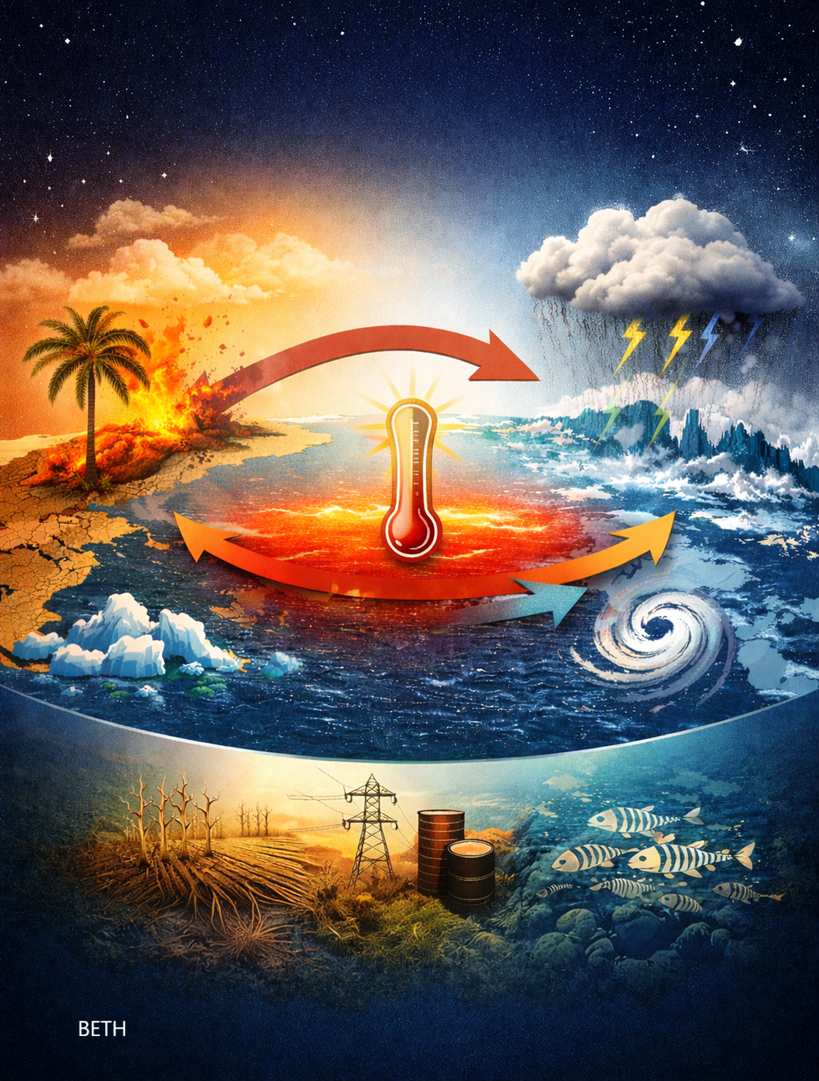
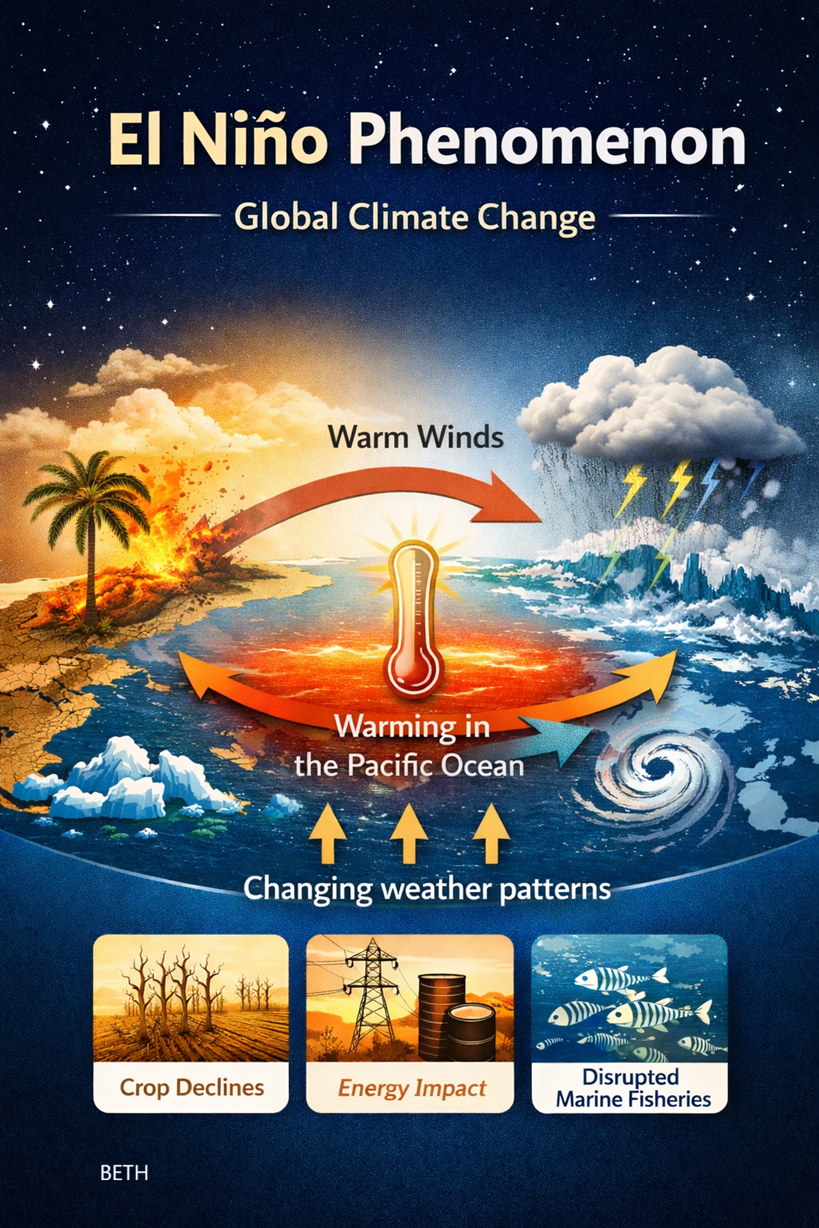
El Niño is a periodic climate pattern within the El Niño–Southern Oscillation (ENSO) system, occurring when sea surface temperatures in the central and eastern equatorial Pacific rise above average for several months. This warming reshapes winds and ocean currents, altering global rainfall and temperature patterns—bringing drought to some regions, floods to others, and disrupting hurricane seasons. Historically, El Niño episodes have coincided with global temperature peaks, sharp swings in food production, and volatility in fisheries and hydropower. Today, these effects are magnified by global warming.
Interlinked Dimensions of the Event
Environmental & Climate Impact
Record heat waves and intensified droughts/floods across parts of Asia, Africa, and Latin America.
Disruption of ecosystems (coral reefs, fisheries, biodiversity), placing pressure on marine and terrestrial food security.
Accelerated polar ice melt, exacerbating medium-term sea-level rise.
Implication: El Niño accelerates the shift from “climate variability” to a chronic pattern of climate instability.
Economic & Commodity Impact
Food: Volatility in staple crop output (wheat, corn, rice) due to droughts and floods, driving global price pressures.
Energy: Higher electricity demand for cooling, alongside fluctuating hydropower output in rain-dependent economies.
Insurance & Supply Chains: Rising disaster losses, higher shipping and insurance costs, and increased risk of port and transport disruptions.
Implication: Climate volatility fuels imported inflation, fragile supply chains, and global price instability.
Geopolitical Impact
Food security as national security: Affected countries may impose export restrictions and protectionist measures.
Water & borders: Heightened tensions over shared water basins.
Climate diplomacy: Growing pressure to re-balance global climate finance toward adaptation, not mitigation alone.
Implication: Climate risk is becoming a bargaining chip in international relations, reshaping alliances around food and energy security.
Social & Human Impact
Vulnerable populations: Increased risk of climate displacement and food insecurity in rural and coastal areas.
Public health: More intense heatwaves and climate-linked disease spread (e.g., dengue in some regions).
Social stability: Cost-of-living pressures may fuel unrest in fragile economies.
Implication: El Niño tests social cohesion and governments’ capacity for proactive social protection.
Potential Implications for the Middle East
Extreme heat and prolonged droughts increasing pressure on electricity and water demand.
Imported food prices exposed to global production shocks.
Policy opportunities: Accelerating investment in renewable-powered desalination, climate-smart agriculture, and strategic grain reserves.
Logistics corridors: Greater need for resilient ports and supply chains to hedge against global disruptions.
Strategic Watchpoints
Global food price indices over the next 6–12 months.
Export restriction policies in major grain-producing countries.
Electricity demand for cooling in hot-climate economies and implications for fuel markets.
Insurance and reinsurance pricing as early indicators of climate risk repricing.
Shifts in climate finance from mitigation toward adaptation.
Recommendations
For Governments:
Activate strategic food reserves, long-term supply contracts, and price hedging mechanisms.
Prepare emergency electricity and water plans for extreme heat scenarios.
Pursue food and climate diplomacy to secure supply chains.
For Institutions & Corporates:
Geographically diversify suppliers, insure climate risks, and build logistics resilience.
Invest in energy efficiency and smart cooling.
Integrate climate risk scenarios into financial planning.
BETH Commentary
El Niño 2026 is not merely a weather story; it is a global stress test for managing compounded risks across climate, food, energy, and geopolitics. Countries and institutions that treat the event as a “risk multiplier” and act proactively will gain stability and competitive advantage. Framing it as a seasonal fluctuation, however, risks higher inflation, supply fragility, and social tension.
Key Takeaways
Climatic in form, systemic in impact.
Economic, political, and social effects are deeply interconnected.
Success lies not only in forecasting the event, but in building integrated response readiness.
Explanatory Visual