


New Escalation in Ukraine
Follow-up & Analysis | BETH
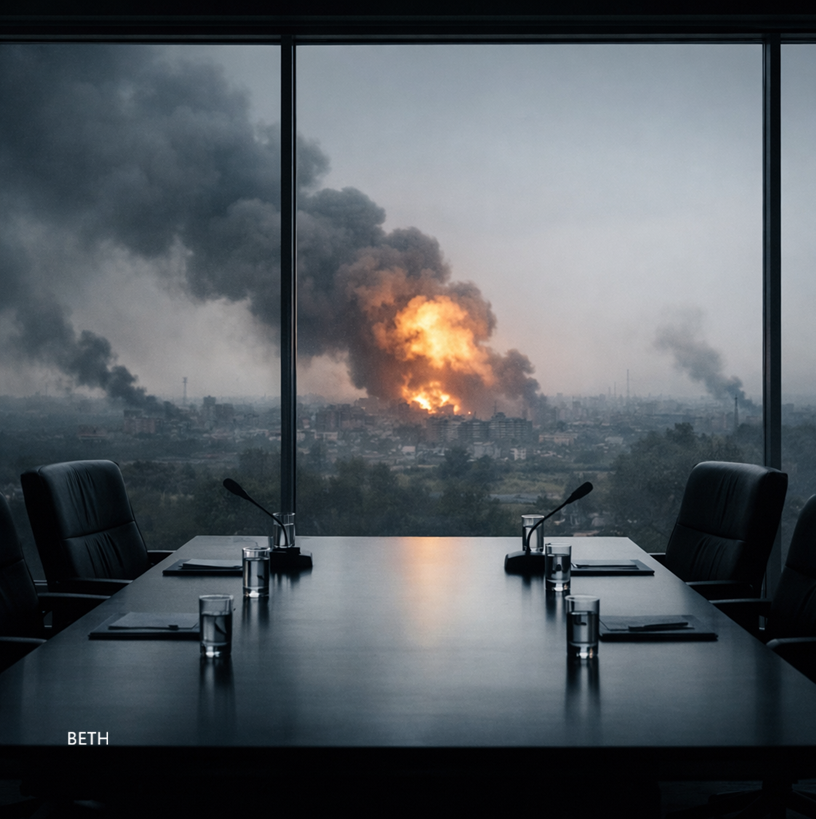
The Russia–Ukraine war has witnessed a new military escalation, coinciding with the launch of another round of internationally sponsored negotiations, reflecting the chronic contradiction between the logic of force and the logic of politics. The escalation followed a series of mutual strikes, raising once again the old question: does the battlefield dictate the terms of negotiation, or have negotiations become part of managing the conflict rather than ending it?
Analysis
This convergence between military escalation and diplomatic engagement is no longer an exception in the Ukraine war; it has become a recurring pattern. Moscow and Kyiv are fighting not only with weapons, but also with political messaging.
Each military escalation is used to improve negotiating leverage, while each round of talks is exploited to buy time and reshuffle military, economic, and international cards.
The war is no longer a purely bilateral confrontation; it has turned into a broader arena where international interests intersect:
Russia views the continuation of the battle as a way to entrench a strategic security and influence equation.
Ukraine sees military resilience as a political and international pressure card.
Supporting international actors are not driven solely by ending the war, but by calculations related to the balance of power, European security, energy markets, and the limits of Russian influence.
Repeated negotiations do not necessarily signal proximity to a solution; rather, they reflect the management of a long-term crisis. Negotiations here are not merely between two parties, but between competing power projects and security visions, making a comprehensive settlement highly complex and leaving the war in a state of “no victory… no peace.”
Questions Guiding the Reader
Why does the war continue despite its heavy human and economic costs on both sides?
How long can this pattern persist: military escalation paired with political talks without a real breakthrough?
Do current negotiations pave the way for a settlement, or have they become part of managing and prolonging the conflict?
BETH Conclusion
The Russia–Ukraine war is no longer just a border dispute; it has become a prolonged test of the international system’s ability to manage conflicts without being able to resolve them. Between escalation and negotiations, the deeper question remains: is the world seeking to end the war… or merely to contain it?
No single actor can end this war alone. The solution is not in the hands of Russia or Ukraine by themselves, but depends on a broader international consensus that balances security concerns, interests, and guarantees. Human suffering in conflict zones will not end as long as wars are politically managed rather than genuinely resolved.