


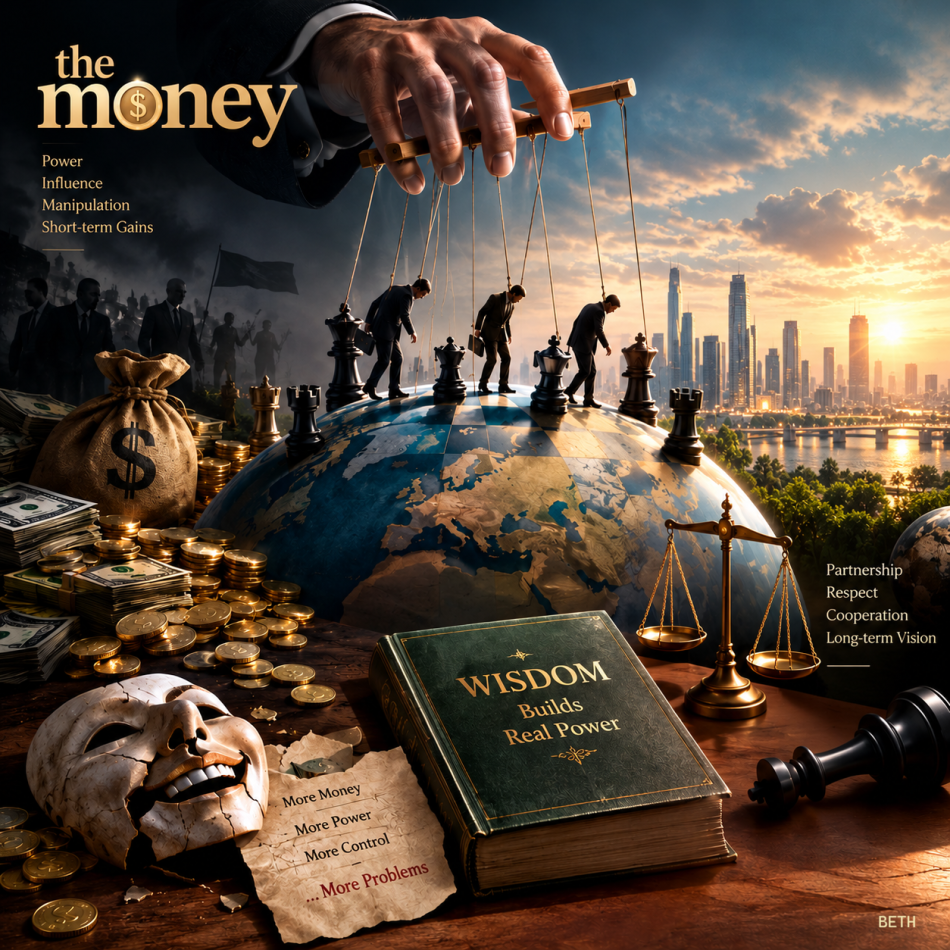
Warning of a Global Order Collapse
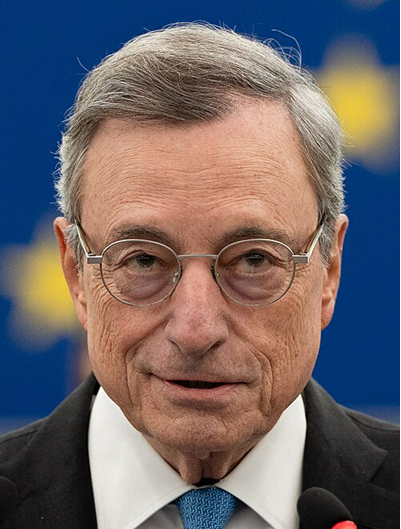
Italian thinker and former Prime Minister Mario Draghi, one of the key architects of European monetary policy, has issued a stark warning, stating that:
“The current global order is effectively dead.”
Monitoring & Analysis | BETH
This is neither a passing remark nor a dramatic prophecy, but a delayed diagnosis of a reality that has been eroding for years.
The fundamental question is not whether the system will collapse,
but whether what we are living in can still be called a system at all.
Why this warning now?
Because the three pillars upon which the post–Cold War global order was built are fracturing simultaneously:
Economy
Resurgence of protectionism
Politicization of trade
Sanctions losing effectiveness and creating parallel economic tracks
Security
Open-ended wars (Ukraine, Gaza…)
Unstable alliances
Decline of the concept of a reliable “global guarantor”
Values and Institutions
Selective application of international law
Global institutions managing crises through paralysis rather than solutions
Draghi is not saying collapse will happen tomorrow.
He is saying the system is no longer capable of producing stability.
Warning — or fear of an inevitable outcome?
The most accurate answer is: both.
A warning, because Europe increasingly sees itself as the weakest link between:
U.S.–China rivalry
Prolonged Russian pressure
Security and economic dependencies that are no longer guaranteed
And a rational fear, because reality suggests that:
The world no longer agrees on the rules of the game
It merely manages disputes… temporarily
This is where the danger lies:
When disorder is managed instead of resolved, disorder becomes the alternative system.
Markets: why the nervous reaction?
Markets do not read data alone — they sense anxiety.
Rising gold prices signal a search for safe havens
Volatile equities reflect loss of direction
Short-lived rallies indicate rebounds, not real recovery
Capital often precedes politics by a step.
What we are seeing is early pricing of a world with less certainty.
Protests: part of the picture?
Yes — not as a cause, but as a symptom.
Protests, in Iran and elsewhere, feed on:
Economic pressure
Political deadlock
A global environment offering no convincing horizon
When people feel that:
“The system neither protects, reforms, nor listens,”
the street becomes an alternative language.
BETH Assessment | Conclusion
There is no single “collapse button”
But there is slow, structural erosion
Economies are shaking
Societies are boiling
Politics is managing time, not solutions
What Draghi expressed is not a forecast, but a belated acknowledgment that the world has entered a phase:
After the order… before the alternative
This leads to the most critical question BETH raises:
Who possesses the mindset to build the alternative — not merely manage the chaos?
Who can build the alternative?
The alternative will not be shaped by the most powerful states,
nor by those skilled at media-driven crisis management.
It will emerge from actors who combine three rare qualities:
Thinking beyond conflict
Polarized states recycle rivalry; system builders reduce the cost of conflict for all.
Internal stability before external ambition
Without social cohesion and adaptive economies, no actor can design a sustainable order.
Legitimacy of action over noise of rhetoric
The next system will be born from practice, not slogans:
Mediation over alignment
Partnerships over blocs
Exporting development instead of importing crises
Final Thought
The world is not searching for a new superpower,
but for a rational mind capable of linking economy, security, and humanity.
Those who possess this mindset
will not declare leadership of the next order —
the world will quietly move toward them.
That is the difference between managing chaos
and building what comes after it.