



The U.S. Shutdown… A Stress Test for the System
Monitoring & Analysis | BETH
News Lead
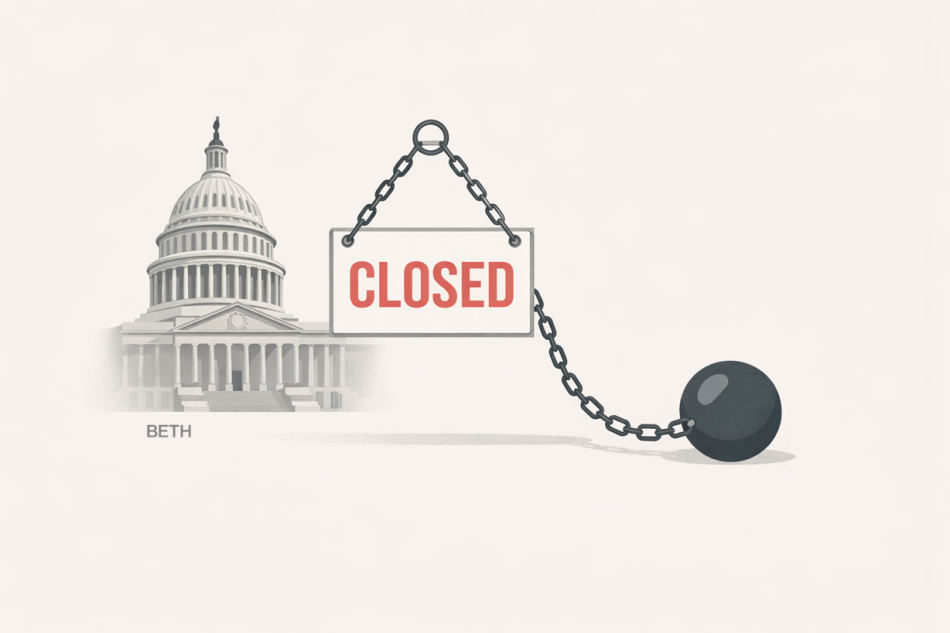
The United States has entered a phase of partial government shutdown after Congress failed to reach an agreement to extend federal budget funding. As a result, several non-essential government agencies have ceased operations, thousands of federal employees have been placed on unpaid leave, while critical services related to security, defense, emergency response, and air navigation continue to operate.
This development comes amid escalating political disputes within Congress—both between Republicans and Democrats, and within each party itself—in a recurring scene whenever the budget shifts from a financial governance tool into a political pressure card.
What Does a Government Shutdown Really Mean?
A shutdown does not mean that the U.S. government stops functioning, nor does it signal institutional collapse. Rather, it means:
Suspension of spending on “non-essential” agencies
Temporary disruption of civilian projects and services
Federal employees bearing the cost of a political conflict unrelated to their work
More precisely:
The state continues to operate—but with reduced efficiency.
Why Does a Shutdown Happen? Politics Before Money
The core reason behind a shutdown is not financial insolvency, but political deadlock.
In the U.S. system:
The budget does not pass automatically
Funding cannot be extended without consensus
A minority or internal party divisions can block financing
As a result, the budget becomes:
A negotiation tool
A pressure weapon
A political message exchanged between rivals
The shutdown is more a battle over narrative and power than an accounting crisis.
How Is a Shutdown Managed?
Technically:
Funding authority expires
Non-essential agencies close automatically
Salaries and services are suspended
Politically:
Each side bets the other will bear public blame
Citizens become leverage
Media turns into a battleground of competing narratives
Impact on the U.S. Domestic Front
Economically
Direct losses amounting to billions of dollars
Delays in public and private projects
Disruption of contracting chains
Socially
Psychological pressure on employees
Erosion of institutional trust
Rising public frustration
Politically
Damage to the image of efficiency
Fuel for populist rhetoric
Deeper polarization
A shutdown does not destroy the economy—but it drains it unnecessarily.
Global Impact… The Unintended Message
Internationally, the shutdown is not viewed merely as a procedural issue, but as a signal:
A country leading the global system unable to agree on funding itself
Temporary market anxiety
Adversaries exploit the scene for propaganda
Allies quietly reassess their calculations
The world does not stop—but it reads between the lines.
Is the Shutdown a Disaster?
No.
But it is not a trivial event either.
It is:
A stress test for the system
A mirror of internal division
An early warning if it becomes normalized as a political tactic
BETH Conclusion
The U.S. government shutdown is neither a sign of collapse nor a display of strength.
It is:
The product of a democratic system that allows open confrontation—and temporarily pays its price.
The real danger lies not in the shutdown itself,
but in its repetition and normalization as a political tool.
An Open Question
Is Washington witnessing a temporary financial shutdown?
Or a deeper political shutdown reflecting a crisis in system governance?
BETH | A calm reading of what lies beyond the event