



The Era of Cost Escalation: Managing the World Without Resolution
Monitoring & Analysis | BETH
News Introduction
What stands out in today’s international landscape is not a single event, but the simultaneous convergence of major pressure files: calibrated escalation between the United States and Iran, renewed push-and-pull in the Venezuela file (oil, sanctions, and deals), the continuation of the Ukraine war as an open bleeding scale for Europe, and Europe itself under compounded economic, energy, and political pressure—all at once.
The result: the world is entering a phase where the cost of decisions is raised instead of decisions being resolved.
Trump – Iran: Pricing Deterrence Before War
The closest reading suggests that Washington is not seeking a comprehensive confrontation, but rather raising the psychological and financial cost on Tehran. Iran, in turn, responds by increasing the cost of any potential strike through the logic of “regional spillover” (maritime routes, proxies, cyber capabilities).
The real danger here is not a declared war, but a small incident that could turn into a “red line” through political and media interpretation.
What should be monitored?
The evolution of sanctions language and measures targeting shipping, insurance, and financing.
Maritime behavior: incidents, warnings, insurance premiums.
The emergence of mediators or practical de-escalation signals.
Trump – Venezuela: The “Conditional Oil” Policy
Venezuela is not merely a humanitarian file; it is a precise equation of oil + sanctions + political legitimacy.
It is typically managed through:
Limited easing in exchange for specific commitments, or
Tightening pressure to renegotiate from a position of strength.
Any movement in this file quickly reflects on supply expectations, energy prices, oil companies’ calculations, and Latin American balances.
Trump – Ukraine: Tactical Ceasefire or Conflict Freeze?
Ukraine has become a testing ground for three key factors:
The West’s ability to sustain support,
Russia’s capacity to manage time,
Europe’s tolerance for the cost of war (energy, economy, politics).
The most discussed global scenario is not a comprehensive peace, but localized understandings, tactical pauses, or a “frozen conflict” under different labels, while the roots of the conflict remain intact.
Trump – Europe: When Economics Press Politics
Europe stands between the hammer of war and the anvil of domestic pressure.
Any American hardline stance on trade or burden-sharing within NATO is not read in Europe as mere rhetoric, but as a domestic political bill affecting governments, elections, and internal EU balances.
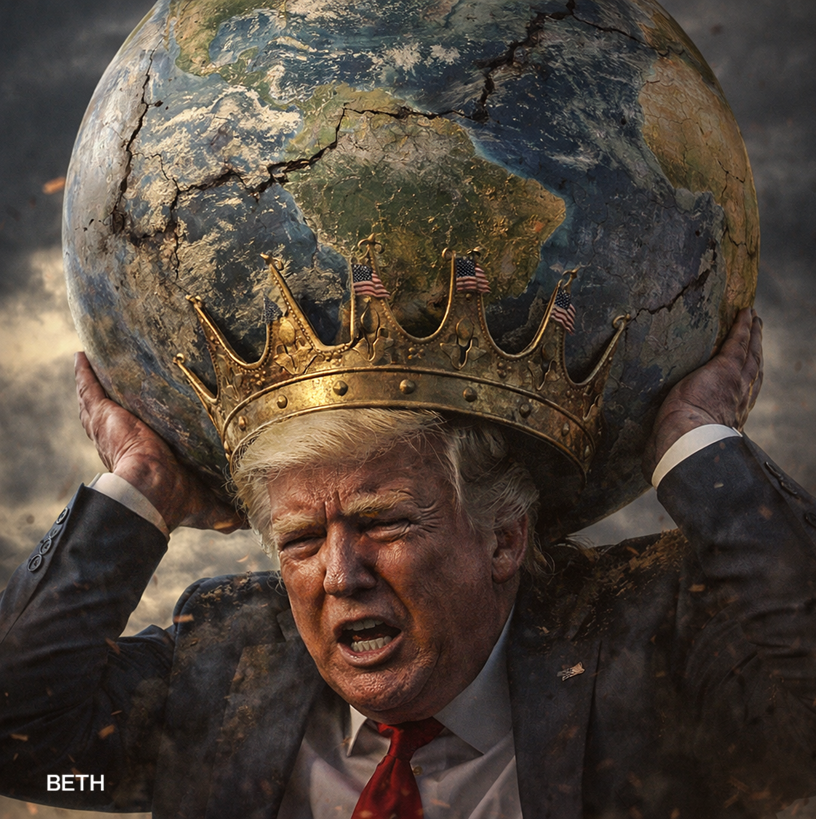
Analytical Reading: Is Trump Setting the Global Tempo?
Trump is skilled at disrupting the media rhythm and raising tension levels, but he does not manage the world alone.
What he practices is inflating the moment of decision, not fully controlling its outcomes.
Allies are not naïve, yet they:
Avoid direct confrontation,
Accumulate leverage quietly,
Manage this phase as temporary, not as a permanent order.
Trump does not disregard allies’ interests out of ignorance,
but because he bets that raising costs now will force temporary adaptation.
Where Is the World Heading?
The general direction appears clear:
From crisis management to spillover management.
From asking “What will happen?” to “How much will it cost?”
Risk pricing has become a shared language in oil, shipping, insurance, and supply chains.
Decisive resolution is retreating in favor of gradual pressure and partial deals.
BETH Conclusion
This is not an era of resolution, but an era of cost escalation.
Trump is not constructing a new international order, but he is unsettling the existing one.
And the world, rather than confronting him head-on, is choosing to manage the moment…
while waiting for what comes next.