



Historic Gold Surge Amid Market Turmoil… Is It Directed?

London | BETH
Gold prices have reached an unprecedented historical milestone, surpassing $5,000 per ounce for the first time, amid escalating geopolitical and economic pressures weighing heavily on global markets. The surge has driven investors toward safe-haven assets as uncertainty deepens across financial systems.
BETH Analysis
This surge does not reflect gold’s strength as much as it exposes fragile confidence in the global financial order.
When gold advances at such a pace, it signals:
Deep anxiety over the trajectory of major economies
Growing fear of imminent political or monetary shocks
A search for assets “outside the system,” immune to rapid policy shifts
Gold is not celebrating — it is warning.
Historical Comparison | When Gold Speaks
Gold’s rise to record levels is not new in itself. It is a recurring language spoken whenever the global system trembles:
2008 Financial Crisis: Gold surged as confidence in banks and markets collapsed, revealing the fragility of complex financial instruments.
COVID-19 Pandemic (2020): Gold climbed again amid supply-chain disruptions and massive liquidity injections unsupported by real production.
Wars and Prolonged Conflicts: Historically, the longer wars persist and political uncertainty expands, the more gold advances as an asset beyond military and monetary power.
The common denominator:
The world does not buy gold out of confidence — it buys gold out of fear.
Critical Reading | The Dollar, Interest Rates, and Central Banks
The current surge coincides with a delicate monetary moment:
The Dollar: While still the world’s reserve currency, mounting U.S. debt and erratic monetary policy have weakened its status as an unquestioned safe haven.
Interest Rates: High rates no longer reassure markets; instead, they signal the difficulty of containing inflation without triggering recession.
Central Banks: Once guardians of stability, they have become reactive players, chasing crises rather than preempting them, following unprecedented balance-sheet expansions over the past decade.
In this context, gold becomes a silent vote of no confidence in prevailing monetary policies — a message that markets seek value beyond printed decisions.
Does Chinese Gold Play a Role in the Record Surge?
Yes — but not through a single market or official announcement.
Rather, through a quiet strategic shift China has pursued for years, accelerating notably in recent months as part of a broader financial realignment.
This role rarely dominates headlines, yet it exerts a profound influence on long-term market direction.
A Shift in Reserve Philosophy
China no longer treats gold merely as a traditional hedge, but as a sovereign instrument to:
Reduce reliance on the U.S. dollar
Strengthen monetary independence
Build flexible financial backing in a multipolar system
In practice:
The People’s Bank of China has steadily increased gold reserves.
Some acquisitions occurred through non-transparent channels, outside open markets — muting media impact while sustaining price pressure.
The result: real, persistent demand without noise.
Physical Gold vs. Paper Gold
China has simultaneously strengthened the role of the Shanghai Gold Exchange, emphasizing physical gold trading over paper contracts dominant in London and New York.
Here lies the turning point:
As demand for physical gold rises, paper markets lose their ability to temporarily contain prices, opening the door to unprecedented price movements.
A Broader Global Intersection
Gold’s momentum is not driven by China alone:
China accumulates quietly
Russia expands reserves
Asian and emerging-market central banks hedge
Global investors reassess their relationship with the dollar and sovereign debt
China is not the sole cause — it is the accelerator of an existing trend.
From Buying Gold to Controlling Its Cycle
China has moved beyond purchasing gold to shaping its entire value chain:
Expanding domestic mining
Enhancing refining capabilities
Securing supply chains
This strategic shift has reduced freely traded global supply, disrupted traditional pricing mechanisms centered in Western markets, and increased volatility — driving further demand for gold as a hedge.
China’s key question is no longer:
How much gold should we buy?
But:
How much control can we exert over gold’s cycle itself?
Is the Price Surge “Directed” Against Chinese Gold?
There is no coordinated decision to raise gold prices to counter China. Markets do not operate that explicitly.
However, in practice:
China has:
Strengthened domestic production
Reduced dependence on Western pricing centers
Used gold as a sovereign tool to dilute dollar dominance
This has created structural distortions in the global gold market.
As prices rise:
Storage and accumulation costs increase
Silent, low-cost buildup becomes harder
Traditional Western markets regain partial pricing influence
BETH Conclusion
When gold breaks historical thresholds, the issue is not price — it is signal.
A signal that the global financial system has entered a new testing zone, where trust outweighs yield, and stability surpasses short-term profit.
China has not abandoned gold.
It has shifted from consumer to producer and cycle-holder — a transformation that has intensified price surges rather than calmed them.
This is not an “attack on China,”
but an undeclared contest between monetary systems,
where gold is no longer a passive asset,
but a quiet battlefield between a world losing faith in the dollar
and another still searching for its alternative.
__________
Reading Images | How BETH Interprets Visuals
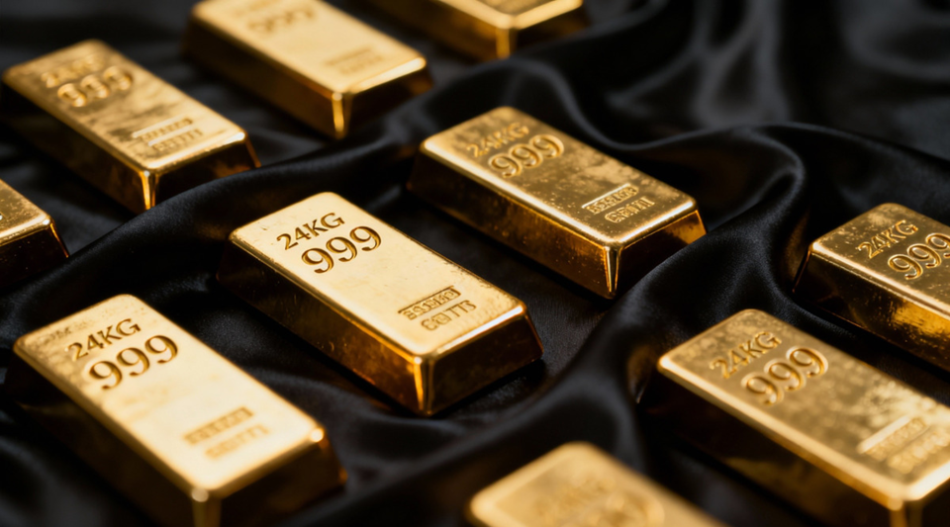
1) Gold Bars | The Image of Silent Power
This image does not speak the language of “economics.”
It speaks the language of sovereignty without rhetoric.
Physical gold = an asset that cannot be printed or borrowed
Gold bars = central banks, reserves, decisions made without press releases
Black fabric = what lies behind the scene: closed rooms, unspoken calculations, the deep game
This image addresses:
Decision-makers
Political power centers
Financial elites who understand that real influence is never announced
It does not persuade.
It signals.
And quietly says:
Someone is reordering the system… without raising their voice.
2) Gold in a Woman’s Hand | The Image of a Market That Cannot Be Controlled
This is an image of global demand beyond politics.
Gold here = inherited trust, instinctive security, social memory
The woman = continuity, society, daily micro-decisions that shape macro-markets
The shine = desire, not policy — and instinct cannot be regulated by interest rates or statements
This image addresses:
The market
Society
Human behavior when it fears, when it trusts, when it preserves
It says:
Even if systems change… gold remains in the hands of people.