



Lessons from History: Why Civilizations Rose… and Why They Fell

Prepared and Analyzed by
Strategic Media Department – BETH News Agency
Introduction
Revisiting history is neither an intellectual luxury nor nostalgia for the past.
It is a tool of awareness—essential for understanding the present and anticipating the future.
The great civilizations that once rose and later vanished were not historical anomalies. They were human models in which patterns of ascent and decline repeatedly appeared, regardless of names or geography.
This report does not treat history as a mere sequence of events, but as a laboratory of ideas—seeking the unwritten laws that shaped power and continuity, and those that silently led to erosion and collapse.
In an era of accelerating political, economic, and technological transformations, reading history becomes a strategic necessity—not only to understand what was, but to comprehend what may come if the same mistakes are repeated.
How Did Great Civilizations Rise? (Drivers of Ascent)
Despite differences in time and place, major civilizations shared common foundations:
1) A Unifying Idea
A civilization without an idea is only temporary power.
That idea could be:
Religious (Islamic civilization)
Legal (Rome)
Philosophical / scientific (Greece)
Organizational / economic (China)
Meaning precedes power.
2) Justice and Order
No civilization endured by force alone.
Law stood above individuals (relatively)
Justice—however imperfect—built trust
When people feel protected by the system, they defend it.
3) Knowledge and Learning
Every rising civilization invested in:
Education
Documentation
Research
Knowledge was a tool of governance, not a luxury.
Ignorance has never built an empire.
4) Flexibility and Adaptation
Successful civilizations:
Changed
Reviewed themselves
Learned from others
They did not live on past glory alone.
Rigidity marks the beginning of the end.
How Did Civilizations Fall? (Erosion and Collapse)
Collapse is rarely sudden.
It is usually slow erosion.
1) Moral Decay Before Structural Collapse
Corruption
Nepotism
Justifying injustice
Double standards
When moral standards collapse, armies cannot save civilizations.
2) Power Becomes the Goal
Power without purpose becomes a burden.
Expansion for its own sake
Repression instead of governance
Power unmanaged by reason consumes itself.
3) Separation Between Rulers and Society
Isolated elites
Marginalized populations
Loss of trust
Civilizations fall not only when people revolt—but when they stop caring.
4) Historical Arrogance
“We are the best.”
“We are the exception.”
“We will never fall.”
Every civilization that said this… eventually did.
The Unwritten Law of History
Civilizations do not die when defeated externally,
but when they decay internally.
Enemies usually exploit weakness—
they rarely create it.
How They Fell
Sumerian Civilization (The Oldest)
Collapsed under internal conflict and resource depletion; the state vanished, the tablets remained.
Pharaonic Civilization
Fell when sanctity turned into rigidity and authority replaced renewal; the state faded, the pyramids endured.
Greek Civilization
Collapsed through internal rivalry and excessive debate over decisive action; the polity fell, the philosophy remained.
Roman Civilization
Collapsed when it expanded beyond sustainability and its core corrupted; the empire fell, the law survived.
Indus Valley Civilization
Disappeared quietly after environmental and economic imbalance; people vanished, planning endured.
Ancient Chinese Civilization (Early Cycles)
Collapsed whenever reform halted within power structures; dynasties ended, philosophy endured.
Ancient Indian Civilization
Declined when social rigidity imprisoned individuals within castes; systems faded, heritage remained.
Mayan Civilization
Collapsed when rituals were sacred and reality ignored; cities were abandoned, ruins survived.
BETH Reading: The Present Moment
History does not repeat itself literally,
but it repeats patterns of collapse.
The greatest threat to any nation today is not:
Lack of resources
External pressure
But:
Declining awareness
Eroding values
Absence of honest self-review
Conclusion
Civilizations are not built by power alone,
nor sustained by wealth alone,
nor saved by technology alone.
They endure through:
A living idea + justice + knowledge + continuous awareness of risk
Those who fail to learn from history are not punished by ignorance—
but by repetition.
Civilizations do not die when defeated,
but when they lose the ability to change.
Final Reflection: When the Present Refuses to Learn from the Past
Great civilizations did not collapse suddenly, nor because they were weak, but because they stopped listening to themselves.
Unchecked power turns into arrogance.
Unmanaged success becomes the start of erosion.
History tells us the true danger does not come only from outside, but from within—when balance is lost:
when reason is replaced by slogans,
values by narrow interests,
and long-term vision by short-term reaction.
In today’s world, where power shifts faster than ever, civilizations are no longer measured by geography, but by depth of awareness, quality of decision-making, and the ability of state and society to adapt without losing identity.
Those who believe civilizations fall only by weapons have not read history well.
Most collapsed when meaning was lost before power.
And here lies the core message:
Learning from the past is not fear of repetition, but protection from entering the same cycle—under new names and different faces.
__________
🔹 Main Image Explanation (The Hourglass)
Overall significance:
Time as a silent judge over civilizations.
Symbolic reading:
The hourglass represents civilization as it passes through two phases:
A slow ascent, grain by grain (building, accumulation, awareness).
Then a silent drain downward (erosion, neglect, stagnation).
The light streaming through the window symbolizes:
Historical opportunities that exist… but do not remain open forever.
The simple surrounding tools (pottery, wood, hand tools) indicate that:
The greatest civilizations began with modest means,
Yet they fell not from lack of resources, but from mismanaging time.
Message:
Civilizations do not collapse suddenly…
They end when time runs out without self-review.
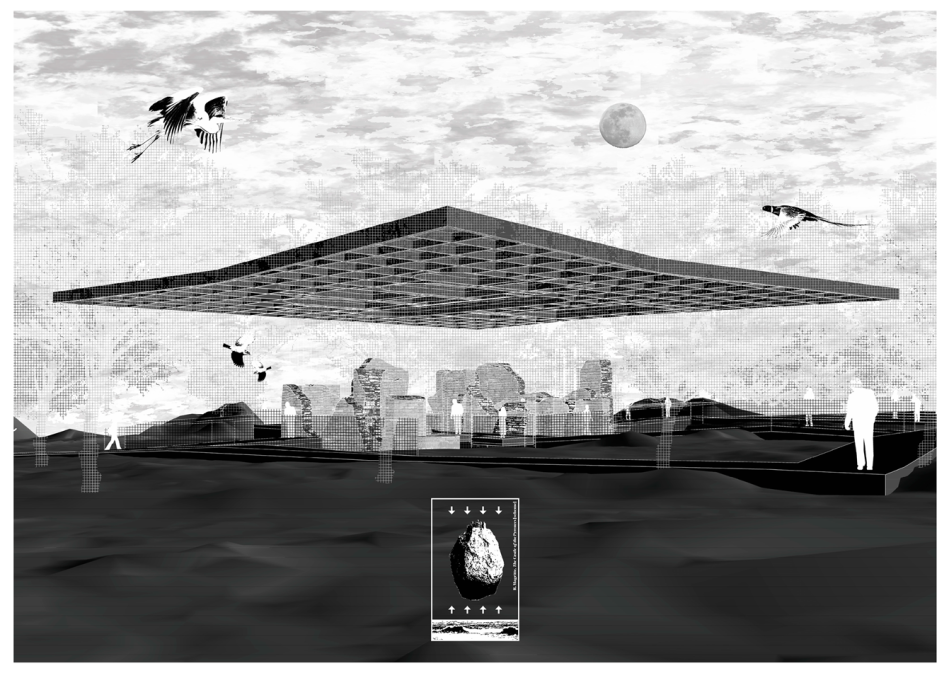
🔹 Inner Image Explanation (The Suspended Platform Above the Ruins)
Overall significance:
The fragility of construction when it detaches from its roots.
Symbolic reading:
The suspended structure represents:
A technologically advanced civilization,
Hanging in midair, without deep ethical or human foundations.
The ruins below symbolize:
Great civilizations that came before,
Believed they had reached the peak… and became memory.
The flying birds suggest:
Free ideas, time, or transformations,
That cannot be confined by any rigid structure, however refined.
The scattered small figures imply:
Human insignificance when one assumes construction alone is enough,
And that form can replace meaning.
Message:
When structure rises above values,
Collapse becomes only a matter of time.
🔹 Visual Integration
The main image: time delivers the verdict.
The inner image: when the idea disappears, neither design nor technology can save it.
Visual conclusion:
History does not judge civilizations by their power,
But by their ability to change before it is too late.
Final line:
Civilizations endure through awareness, justice, and the constant capacity for self-review.
A Lesson from History
History proves that military power and wealth may prolong the lifespan of states, but they do not keep them alive.
When power is not exercised in the service of justice, and wealth is not directed toward construction rather than destruction, their decline becomes inevitable—along with everything they have accumulated.