



Aljadaan from Davos: Sustainability Is Not Austerity… It’s a Smart Decision
Follow-up & Analysis | BETH
Fiscal Sustainability: Redefining the Concept, Not Cutting Spending
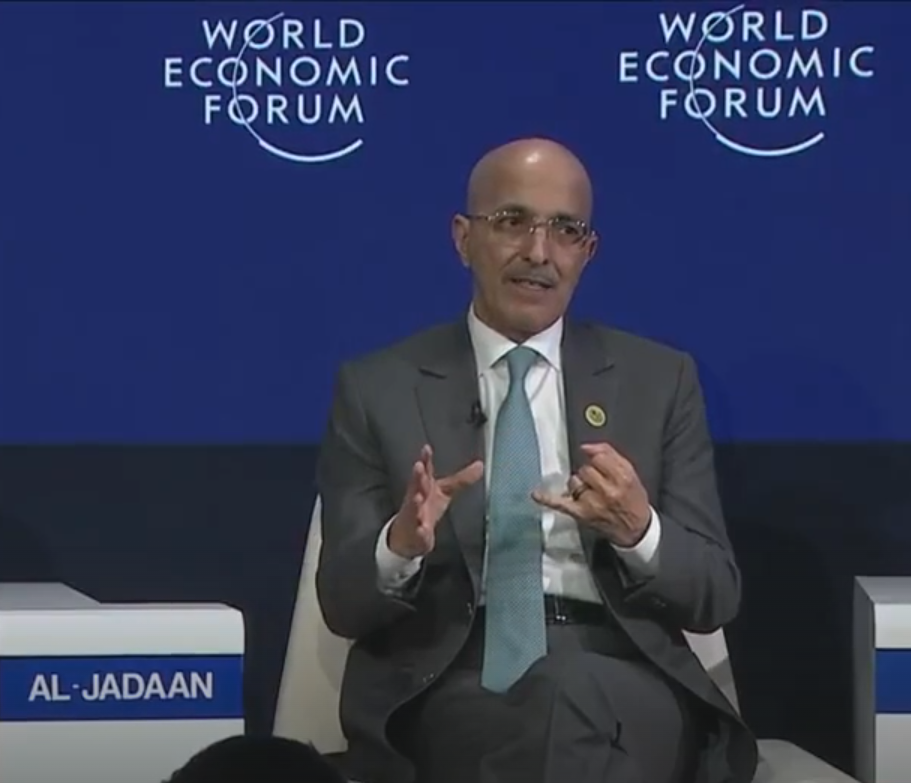
Saudi Minister of Finance Mohammed Aljadaan stated, during his participation at the World Economic Forum in Davos, that fiscal sustainability does not mean cutting spending, but rather directing it intelligently toward sectors and projects capable of delivering qualitative transformation to the economy. He stressed that the Saudi experience has become a rich model offering valuable lessons to countries participating in the forum.
In an interview with Al Arabiya Business, Aljadaan explained that one of the biggest challenges facing economies today is being distracted by media noise at the expense of core issues, calling for a focus on what can be economically controlled and for avoiding distractions that weaken the quality of decision-making.
Monetary Policy and Debt: Reassuring Messages to Markets
The Minister reaffirmed that the Saudi riyal remains pegged to the US dollar, with no intention to change this policy, noting that foreign reserve management is handled by the Saudi Central Bank in line with well-defined investment policies.
Regarding public debt, Aljadaan emphasized that the Kingdom’s national debt strategy is clear and governed by strict ceilings, stressing that the objective is not borrowing per se, but rather the efficient use of debt instruments to support economic growth and long-term sustainability, while keeping debt levels within safe ranges compared to peer countries.
Government Spending: Impact Over Volume
Aljadaan confirmed that government spending is focused on high-impact projects, whether in job creation, productivity enhancement, or strengthening the competitiveness of the Saudi economy, in line with the objectives of Saudi Vision 2030. He noted that the current budget deficit represents a deliberate and calculated decision that supports future growth while safeguarding public finances.
Relations with the United States: Continuity and Confidence
On the international front, the Minister stressed that the US economy remains very strong, and that Saudi investments in the United States continue without any change in strategic direction. He added that discussions with the US government are ongoing to monitor developments in bilateral economic and investment agreements, within a long-term strategic partnership based on mutual interests.
__________
What Did the World Say? | Monitoring the International Echo
Although Aljadaan’s remarks were not always presented as standalone headline stories in Western media, their impact was clearly reflected in global economic coverage and analytical reporting, particularly within investment circles.
US and UK Economic Media – The General Reading
A confidence signal to markets: Aljadaan’s remarks were widely interpreted as evidence that Saudi Arabia is successfully balancing financial stability with development ambition—a rare equilibrium among emerging economies.
Policy clarity: Investment-focused media highlighted that the clarity of the debt strategy and currency peg enhances predictability, a key factor for investors.
Growth without excess: The concept of a “calculated deficit” was understood as a strategic economic management tool, not a sign of fiscal stress.
Institutions and Markets
Aljadaan’s statements reinforced the prevailing narrative in international institutional reports that Saudi Arabia has transitioned from defensive fiscal management to strategic, investment-driven governance.
The emphasis on fiscal discipline strengthened the Kingdom’s image as an economy capable of absorbing global shocks.
BETH Analytical Reading
What Aljadaan delivered in Davos was not aimed at the media as much as it was directed at markets and decision-makers. The core message was clear:
Sustainability is not austerity—it is smart governance of resources.
Saudi Arabia no longer explains why it spends, but rather how, why, and where it spends. This marks an advanced phase of economic management, placing the Kingdom among economies that set the rules rather than merely react to them.
Conclusion
In Davos, Saudi Arabia was not defending its policies—it was presenting a model:
A disciplined economy, targeted spending, managed debt, and growth measured by impact rather than noise.