



Davos 2026… When the Economy Becomes a Language of Political Pressure
Analysis & Follow-Up | Strategic Media Department – BETH News Agency
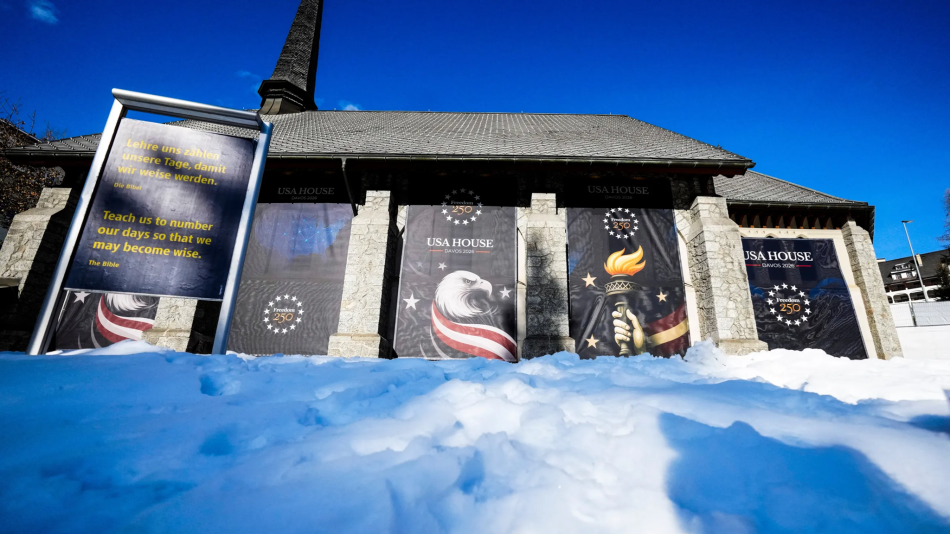
The World Economic Forum – Davos 2026 was not a conventional gathering for discussing growth and sustainability. This year, it emerged as an open arena for a new form of confrontation—one where politics and economics intertwine, and trade is increasingly used as an instrument of pressure rather than cooperation.
Inside Davos, a forum meant to outline the future, anxiety dominated discussions over escalating trade tensions and the return of tariffs as political weapons, alongside intensifying geopolitical disputes—most notably in the Arctic and the Greenland file.
Davos… What Has Changed?
This year, Davos did not revolve around disagreements on how the global economy should grow, but rather on how conflict between major powers is managed.
European leaders and senior economic officials openly voiced concerns that the global economy is becoming hostage to short-term political decisions—driven by deterrence rather than partnership, and pressure rather than dialogue.
The underlying message from Davos was clear:
The economy is no longer a neutral space—it has become a tool of confrontation.
Greenland… Geography Ignites the Debate
In the background of Davos discussions, Greenland surfaced as a vivid example of how security, geography, and economics now overlap.
Danish military reinforcements, explicit European support for the island’s sovereignty, and U.S. signals linking political positions to potential trade measures have turned Greenland into a symbol of a broader struggle:
Who controls decision-making in emerging strategic regions?
This is no longer about an island—it is about:
Future maritime routes
Natural resources
Power balances in a world reshaped by climate change and geopolitical shifts
The Economy Under Threat… Warnings from Inside the Hall
Warnings voiced in Davos were far from theoretical. The real concern centers on:
The return of aggressive trade wars
Fracturing global supply chains
Rising investment costs due to uncertainty
The spillover of market tensions into societies
Tariffs, once framed as negotiation tools, are now widely viewed as sparks for reciprocal escalation that may later prove uncontrollable.
From Trade to Security… The Most Dangerous Link
One of the quieter yet most critical discussions in Davos was this:
Economic pressure rarely remains purely economic.
When markets suffer, governments seek domestic protection.
When resources tighten, conflicts expand.
Here, the economy becomes a gateway to security challenges rather than a separate domain.
The central warning:
Repeated trade escalation risks reproducing political and security crises in already fragile regions—fueling displacement, social instability, and potentially open conflict.
BETH Reading: Davos Reveals What the Final Statements Do Not Say
Beyond official communiqués, Davos 2026 reveals a precise reality:
The world is entering an era of politicized economics.
An era where:
Disputes are not managed through diplomacy alone
Markets no longer function independently
Financial decisions carry geopolitical consequences
The unspoken question present in every session was:
Does the current global system still possess the tools to contain this shift?
Strategic Conclusion | BETH
This year’s Davos was not a forum of ideas—it was a mirror of global anxiety.
A mirror reflecting a world where economics, politics, trade, and security are no longer separable.
What we are witnessing is not a passing crisis, but a redefinition of the rules of the game.
In this context, only states and institutions that possess:
Calm strategic vision
Smart negotiation tools
The ability to distinguish between deterrence and self-destruction
will be able to navigate this phase without compounded losses.
Those who treat the economy merely as a pressure card
may discover—too late—that they have ignited more than they can contain.