



The World on the Brink of Tariffs
Analysis & Monitoring | Strategic Media Department – BETH
Tariffs are no longer merely an economic instrument, nor are global forums the soft dialogue platforms they once were.
Today’s world is witnessing a sharp convergence of economics, sovereignty, and politics, where trade decisions are increasingly transformed into tools of geopolitical pressure, and economic platforms become testing grounds for the international order itself.
Between American threats redefining alliances, European objections sensing an erosion of sovereignty, and a global forum attempting to mend what has fractured, the contours of a more tense—and far less certain—phase are taking shape.
International Tensions Over Trump’s Tariff Threats
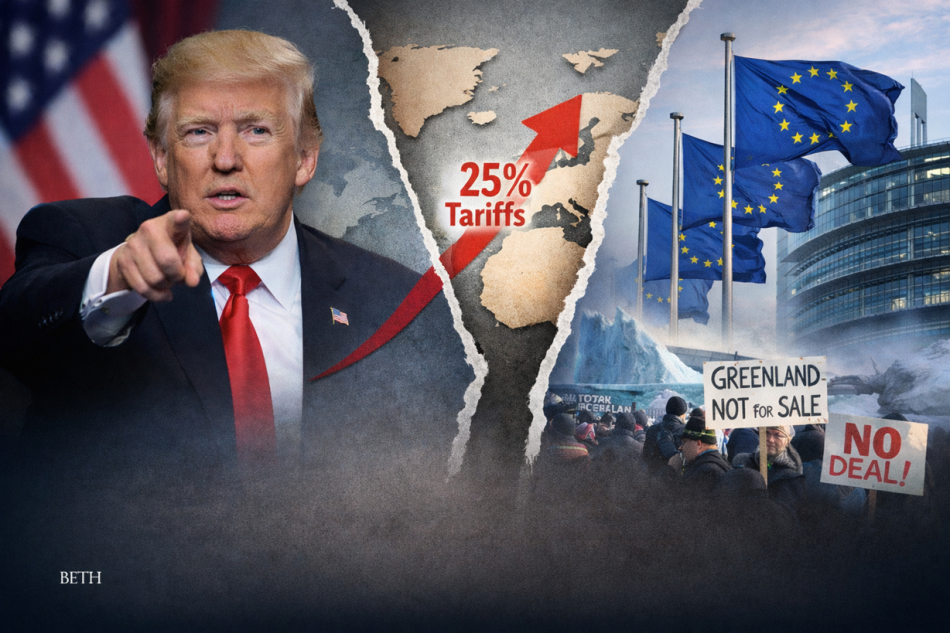
U.S. President Donald Trump’s announcement of his intention to impose tariffs of up to 25% on European countries, unless they support his proposal regarding Greenland, was neither a passing remark nor a conventional pressure tactic.
The message was clear:
Trade is being used as an instrument of political coercion, not merely as a tool of economic negotiation.
European reactions were swift and angry, from Paris to London, viewing the move as one that:
Undermines the rules of international trade
Violates the principle of sovereignty
Pushes transatlantic relations back into a zone of uncertainty
Within Greenland itself, the issue shifted from a geopolitical debate to direct popular rejection of any approach that reduces land and identity to a political transaction.
Why Are Tariffs a Dangerous and Pivotal File?
Because they stand at the intersection of three highly sensitive spheres:
1) The Global Economy
Tariffs of this scale imply:
Disruption of supply chains
Increased pressure on markets
A revival of trade-war dynamics
2) International Politics
The move deepens the rift between Washington and its European allies, opening the door to:
Strategic realignment
Questions over the reliability of traditional alliances
3) Identity and Sovereignty
Greenlanders’ rejection of decisions imposed from above serves as a reminder that:
Sovereignty is not a negotiable clause,
but a political flashpoint when mishandled.
For this reason, the issue has transcended the realm of economic news, becoming an open-ended geopolitical context likely to escalate and demand close monitoring in the coming days and weeks.
Davos 2026… A Platform for Rescue or a Mirror of Crisis?
Amid this charged atmosphere, Davos 2026 convenes with heavy global leadership presence, yet under an unspoken central question:
Is the global economic system still reformable… or are we managing a full-scale crisis of confidence?
The forum addresses:
U.S. trade policies
The war in Ukraine
Middle East repercussions
The future of international cooperation
Yet the real challenge lies not in the number of issues,
but in the absence of consensus over the rules of the game themselves.
This time, Davos is not merely searching for growth,
but for a point of balance in a world where long-held assumptions are rapidly eroding.
BETH Conclusion
What is unfolding is not:
Tariffs…
Nor an economic forum…
Nor a passing political dispute.
It is a hard test of the international system itself:
Is the global economy governed by power?
Is sovereignty still respected?
Can dialogue still contain confrontation?
The answers will not come from statements,
but from what is implemented on the ground.
At this point,
monitoring is no longer a media choice,
but a necessity to understand where the world is heading.
_____
Reading the Image
Economy… Sovereignty… Politics
A Global Triangle of Confrontation