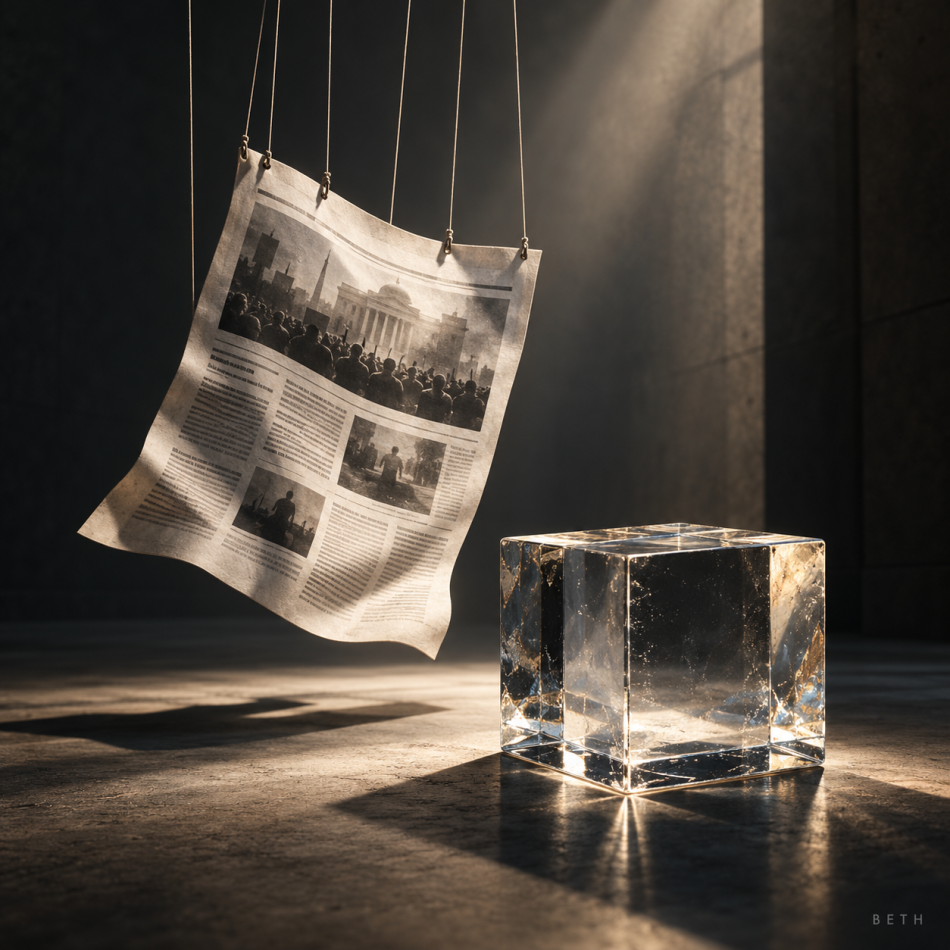



The Calm Before the Storm
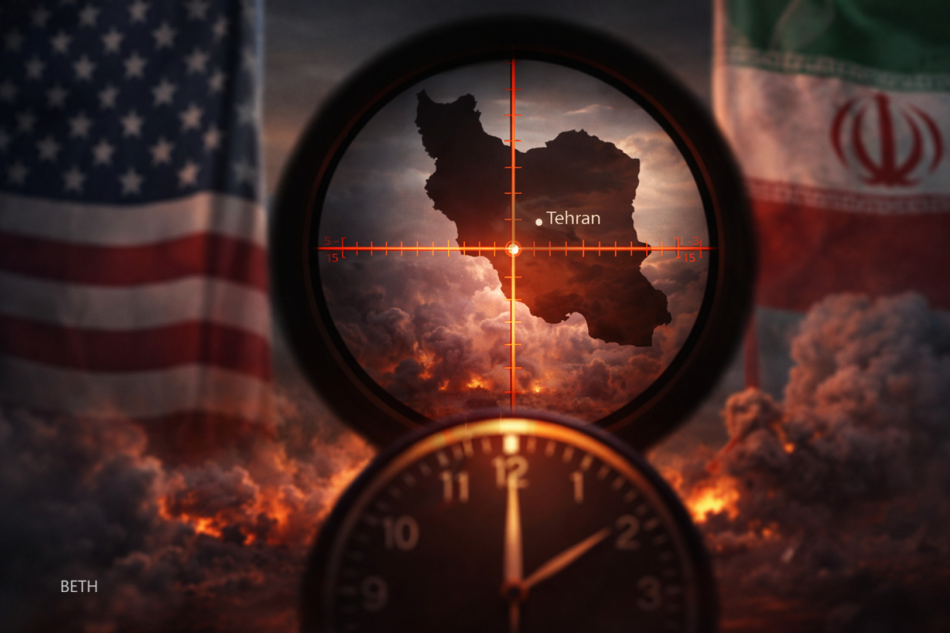
Monitoring & Analysis | Strategic Media Department – BETH Agency
Short Introduction
A softer tone of threat does not mean diminished danger.
In international politics, calculated silence is often more dangerous than declared escalation, because it is managed in planning rooms—not on media platforms. What we are witnessing today regarding Iran is not a retreat of crisis, but a recalibration of timing.
Pre-Shock Indicators (Evidence-Based, Not Rhetorical)
Safety Signals Before the Decision
Travel warnings, diplomatic mission reductions, and maritime security measures are not symbolic gestures. They are taken when multiple intelligence assessments converge on a heightened risk of escalation. These are measures to reduce the cost of surprise, not declarations of war.
Technical Warfare Before Military Action
Navigation interference, airspace readiness tests, and elevated cyber alert levels are tools of the pre-confrontation phase. The objective is not the strike itself, but to paralyze the ability to comprehend and respond if it occurs.
Shift in the European Mood
Moving away from a wait-and-see approach and the rise in calls for broader isolation reflect a growing belief that the cost of leniency now exceeds the cost of pressure. Europe may not lead wars, but it often closes the window of political maneuverability.
Hardening of the Iranian Interior
Whenever the regime senses a shrinking margin of external maneuver, it tightens its grip internally. This is a familiar defensive pattern: militarizing society to compensate for eroding legitimacy.
Indicator Summary:
The scene does not point to an imminent strike as much as it signals that all parties are preparing for multiple scenarios—while deliberately preserving the element of surprise.
The Three Scenarios
Scenario One | Pressure Without a Strike (Most Likely)
Continued multi-layered strangulation:
Deeper sanctions, political isolation, financial and technological constriction, and limited undeclared deterrence operations.
Objective: Restrain behavior, not overthrow the regime.
Who benefits? Actors who fear chaos and prefer a weakened Iran over a collapsed one.
What shifts the balance?
A major incident affecting maritime security or foreign forces, or a sudden nuclear escalation.
Scenario Two | A Limited, Controlled Strike
A tactical response designed to send a deterrent message without sliding into open war.
Objective: Redraw red lines, not open a comprehensive front.
What shifts the balance?
Repeated provocations or a miscalculation that raises the political cost of “non-response.”
Scenario Three | Breaking the Equation (Least Likely)
A broad escalation betting on simultaneous internal fragmentation.
This scenario requires international consensus, a viable “day-after” plan, and a credible internal alternative—conditions that rarely converge.
What shifts the balance?
A sharp split within the ruling elite, or accelerated economic/social collapse that strips the regime of its control mechanisms.
The BETH Reading: Who Truly Defends the Regime?
The real defenders are not those who justify its behavior publicly, but those who benefit from the continuation of chaos:
shadow economies, smuggling networks, actors who fear a vacuum, and extremist forces that thrive on the existence of an “absolute enemy” to justify their own policies.
Here emerges the functional symbiosis between extremisms:
each escalation by one side grants the other a renewed rationale for survival.
BETH Conclusion
What we are witnessing is neither a peace truce nor a confirmed prelude to war.
It is a managed tension, conducted with precise tools—where noise is replaced by calculation, and threats by positioning.
Purpose of this analysis:
To enable the reader to understand what unfolds beneath the calm—
before reality imposes its own interpretation.