

Iran on the Brink of Collapse
Strategic Briefing | BETH Global Analysis
January 12, 2026
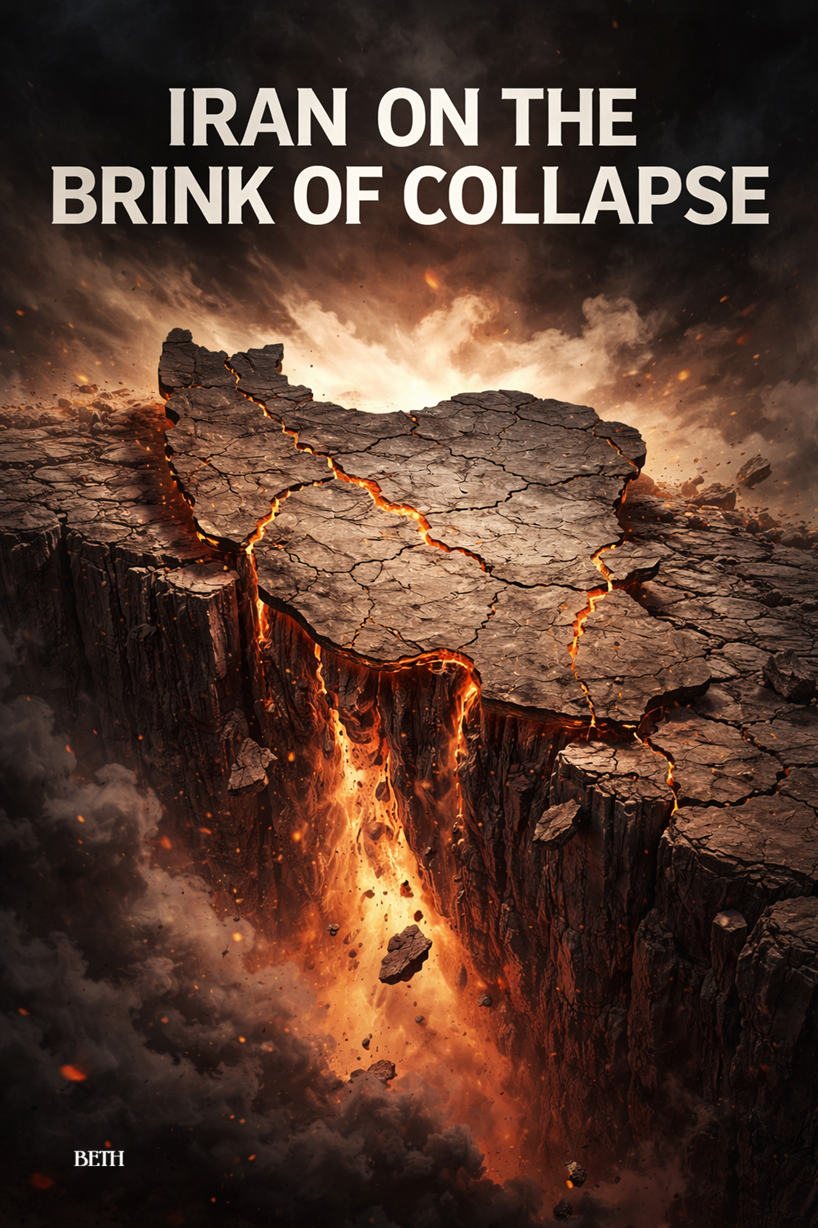
Iran is experiencing its most intense wave of internal unrest in years, as protests that began in late December over economic hardship have evolved into a nationwide challenge to state authority.
Demonstrations have now been reported across Tehran, Kurdistan, Baluchestan, and major industrial cities, with growing indications that the unrest is no longer limited to socio-economic grievances but has entered a deeper political phase.
Security forces have responded with heavy force, including live ammunition, mass arrests, and a near-total shutdown of internet and mobile communications in large parts of the country. The information blackout has made independent verification difficult, but multiple regional and international sources describe a rapidly deteriorating internal situation.
From Economic Protests to a Crisis of Legitimacy
What began on December 28 as demonstrations against inflation, unemployment, and declining living standards has gradually shifted into a broader rejection of the governing system.
The scale and geographic spread of the protests suggest that the issue is no longer local or sectoral. Instead, Iran appears to be facing a structural challenge to its political model.
The government maintains that the situation is “under control” and has accused foreign powers of fomenting unrest, warning the United States and Israel against interference. At the same time, pro-government rallies have been organized in several cities, underscoring the country’s deep internal polarization.
State Power Under Pressure
The government’s reliance on executions, mass detentions, and communications blackouts is widely interpreted by analysts as a sign of stress rather than strength.
In authoritarian systems, such measures typically indicate that traditional tools of persuasion and limited accommodation have failed, leaving coercion as the primary remaining instrument of control.
The prolonged internet shutdown is particularly significant. It not only disrupts protest coordination but also isolates the country from external scrutiny, creating conditions in which internal escalation can occur with little real-time visibility.
Women at the Center of the Movement
One of the most striking features of the current unrest is the prominent role played by women.
Across multiple provinces, women have been visible in frontline protests, organizing networks, and digital documentation before the communications blackout. This has transformed the uprising into a broader cultural and generational confrontation with the state, not merely a political dispute.
For many observers, this dimension makes the current movement fundamentally different from earlier waves of dissent.
Organized Networks Inside the Protests
Reports indicate the presence of structured activist networks operating inside Iran, including groups associated with opposition organizations such as the People’s Mojahedin Organization of Iran (MEK).
While these networks appear to be playing a role in mobilization and coordination, the protest movement itself remains broader and more diverse, encompassing students, workers, ethnic minorities, and urban middle-class communities.
This diversity complicates any attempt to frame the unrest as being driven by a single political faction.
International Reactions: Concern Without Commitment
Western governments, including Canada and several European states, have issued statements condemning the use of lethal force against demonstrators and calling for restraint.
However, international responses remain limited to diplomatic pressure. There is little indication so far of concrete measures that would significantly alter Tehran’s calculations.
Many governments remain wary of the risks associated with instability in a major regional power without a clearly defined political alternative.
Strategic Outlook
Iran now faces one of three broad trajectories:
Temporary containment through force, at the cost of long-term legitimacy.
Prolonged instability, with recurring cycles of protest and repression.
A deeper political rupture, in which the current governing model is no longer sustainable.
What is already clear is that the psychological barrier of fear has been breached. Once that threshold is crossed, political systems rarely return to their previous equilibrium.
BETH Assessment
Iran is no longer dealing with a protest wave.
It is confronting a crisis of state identity.
The question being asked in the streets is no longer about wages or prices, but about who has the right to rule — and on what basis.
That is the most dangerous moment for any political system.