



What Is Happening in the Region? Israel Between Positive Normalization and the Risk of Regional Disorder
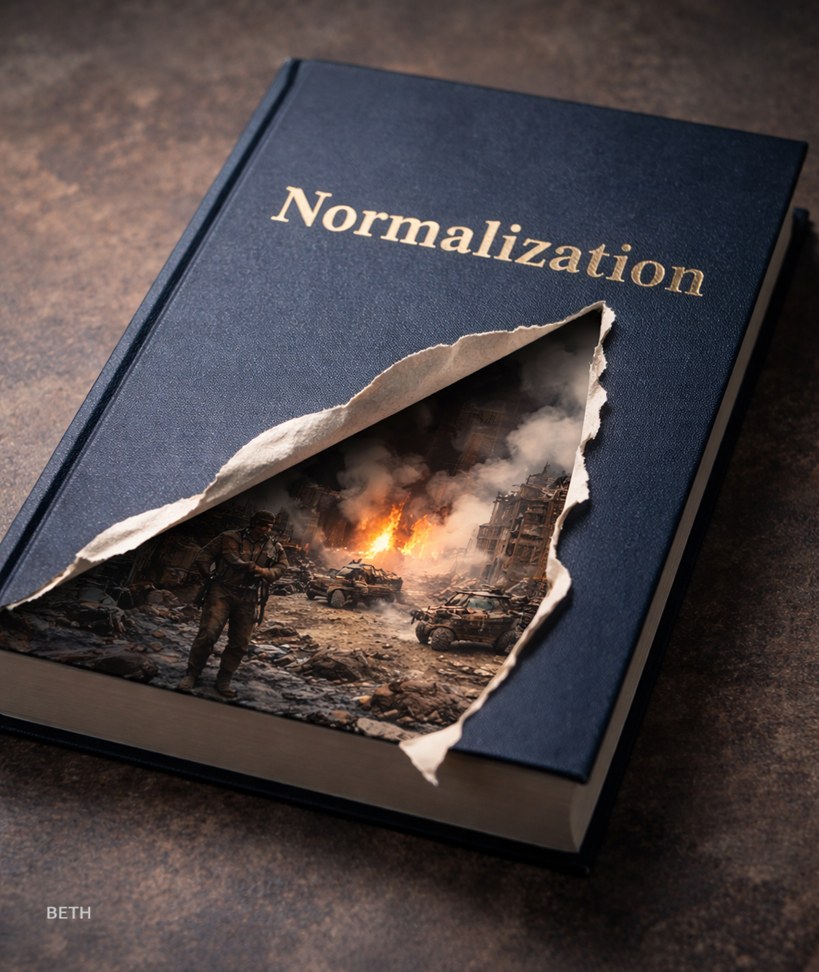
Briefing, Analysis & Assessment | Strategic Media Department – BETH News Agency
The region is undergoing a phase of repositioning rather than comprehensive re-engineering—a critical distinction.
Simultaneous developments (armed conflicts, economic crises, internal fragmentation, and international competition) have created a fluid environment in which all actors—Israel, Iran, Turkey, the United States, and Arab powers alike—are seeking to optimize their position within a shifting landscape, not redraw the map from scratch.
Within this context, Israeli–Arab relations, often framed under what is termed the “Abrahamic” framework, appear as part of a broader regional equation shaped by security concerns, influence, economic interests, and the cost of prolonged conflict.
How Does Israel View Its Relationship with the Arab Neighborhood?
Israel’s strategic mindset can be understood through three overlapping circles:
A) Direct Security
Reducing the likelihood of conventional warfare
Establishing deterrence, early-warning mechanisms, and security cooperation where possible
B) Breaking Isolation
Shifting Israel’s status from an “exception” to a “normalized actor”
Moving the conflict from questions of legitimacy toward the management of disputes
C) Economy and Technology
Opening markets and investment opportunities
Expanding technological and knowledge exchange
Building networks of mutual interest that make disengagement costly for all sides
These dynamics do not inherently reflect “good” or “bad” intentions; rather, they represent state behavior aimed at securing the best possible position in an unstable regional environment.
What Kind of “Abrahamic Framework” Does Tel Aviv Seek?
This is the core question. The “Abrahamic” concept does not operate on a single level, but across multiple layers:
Level One: Relations-Based Abrahamic Framework
Formal diplomatic ties, trade, travel, cooperation, and security coordination.
Level Two: Narrative-Based Abrahamic Framework
A shift in regional discourse—from conflict toward coexistence and tolerance.
Level Three: Structural Regional Abrahamic Framework (Most Critical)
The integration of Israel into wider regional arrangements—security, economic corridors, energy, and infrastructure—so that it becomes part of the regional stability equation, rather than an external actor.
Public skepticism in Arab societies often emerges when narrative-level normalization is presented as a substitute for tangible political or security outcomes, or as a replacement for unresolved conflict files.
The Arab Public Question: “What Has Been Achieved?”
This question is legitimate, as normalization is assessed through two distinct lenses:
State-Level Assessment
Economic interests
Technological cooperation
Security understandings
Containment of specific conflict files
Public-Level Assessment
Have wars declined?
Has stability increased?
Has daily life improved?
Has the Palestinian issue advanced or de-escalated?
The gap between these two perspectives creates a space often filled by doubt, exaggeration, or accusations.
Sudan and Yemen: Does Israel Have a Role, or Are Accusations Exaggerated?
Precision is essential here.
Sudan and Yemen represent long-standing arenas of internal and regional complexity, characterized by:
Local power struggles
Institutional fragmentation
Multiple regional interventions
War economies and arms networks
Like other actors, Israel may seek to manage risks, exploit opportunities, or improve strategic positioning.
However, attributing these crises to a single external actor weakens serious analysis.
BETH’s calibrated formulation:
“Multiple powers—including Israel—may have intersecting interests, but interpreting the crises of Sudan and Yemen as the result of a single actor oversimplifies reality and replaces analysis with narrative.”
**Does Israel View Disorder as a Security Guarantee?
And Where Do Normalizing States Stand in This Equation?**
Realist security theory suggests that some states may prefer weakened neighbors as a buffer.
Yet deeper strategic thinking reaches the opposite conclusion:
Disorder generates threats that are difficult to control.
Thus, the more accurate question is not whether Israel seeks disorder, but rather:
Can Israel bear the cost of disorder if it emerges—and can it effectively manage its consequences?
Here lies a critical paradox:
Prolonged instability risks producing new generations that are more radicalized, more hostile, and less containable.
Is Regional Reshaping Easy for the United States and Israel?
Most likely: No.
For two reasons:
The region is not a chessboard controlled by a single player
Local actors possess independent interests and agency
What is feasible is repositioning—forging agreements, establishing economic corridors, and neutralizing select risks.
Comprehensive regional redesign, however, requires rare historical conditions.
Where Does BETH Stand? (A Balanced Strategic Conclusion)
Normalization is a political instrument, not a moral guarantee
Israel, as a state, seeks security, influence, and regional integration—consistent with state logic
Some security strategies may aim to weaken or neutralize adversaries, but disorder is rarely a sustainable or intelligent option
Crises such as Sudan and Yemen are too complex to be attributed to a single external actor
The key regional question is not “Who is to blame?”
but rather: What makes certain arenas structurally vulnerable to ignition in the first place?
Because internal fragility is what ultimately enables external influence.
Closing Question of Awareness
If the Arab citizen asks, “What is Israel’s role?”
The parallel question that must not be overlooked is:
What made parts of the region structurally fragile enough to become arenas for proxy conflict?
Here begins analysis that serves awareness—not anger.
Conclusion | BETH
Policies of fear and intimidation may succeed temporarily,
but they fail strategically.
What proves more effective is managing awareness, not breaking will.
Smart transparency lasts longer than coercion,
and partnership in meaning produces stability—not a delayed explosion.
And in the logic of states and societies:
Those who convince people do not need to frighten them.