



Iran | Protests and Internet Shutdown From a Cost-of-Living Crisis to a Test of Legitimacy
Analysis | BETH
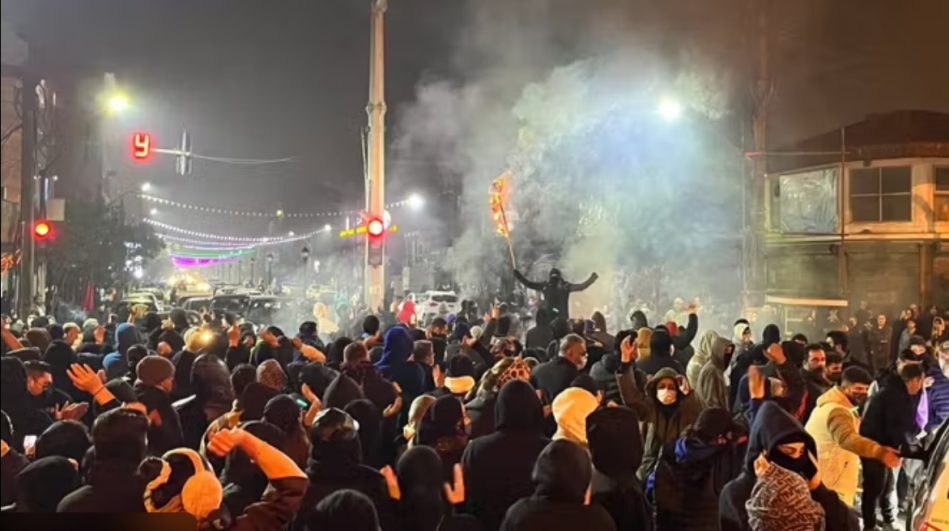
The Iranian scene can no longer be read as a conventional economic protest alone. What is unfolding represents a complex phase of internal tension, where economic pressure intersects with political legitimacy and a battle over narratives. At the heart of this escalation stands the internet shutdown—not as a technical measure, but as a political tool aimed at disrupting coordination and preventing a unified narrative.
What Iran is experiencing today defies a single definition.
It is neither a fleeting outburst, nor a completed revolution, nor merely an economic downturn.
It is a convergence of accumulated pressures that has reached a sensitive threshold—one of its clearest indicators being the management of the digital space.
What is happening?
Current protests display features distinct from previous waves, most notably:
Irregular geographic spread
Strong participation from economically strained youth segments
A shift from demand-based slogans toward broader rejection
Rapid security intervention to contain the narrative before the streets
These indicators do not necessarily signal an imminent turning point, but they do reflect a state of internal exhaustion that is beginning to exceed traditional containment mechanisms.
Why now? (The roots of the moment)
1) The economy as a silent pressure
Inflation, shrinking incomes, and blocked opportunities are no longer absorbable through official rhetoric.
Protest here is not a call for improvement, but an expression of eroded confidence in the possibility of improvement.
2) A legitimacy gap with a new generation
The post-revolution generation does not operate under a sense of “historical debt.”
It evaluates performance through present realities, not inherited narratives.
3) External conflicts reflecting inward
The cost of regional policies has become a legitimate internal question:
Why are battles managed beyond the borders while the domestic front deteriorates?
4) Fear of synchronization
Authorities fear not protests per se, but synchronization:
multiple cities, one narrative, one moment.
This fear explains the decision to cut internet access.
The internet shutdown: what does it really mean?
It is not a technical decision, but a political message aimed at:
Breaking coordination
Preventing a unified narrative
Isolating the الداخل from the outside
Experience shows, however, that such measures may slow protest momentum, but rarely eliminate the structural causes behind it.
How are external analyses interpreted?
Amid these developments, several external political readings have emerged, including an article by Abdulrazzaq Al-Zarzour, a Syrian lawyer and human-rights activist, which argues that the situation has moved beyond protest toward what he describes as “structural targeting” of the system.
BETH’s professional assessment:
These analyses reflect an opposition perspective and a heightened rhetorical tone
They contain definitive conclusions regarding organization, leadership, and alternatives
They do not represent a consensus-based or neutral assessment
What can be utilized without endorsement:
Noting the evolution of pressure tools such as strikes
Highlighting the psychological impact of fear erosion
Understanding how events are perceived outside Iran, not only within
Terms such as “collapse,” references to a “ready alternative,” or naming specific factions remain the author’s views and do not represent BETH’s position.
Pressure tools and their impact
Strikes
If they expand, strikes could become a significant escalation factor, shifting pressure from the streets to economic circulation, thereby raising the cost of containment.
Psychological impact
When the state’s ability to manufacture fear diminishes, fear itself becomes fragile—a critical element in the sustainability of prolonged protest movements.
The international dimension
International engagement with Iran oscillates among three primary files:
Human rights
Regional security
The nuclear dossier
Human-rights concerns are often used as political leverage, but they do not consistently translate into a unified international stance supporting direct political change, as interests and balances vary across capitals.
What comes next? (Realistic scenarios)
The most likely short-term scenario
Localized security containment
Gradual restoration of internet services
Limited economic and media de-escalation
A temporary success without structural resolution.
The mid-range scenario
Less dense protests
Greater mobility and adaptability
Unpredictable timing
A pattern that is more exhausting for the state.
The deeper, long-term risk
Even if streets quiet down, trust erosion between society and the state persists—an issue that cannot be resolved through security measures alone.
Conclusion | BETH
What is unfolding in Iran cannot be reduced to a single headline.
It is a blend of economic fatigue, a legitimacy gap, narrative conflict, and a state wary of a connected street.
And while cutting the internet may temporarily halt the flow of information,
it rarely halts the flow of causes.
— BETH