


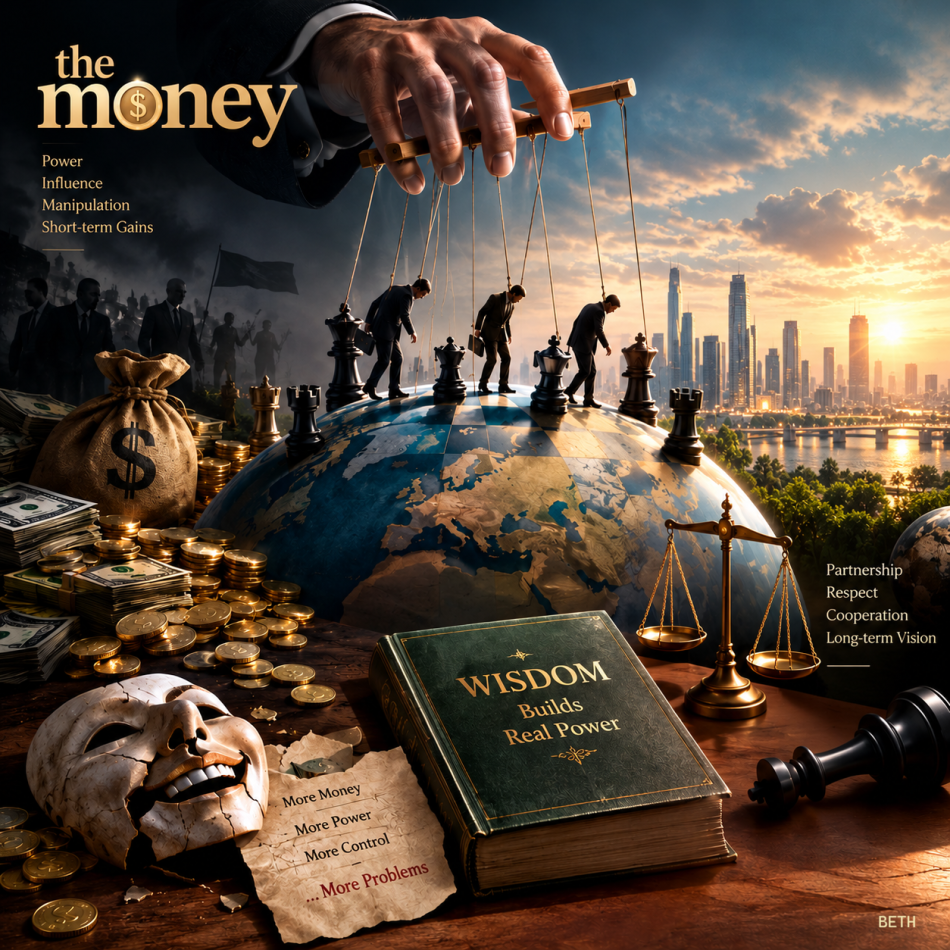
Which Comes First: Politics or Economics?… And Which Attracts the Other: Advertising or News?
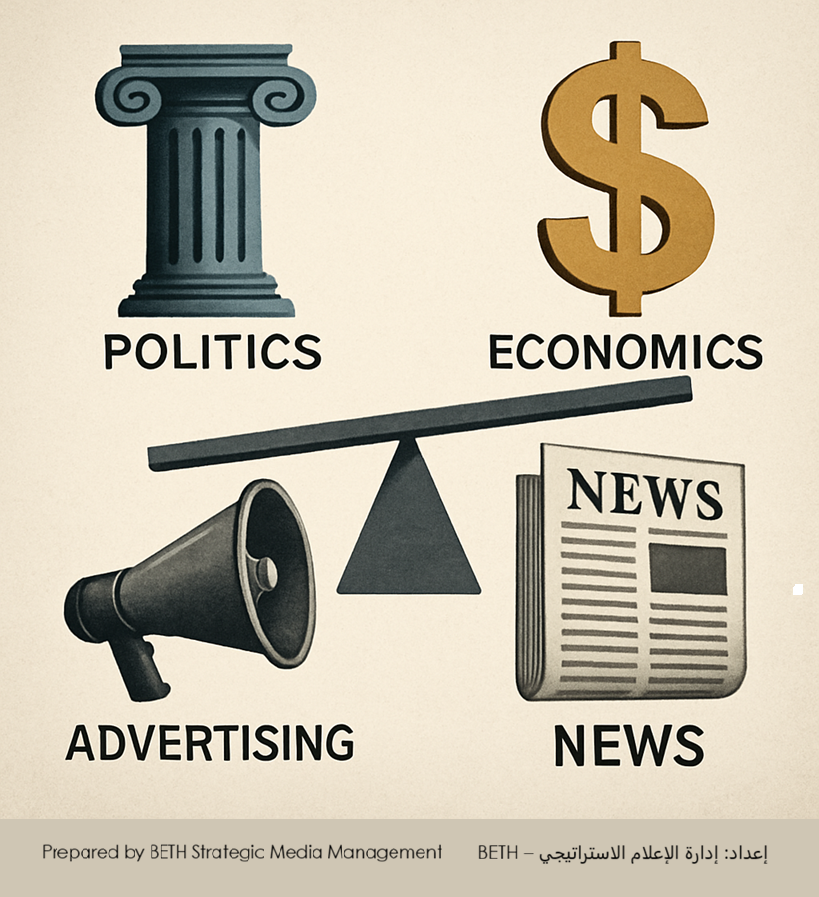
A Deep Analytical Perspective – Prepared by the Strategic Media Department at BETH
What connects two questions from two different worlds?
At first glance, the questions seem unrelated:
Which comes first: politics or economics?
And which attracts the other: advertising or news?
But the truth is—they revolve around one core idea:
Who drives influence… and who shapes the equation?
Politics ↔ Economics
Advertising ↔ News
These are not parallel races, but intertwined circles of influence:
A moment when politics leads.
A moment when economics dictates.
A moment when news commands respect.
And a moment when advertising buys the path—but never buys awareness.
They belong under one title because:
It is the same question… in two different fields.
First: Which Comes First — Politics or Economics?
Does politics lead economics…
or does economics ultimately pull politics by the collar?
This is not a theoretical debate—
it is a practical question for every country, every investor, every media analyst:
Where does the story begin?
Who holds the “start button”?
1) The illusion of a race
It is not a straight line:
Politics → Economics
or
Economics → Politics
It is a circle of mutual influence:
Politics sets the framework (laws, stability, alliances).
Economics applies pressure (jobs, prices, markets).
Every major political decision carries an economic calculation.
Every real economic leap is born from a political door opened or closed.
2) When politics leads economics
Politics moves first in transformative moments:
National visions
Reshaping international relations
Major structural reforms: privatization, taxes, deregulation
Politics creates the environment…
Economics responds to it.
3) When economics dictates the rhythm of politics
Once the wheel starts turning:
Unemployment
Inflation
Strategic investments
Shifts in global markets
Numbers force political decisions to adapt.
4) In the Gulf—who truly leads?
In Saudi Arabia:
Politics launched the economic transformation:
Vision 2030, restructuring, massive investments, and megaprojects.
But economics became a pillar of political stability:
Jobs
Growth
Cross-border projects (like the Riyadh–Doha high-speed rail)
Global investment influence
The outcome:
Strategic leadership that turned economics into a full partner—not a passive follower.
5) What matters for the media?
For BETH, the question isn’t “Who comes first?”
but: How do we explain the interaction to the public?
Shallow media looks for a single “hero.”
Analytical media sees a chain:
Politics → Economy → Society → New political adjustments.
BETH Insight
Politics may push…
Economics may pull…
But the one that truly leads is the strategic mind that manages both.
Second: Which Attracts the Other — Advertising or News?
In a world drowning in platforms and screens, the real question is:
What drives influence today?
1) Advertising without news… is noise without ground
Advertising needs:
Audience
Trust
Content
Context
A platform without credible news becomes a beautiful but empty billboard.
Classic equation:
News builds the audience…
The audience attracts advertisers.
2) And news without an economic model… is incomplete influence
High-quality content without a viable model equals short-lived impact.
News attracts—
but smart advertising sustains.
3) Who attracts whom today?
There is no longer a one-way arrow.
It is a triangular network:
Content → Trust → Business Model
Good news attracts quality audiences.
Quality audiences attract intelligent advertisers.
Smart advertisers reinvest in content—if they don’t break trust.
When advertisers attempt to control the news,
both sides eventually lose.
4) Where does the BETH style stand?
BETH sees advertising as a conditional partner:
Allowed only when it doesn’t corrupt the narrative.
Must respect the reader’s intelligence.
Supports content… never hijacks it.
BETH Insight:
Advertising may fill the screen,
but what stays in memory is the truth of the content beside it.
**Harmony or Tension?
Advertising & Economics… Journalism & Politics**
**Advertising ↔ Economics:
Who creates whom?**
Advertising is the language of the market.
Economics is the stage where that language plays.
Economics produces the product and purchasing power.
Advertising produces desire and perception.
An economy without advertising is an economy without light.
Advertising without an economy is desire without purpose.
**Journalism ↔ Politics:
Who controls the narrative?**
Politics produces events.
Journalism produces meaning.
Politics holds executive power
Journalism holds narrative power
Politics moves facts… journalism moves minds.
BETH Conclusion — A Focused Insight
In each pair:
Politics ↔ Economics
Advertising ↔ News
Neither truly precedes the other.
Their influence becomes complete only when both interact.
Economics may drive markets… but advertising drives behavior.
Politics may govern nations… but journalism governs awareness.
The shared truth:
No field survives by leading alone.
Real influence is the product of complementary forces—not competing ones.