



When Riyadh Creates a Global Day… Women at the Heart of Industry, Not on the Sidelines of Celebration
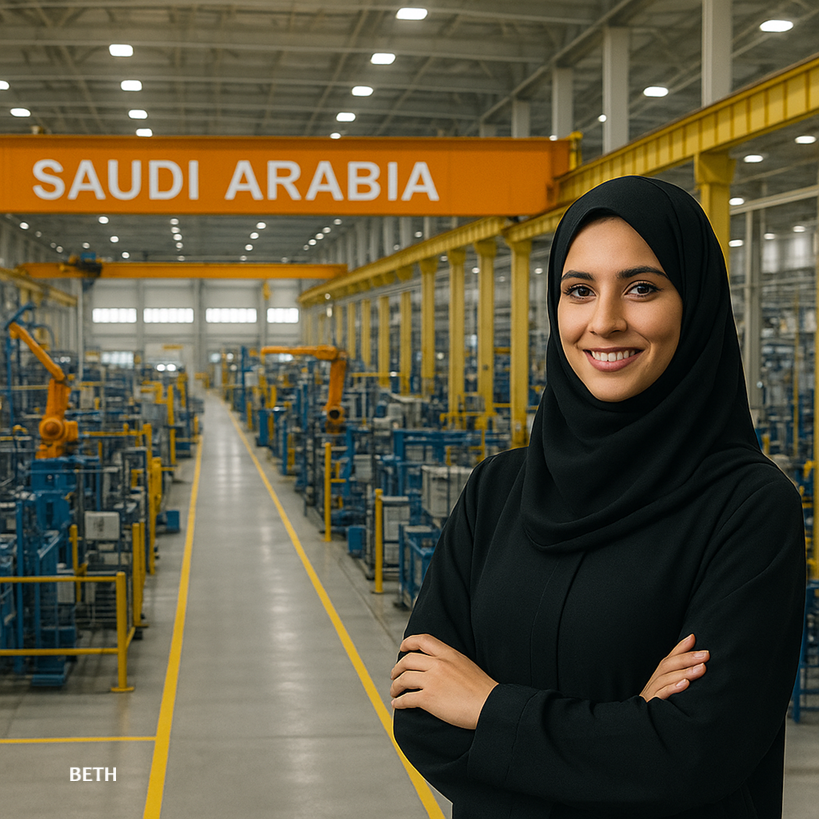
📊 Analytical Report – BETH
Introduction
Hosting the United Nations Industrial Development Organization (UNIDO) Conference in Riyadh was far from an ordinary item on the international calendar. The conference became a platform through which the Kingdom shaped a historic decision that will stand as a global milestone: the adoption of April 21 as the International Day of Women in Industry.
A decision born in Riyadh but addressed to the entire world — carrying a message far deeper than a ceremonial “celebration”:
The era of women working on the sidelines has ended.
With this step, the Kingdom redefined the role of women in the industrial sector — a sector long dominated by the stereotype that it belongs exclusively to men. Today, Saudi Arabia opens the door to a new phase in which empowering women becomes a structural pillar of a broad economic transformation aligned with Vision 2030 and the state's shift toward a diversified, production-based economy.
1. How Riyadh Transformed the UNIDO Platform into a Global Symbolic Engine
The significance of establishing the “International Day of Women in Industry” lies not only in its timing or place of approval, but in the symbolism of its announcement from Riyadh at a moment when the Kingdom is securing a leading position in shaping the future of global industry:
Advanced factories driven by technology,
Major investments in supply chains,
A competitive industrial footprint on the global economic map,
And an ascending sector led by a new generation of national talent.
Declaring this day from Riyadh sends a clear message:
Saudi Arabia does not merely participate in international decision-making… it helps shape it.
The Kingdom has leveraged its rising industrial presence to generate a new global narrative on women — a narrative centered not on courtesy or symbolism, but on tangible presence in factories, laboratories, tech companies, and production management.
2. Saudi Women: From the “Professional Margin” to the “Core of Industry”
Historically, women’s presence in Arab industry was limited to narrow or simplified roles. Yet what Saudi Arabia is witnessing today is nothing less than a structural transformation, not a cosmetic adjustment:
1. Real presence in vital industrial environments
Advanced metals and energy factories
Intelligent production lines
Industrial innovation centers
Product development labs
Industrial human resources
Executive leadership in major companies
2. Strong participation in new and emerging industries
Advanced technologies
Green hydrogen solutions
Pharmaceutical manufacturing
Semiconductor production
Industrial robotics
AI-linked industrial sectors
3. Direct impact on productivity — not “corporate decoration”
Women’s presence is no longer symbolic; it has become a value-adding force. This is reflected in Ministry of Industry data, technical training programs, and an industrial labor market increasingly attractive to women.
3. Technical Education… The Bridge That Redefined Women’s Place in Industry
Key transformations enabling this shift include:
Expansion of engineering and technical colleges for women
Introduction of advanced industrial and energy programs
Support for technical career pathways
Development of industrial-focused scholarship programs
Partnerships with global companies to train women in specialized fields
Saudi women have moved from “traditional study areas” into advanced industrial education tracks, making their presence in factories a natural progression, not an exception.
4. How This Decision Elevates Saudi Arabia’s Global Image
1. A new form of soft power
Positioning women within industry — not as a social issue but as an economic force — elevates the global narrative surrounding Saudi Arabia.
2. Strengthened influence within international institutions
Riyadh has shifted from being merely a “host,” to becoming an active shaper of agendas and priorities within global organizations.
3. Reinforcing the Kingdom’s identity as an emerging industrial power
The decision reflects a national transition from an oil-dependent economy to one fueled by:
Industry
Technology
Innovation
Human capital
5. What Does the ‘International Day of Women in Industry’ Mean for the World?
The decision signals to the world that:
Industry is not the domain of men alone.
True empowerment begins on production floors, not on ceremonial stages.
Industrial transformation cannot succeed without expanding women’s participation globally.
Economic and climate challenges demand diversified workforces — with women as a critical pillar.
Thus, April 21 becomes a reminder that industrial development cannot be complete without half of society.
Conclusion: Riyadh Is Not Launching a Global Day… It Is Launching a Global Path
This global day is not a symbolic gesture from Riyadh to the world.
It is a statement:
Industry is no longer exclusive to any group.
Global competition in manufacturing cannot be won without women’s skills.
Saudi Arabia, through its new vision, is not reacting to global changes — it is leading them.
A decision originated in Riyadh…
But it will echo across the world as an economic, social, and industrial transformation.
A transformation through which Saudi Arabia declares:
We are not celebrating women — we are placing them at the heart of shaping the future of industry.