



G20 Summit in South Africa… A World Facing a New Test
📍 Johannesburg – BETH
The G20 Leaders’ Summit opened today in South Africa, bringing together the heads of the world’s largest economies at a moment defined by economic uncertainty, geopolitical tensions, and the urgent need for a shared vision to secure global stability.
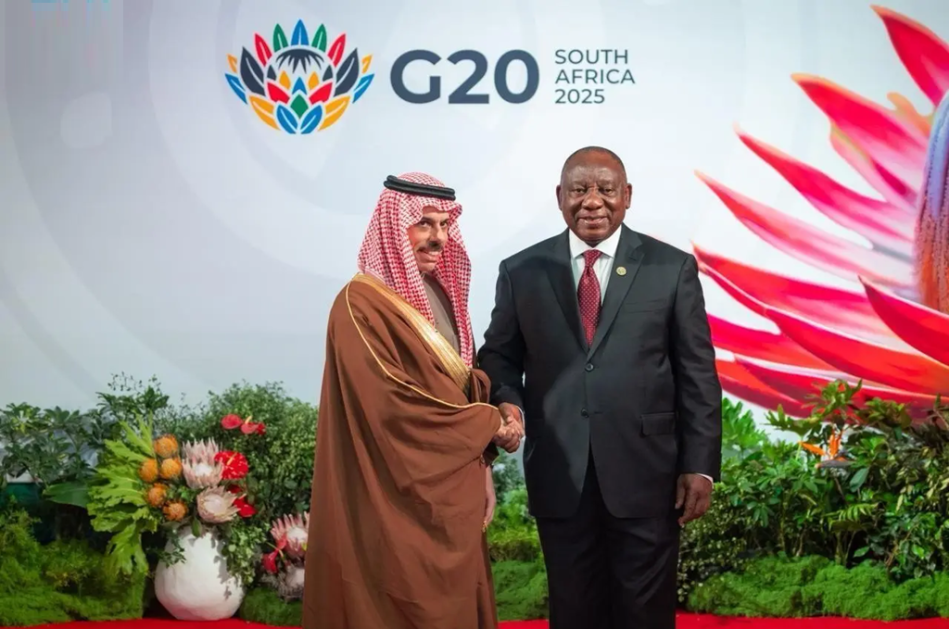
Saudi Arabia Participates in the G20 Summit in Johannesburg, Led by the Foreign Minister on Behalf of the Crown Prince
On behalf of His Royal Highness Prince Mohammed bin Salman bin Abdulaziz Al Saud, Crown Prince and Prime Minister — may God protect him — His Highness Prince Faisal bin Farhan bin Abdullah, Minister of Foreign Affairs, headed today the Kingdom’s delegation participating in the opening session of the G20 Leaders’ Summit held in Johannesburg, Republic of South Africa.
The summit was inaugurated by H.E. President Cyril Ramaphosa, President of South Africa, who emphasized in his opening remarks the importance of strengthening multilateral cooperation to address pressing global challenges — foremost among them global economic stability, and energy and food security.
The session was attended by H.E. the Minister of Finance, Mr. Mohammed bin Abdullah Al-Jadaan, and H.E. the Saudi G20 Sherpa, Deputy Minister of Finance, Mr. Abdulmohsen bin Saad Al-Khalaf.
This year’s summit convenes under the theme:
“Inclusive Growth… Connected World… Sustainable Future.”
A message clearly aimed at addressing global divides and reorganizing economic priorities amid shifting markets, energy transitions, and rapid digitalization.
────────────────────────
1. Objectives of the Summit — Why the G20 Meets Today
1) Resetting the Global Economic Path
Amid slowing growth, inflationary pressures, and rising energy and food costs, the summit seeks joint economic measures to reduce risks and expand investment and infrastructure.
2) Reforming Global Financial Institutions
Voices from the Global South (including South Africa, India, and Saudi Arabia) renewed calls to reform:
The IMF
The World Bank
Development financing mechanisms
Ensuring fairer representation and more equitable support for developing nations.
3) Energy and a Just Transition
The summit aims to craft a global framework that balances:
Energy security
Renewables
Clean fuels
Support for developing economies transitioning gradually
4) Artificial Intelligence & Digital Economy
For the first time, AI appears as a core agenda item, pushed by fast-advancing nations such as Saudi Arabia, China, and India.
5) Geopolitical Stability
Efforts focus on lowering tensions related to:
The war in Ukraine
Supply-chain fragmentation
U.S.–China competition
────────────────────────
2. Final Communiqué — The Core Outcomes
Despite global tensions, the summit produced a consensus statement emphasizing:
1) Commitment to an Open Global Economic System
Rejection of protectionism and support for a rules-based trading system under the WTO.
2) Support for Developing Countries
Expanding financing initiatives, easing debt burdens, and investing in green infrastructure.
3) Strengthening Global Energy Security
Recognition of the vital role of producing countries — including Saudi Arabia — in stabilizing markets.
With a focus on a “gradual and responsible” energy transition.
4) Safe AI Framework
A preliminary agreement on:
Data protection
Algorithmic safeguards
Preventing technological monopolies
International cooperation on AI research and supply chains
5) Food Security & Supply Chains
Commitment to securing essential commodities including wheat, maize, and critical minerals.
6) Balanced Language on Global Conflicts
The communiqué avoided explicit condemnation, reflecting a desire to prevent escalation and maintain global stability.
────────────────────────
3. BETH Analysis — Reading the Summit Through a Strategic Lens
This summit is not routine…
It is a transition summit for a changing world.
1) The Rise of “Southern Leadership”
South Africa, India, Saudi Arabia, and Brazil are shifting from being “voices” to becoming rule-shapers.
The summit reflects the growing influence of the Global South in global economic governance.
2) Saudi Arabia as a Central Player in Energy and AI
Saudi prominence was visible in:
Energy security
Hydrogen initiatives
Digital transformation
AI leadership
Making Riyadh an indispensable partner in shaping the summit’s compromises.
3) The West Can No Longer Shape the Agenda Alone
The communiqué’s balanced tone reveals a world where Western dominance is giving way to shared global leadership.
4) Energy Defines the Next Decade
The summit acknowledged that the energy transition cannot be forced without ensuring traditional energy stability —
a position Saudi Arabia has long championed, and which has now become global doctrine.
5) AI as the Next Global Battleground
For the first time, the G20 recognized AI as a “sphere of influence,” not just a sector — marking the beginning of an intense global race.
6) Geopolitics Managed, Not Resolved
The cautious language demonstrates:
Strategic avoidance of confrontation
Desire to prevent global economic rupture
Recognition of limits on power and influence
7) Why This Summit Is Pivotal
Because it marks the shift from:
Unipolar dominance
to
Multipolar partnership
Where multiple blocs — West, East, and Global South — now share decision-making.
────────────────────────
Conclusion — What Comes After the South Africa Summit?
The world is entering a new era:
Neither war nor peace… but intelligent crisis management.
The G20 sent a clear message:
✔ Emerging powers now set the rhythm
✔ Energy & AI define the future
✔ The global economy won’t return to its pre-2020 shape
✔ Saudi Arabia is a central pillar in the new balance of power
This summit reflects the world as it is:
crowded… shifting… and moving steadily toward multipolar leadership.
Latest Developments – G20 Summit in Johannesburg
🔹 A Final Communiqué Despite U.S. Objections
Leaders of the G20 adopted a unified presidential declaration at the opening of the summit in Johannesburg, reaffirming their commitment to:
Supporting global economic stability
Strengthening energy and food security
Addressing climate change through expanded renewable energy
Easing the debt burden on low-income countries
Despite the United States boycotting the drafting stage, South Africa’s presidency succeeded in passing the declaration — a move viewed as a historic diplomatic victory for the African continent.
🔹 Shift in the U.S. Position
New reports indicate that the United States has begun consultations to rejoin the summit discussions after its initial withdrawal — a sign of a calculated retreat in the face of international consensus.
🔹 Preparations to Transfer the G20 Presidency
Official sources confirmed that preparations are underway for the G20 presidency to transition from South Africa to the United States for the upcoming year.
Why These Developments Matter to Saudi Arabia
Saudi Arabia is a central player in global energy alliances, and the summit’s declaration reinforces the Kingdom’s approach of balancing oil with clean energy.
Debt and development issues overlap with the Kingdom’s role in global development financing (Saudi Fund for Development, Asian Infrastructure Investment Bank, strategic investments).
Continued Saudi participation in major global summits reinforces its position as a regional stabilizer and a key actor in the emerging international order.
Analytical Conclusion – BETH
In a summit crowded with contradictions, the world — despite everything — still seems in search of a platform where it can agree on the minimum threshold of stability. Amid this landscape, Saudi Arabia emerges as one of the few nations capable of navigating between lines of tension without losing its weight or clarity of vision.
The summit’s ability to adopt a unified declaration despite the objection of the world’s most powerful nation sends an additional signal that the international system is being reshaped… and that a balanced voice is now more valuable than a loud one.
And as the presidency shifts next year to Washington, the Kingdom’s presence remains constant:
calm… influential… and embodying the rational voice the world seeks when the compass is lost.