



Arms Economy vs. Value Economy
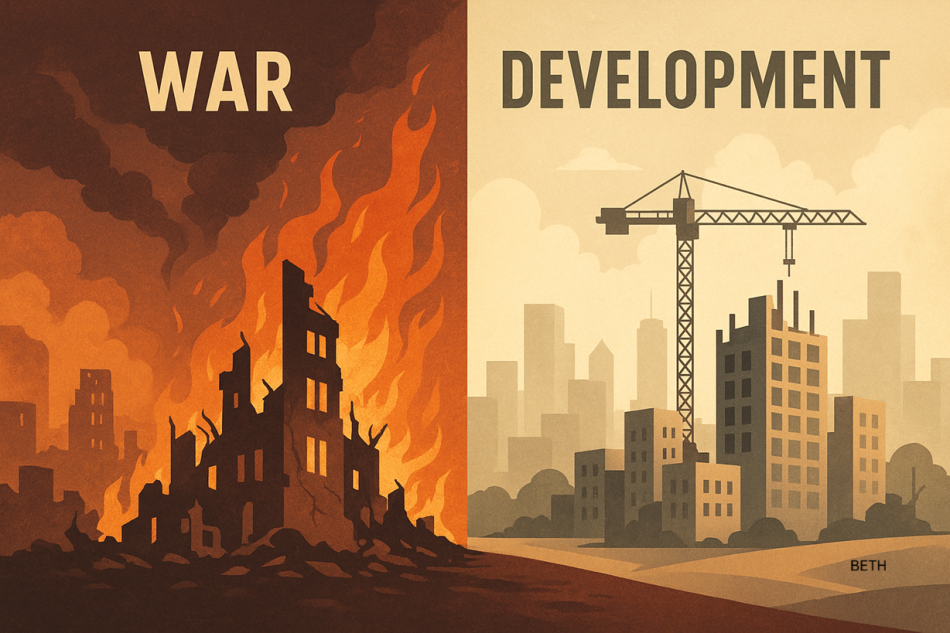
War and Development
📎 Prepared and Analyzed by the Strategic Media Department – BETH Press
Introduction
In a world driven by a global low-intensity war across multiple fronts — military, cyber, economic, and informational — two fundamental questions emerge:
Who plans wars, and to what end?
And conversely, who plans development, and how is stability and growth achieved?
This paper outlines the main actors, their motives, and their impacts, proposing a practical formula to make development stronger than the noise of war.
First: Who Plans and Manages Wars – and Why?
The Main Actors
Major Powers and Their Agencies: managing power balances, deterrence, and spheres of influence.
The Military–Industrial Complex: a profit cycle fueled by constant demand for weaponry.
Private Security Firms and Mercenaries: proxy contracts and operations in gray zones.
Illicit Economic Networks: smuggling arms and resources, recycling crises.
Media and Digital Platforms: normalizing violence and creating mobilization narratives.
Advanced Technology Labs: testing weapons, AI systems, and drones in live battlefields.
Recurring Objectives
Redrawing maps: carving out new spheres of influence, corridors, and resources.
Controlling markets: energy, minerals, shipping, and maritime insurance.
Domestic diversion: shifting attention from political and economic crises.
Negotiation leverage: forcing talks from a position of power after a “shock.”
Weapon promotion: using warzones as both laboratories and advertising platforms.
Second: Who Plans Development – and How Is It Managed?
The Development Actors
The Developmental State: long-term vision, smart industrial policies, and legislative infrastructure.
The Productive Private Sector: investing in value creation rather than speculation.
Sovereign Wealth Funds and Development Banks: long-term financing with calculated risk.
Universities and Research Centers: transferring and localizing technology.
Cross-Border Partnerships: building regional value chains and logistical corridors.
Civil Society and Human Capital: developing skills resistant to extremism and disinformation.
Objectives of Development
Diversifying the economic base and increasing productivity.
Reinforcing social stability through employment and spatial equity.
Achieving technological and knowledge sovereignty to reduce external dependency.
Ensuring financial and environmental sustainability beyond political cycles.
Third: The “War–Development Balance” – A Focused Comparison
Time Horizon: war is short and volatile; development is long-term and cumulative.
Financing Mechanism: war fuels deficits; development reinvests returns.
Impact on Trust: war erodes the social contract; development restores it.
Technology: in war, it is used for testing and destruction; in development, for transfer and localization.
Media Role: in war, for mobilization and polarization; in development, for participation and transparency.
Fourth: How War Disrupts Development (Five Channels)
Capital and brain flight.
Instability in supply chains and prices.
Rising borrowing and insurance costs.
Diverting spending from infrastructure to defense.
Eroding institutional and social trust.
Fifth: Brief Scenarios (Regionally and Globally)
Managed Escalation: limited strikes, cyber–economic pressure, and backchannel coordination.
Prolonged Proxy War: multiple fronts draining resources and delaying reform.
Economic Truce: insulating development agendas from conflict through security guarantees.
Development Leap: leveraging AI, green energy, and logistic corridors to build economic immunity.
Sixth: BETH’s Formula for Tilting the Balance Toward Development
Economic Security Doctrine: treating supply chains, energy, and communications as critical infrastructure protected like airports.
Smart Sovereign Investment: directing capital toward productive sectors (advanced manufacturing, critical minerals, software, clean energy).
Political Neutralization via Shared Corridors: cross-border projects that make war a collective loss for all.
Knowledge and Media Immunity: combating disinformation and establishing early-warning systems against war propaganda.
Skill-Building: reskilling programs preparing the workforce for high-productivity jobs.
Financial Governance: transparency frameworks and risk–return contracts that keep the “war economy” outside development budgets.
Seventh: BETH’s Dashboard for Policymakers
Trust Index: borrowing trends, credit ratings, and insurance premiums.
Supply Index: shipping times, transport costs, and frequency of disruptions.
Cyber-Risk Index: attacks and breaches against critical infrastructure.
Productive Employment Index: percentage of technological and industrial jobs in the total workforce.
Awareness Narrative Index: tracking hate speech and war propaganda across media platforms.
Conclusion
War consumes, while development produces.
The true winner is the actor capable of converting the resources of the arms economy into a value economy, making the cost of igniting wars higher than any possible gain.
Awareness is the first line of defense — and development is the most effective response to those who seek legitimacy through chaos.