



The Great Powers’ Struggle Over Global Ports
By Adnan Kareemeh
If empires begin their eras of prosperity through the growth of their internal economies, later extending their influence outward and advancing into militarization, then China is following that path. Despite the intensifying "trade wars" and its expanding web of new alliances shaped by evolving geopolitical realities, Beijing is not currently seeking a military confrontation with the United States — recognizing that its primary and decisive battle remains economic in nature.
Since ports are the gateways through which a nation ascends to the peak of global economic leadership, China views maritime dominance as a symbol of a broader struggle. It relies on state capital and economic integration to secure control over trade routes, while the United States mobilizes private capital and international alliances to counter Beijing’s expanding influence. Control over ports is not merely about financial profit — it is a tool of soft power that extends into political and even military leverage.
Global Trade Turbulence
The world is witnessing its greatest disruption in trade rules in over eighty years, triggered by U.S. President Donald Trump’s imposition of tariffs. Yet, global trade surprisingly recorded a $300 billion increase in the first half of this year, driven by a 14% rise in U.S. imports and a 6% increase in EU exports, according to the latest UNCTAD report.
The report revealed a shift in trade growth patterns — developed economies outperformed emerging ones in the first quarter, reversing the trend of recent years when the Global South led the way. Meanwhile, trade imbalances have widened: U.S. deficits grew, while China and the EU posted growing surpluses. America’s annual trade gap now stands at $360 billion with China, $276 billion with the EU, and $116 billion with Vietnam.
UNCTAD warned of rising risks to global trade in the second half of the year amid policy uncertainty, geopolitical tensions, slowing global growth, and increasing industrial protectionism. Despite these headwinds, resilience factors remain — particularly in maritime shipping, regional economic integration, and robust trade in services.
The Global Ports Landscape
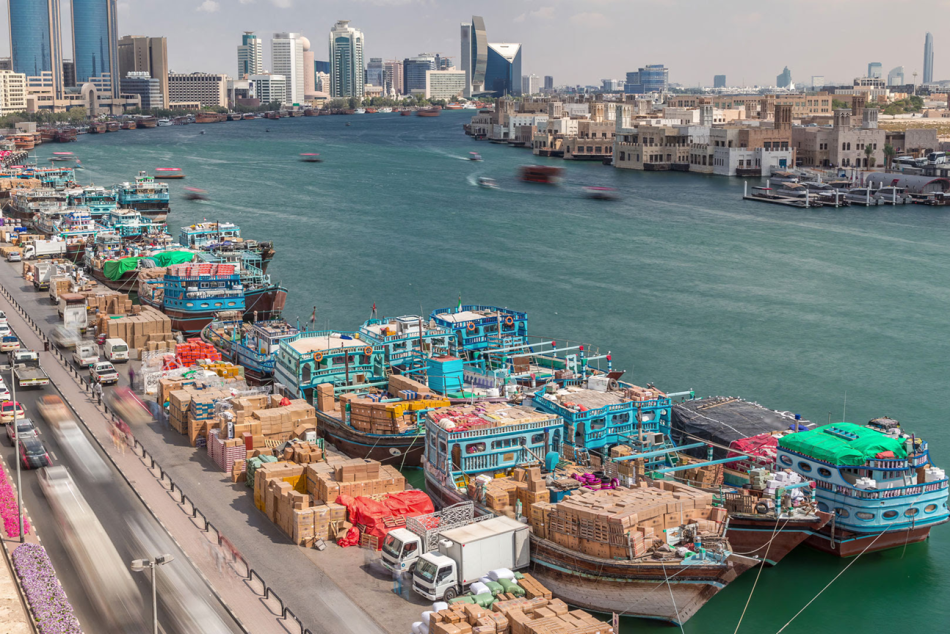
According to Clarksons Research (2024), over 80% of global trade by volume moves by sea through more than 940 major ports worldwide. China leads this sector with two global giants: Shanghai Port, handling about 50 million containers annually, and Ningbo–Zhoushan, handling 33 million. They are followed by Singapore (39 million), Rotterdam in the Netherlands (14.3 million) — Europe’s largest — and Jebel Ali in Dubai (14.1 million), the biggest in the Middle East.
These figures reveal how port throughput mirrors a nation’s economic power. The general rule holds: the more ports a country operates, the greater its influence over global trade routes and corporate logistics decisions.
According to Drewry’s Port Report, seven major operators control over 40% of global port traffic. Leading them is DP World (UAE) with 78 terminals in over 40 countries; followed by APM Terminals (Denmark) with over 70; and two Chinese giants — Hutchison Ports (Hong Kong) with 52 terminals in 26 nations, and China Merchants Holdings, operating 50 terminals across Asia, Africa, and Europe.
This expansion reflects Beijing’s long-term strategy to consolidate maritime influence, challenging Western dominance that has weakened due to environmental regulations and declining infrastructure investment. In 2000, China managed just 16 ports; today, it has a footprint in 102 ports worldwide.
The U.S.–China Maritime Rivalry
Washington woke up late to the strategic implications of this issue. It has since moved to establish security and logistical partnerships across the Gulf and the Horn of Africa.
In July, The National Interest published an article by Matthew Fylan titled “Can America Stop China’s Port Expansion?” highlighting fears that “China’s growing presence in global ports threatens U.S. economic security and trade freedom.” The article urged Washington to counter Beijing’s influence through development funding, diplomatic pressure, and coordination with allies — before it’s too late.
Since World War II, the United States has viewed control over maritime routes not merely as a trade matter but as a strategic military domain. The expansion of Chinese port operations now poses a direct challenge — particularly as China cements its role as Latin America’s top trading partner and eyes key Brazilian ports now open for sale.
What most alarms Washington is China’s growing reach into the Western Hemisphere — the U.S.’s traditional sphere of influence. Beijing’s increasing presence around the Panama Canal — a vital artery of global trade — could, according to analysts, prompt military responses from President Trump’s administration.
Africa: The New Maritime Frontier
Africa, with its 30,000 km of coastline and over 300 ports, has emerged as a major arena for global competition. Chinese firms dominate key logistical nodes, investing in 62 seaport terminals including projects in Nigeria, Kenya, Angola, and Tanzania.
Europe, meanwhile, is attempting a strategic re-entry through security and trade agreements with nations like Senegal and Angola.
The continent holds vast natural resources — oil, gold, uranium, and rare minerals — much of which remains untapped. Analysts estimate Africa offers 200 years of potential development. Some 33 African ports on the Atlantic serve as export hubs for minerals, while 17 Chinese-funded ports line the Indian Ocean and East Africa, including the Horn of Africa. Chinese firms now hold 61% of the global port development market share.
Egypt, Africa’s northern gateway, operates 19 commercial seaports on the Red Sea and the Mediterranean. Alexandria and Port Said — near the Suez Canal, which handles 12% of global trade — process roughly 6 million containers annually. The Suez Canal Container Terminal, run by SCCT, attracts both Chinese and European investments.
DP World and Gulf Leadership
Egypt’s ports have long been magnets for foreign investment, but Gulf partnerships — especially from the UAE — have accelerated since 2017. DP World, the Dubai-based global ports operator, has become a major player in Egypt and across Africa.
The company now manages 12 ports in Africa and plans to invest $3 billion over the next three years in African port infrastructure to meet the long-term demand for critical minerals exports.
The appeal is clear: eight of the world’s fifteen fastest-growing economies are in Africa, according to the IMF. Despite global economic and geopolitical volatility, DP World reported strong financial and operational performance in the first half of the year — underscoring the strength and resilience of its integrated global logistics platform.
BETH Analysis 🌍⚓
Adnan Kareemeh’s article highlights one of the most dynamic and under-discussed fronts in today’s geopolitical landscape — ports as the silent pillars of great-power influence.
The battle is no longer fought on land or in the air, but at the gates of world trade that run through the seas. China’s management of more than a hundred ports marks a shift from domestic industry to global maritime supremacy. The United States, long dominant at sea since WWII, now finds itself facing an economic rival using cranes instead of cannons, and infrastructure instead of invasions.
This contest is not only about commerce — it’s about who will hold the keys to the world economy in the decades ahead. Control of ports means control over trade flows, market rhythms, and the pulse of emerging economies.
In essence, the world is witnessing a maritime version of the new Cold War — where submarines are replaced by investments, generals by engineers, and bullets by long-term contracts.
🟦 BETH Summary:
The struggle over ports is a race to command the future.
The sea, as history reminds us, has always mirrored imperial power —
but in the age of globalization, it has become the mirror of intelligent economics.