



From Jeddah… Official Launch of the MENA–ARIN Network for Asset Recovery
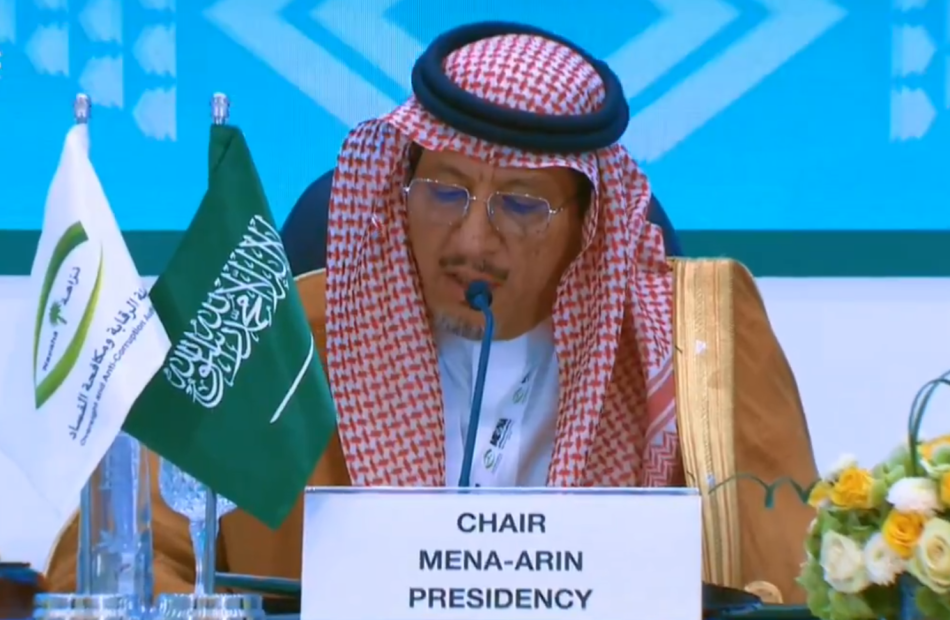
Jeddah – BETH | October 9, 2025
The Kingdom of Saudi Arabia, represented by the Oversight and Anti-Corruption Authority (Nazaha), concluded today the first annual general meeting of the Regional Asset Recovery Interagency Network for the Middle East and North Africa (MENA–ARIN).
Held in Jeddah from October 8–9, 2025, the meeting gathered ministers, attorneys general, heads of anti-corruption agencies, and financial intelligence units, along with representatives from international and regional organizations and national entities concerned with asset recovery and anti-corruption efforts.
Global and Regional Participation
The event witnessed wide participation from more than 30 countries across the Middle East, Africa, Asia, and Europe — including Egypt, the UAE, Sweden, Kazakhstan, Malaysia, Nigeria, and the Czech Republic — alongside representatives from global asset recovery networks (ARINs) in Europe, Africa, Asia, and Latin America.
Key organizations such as the United Nations Office on Drugs and Crime (UNODC), INTERPOL, the Organization of Islamic Cooperation, and the League of Arab States also took part, underscoring the importance of enhanced coordination among regional and global networks to strengthen international asset recovery and anti-corruption efforts.
Official Launch and Founding Charter
In his opening remarks, Mr. Mazin bin Ibrahim Al-Kahmous, President of Nazaha, welcomed participants and highlighted that the establishment of the MENA–ARIN network marks the beginning of a new era of collective regional and international action, aligned with the goals of Saudi Vision 2030, which places combating corruption and recovering assets among its top national priorities.
During the session, Mr. Al-Kahmous announced the official launch of MENA–ARIN, and the adoption of both the Network Charter and the Declaration of Intent, setting out the institutional and governance framework that will guide the network’s operations and cooperation mechanisms.
Dialogue and Policy Exchange
The second day of discussions focused on enhancing international cooperation, harmonizing national procedures, and accelerating asset recovery processes.
Participants exchanged experiences on non-conviction-based confiscation, showcasing its effectiveness as a key tool for the recovery of illicit assets.
Delegates from the United Kingdom, France, Spain, Denmark, Portugal, Latvia, and South Korea contributed to the sessions, joined by international institutions such as the OECD, the Basel Institute on Governance, and the UNODC.
Capacity-Building Workshops
On the sidelines of the meeting, Nazaha organized two specialized workshops:
“Fundamentals of Virtual Asset Transfers” (October 5–7, 2025): addressing cryptocurrency tracing, digital wallet monitoring, and virtual asset management.
“Asset Recovery and Management” (October 7–9, 2025): focusing on pre-seizure planning, legal frameworks, and mechanisms for converting seized assets into financial value.
More than 35 experts representing judicial, financial, and regulatory institutions participated in the workshops.
Saudi Leadership and International Milestone
In his closing statement, Dr. Nasser bin Ahmed Aba Al-Khail, Deputy Governor for International Cooperation at Nazaha, expressed appreciation to all participating countries and organizations, emphasizing that the meeting’s success represents a historic milestone in strengthening international collaboration on asset recovery.
The Saudi presidency of MENA–ARIN for 2025 announced a set of key recommendations, including:
Activating national contact points and enhancing operational data exchange.
Aligning national legislation with international standards on confiscation, settlements, and freezing of assets.
Expanding cooperation with global networks such as CARIN, INTERPOL, and GlobE.
Launching specialized training programs for investigators, prosecutors, and judges to build institutional capacity across the region.
A Turning Point for Transparency and Integrity
The meeting concluded with the United Arab Emirates assuming the presidency of MENA–ARIN for 2026, followed by Qatar for 2027.
Participants praised Saudi Arabia’s outstanding organization, coordination, and leadership, affirming that the launch of MENA–ARIN from Jeddah marks a pivotal moment in regional and global efforts to promote transparency, recover stolen assets, and combat corruption.
The initiative underscores the Kingdom’s pioneering role in fostering international cooperation, legislative development, and institutional capacity-building—advancing sustainable development and reinforcing global confidence in the region’s collective integrity.