


US–China Economic Competition with Geopolitical Dimensions — 美国与中国:兼具地缘政治维度的经济竞争
English Version
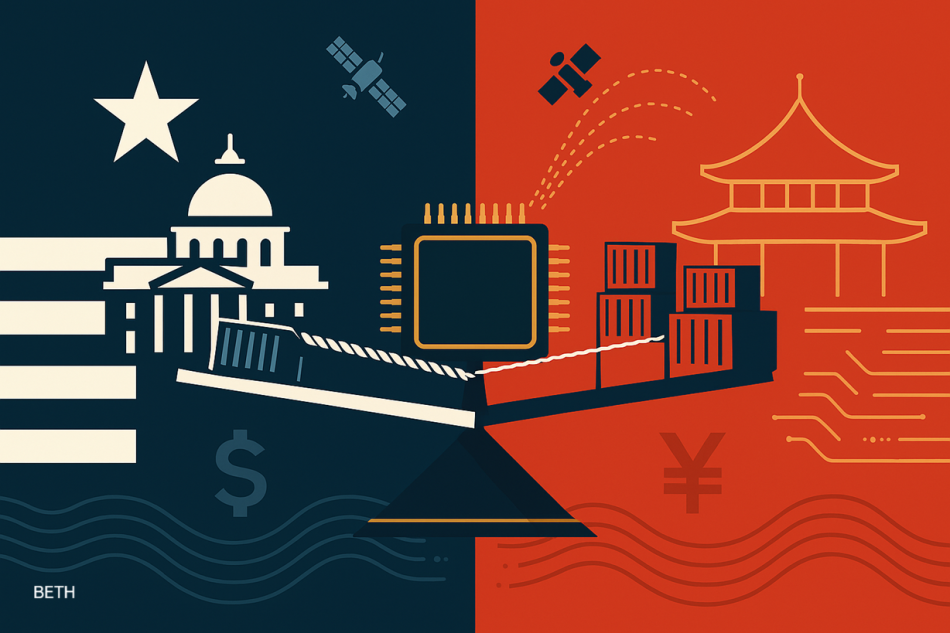
US–China Competition: Economy, Technology, and the Next World Order
BETH | Analytical Report
By: Dr. Mohammad Diab — Lebanese researcher in economic & geopolitical affairs
Introduction
The United States and China are locked in a multi-layered contest—economic, technological, military, and ideological. The outcome will shape rules for trade, supply chains, tech standards, and power projection in the coming world order.
1) Economic Competition — Tariffs, Tech, and Interdependence
Escalating controls: Successive U.S. administrations tightened export controls and sanctions—especially on advanced tech and semiconductors.
Chip battleground: U.S. global share of semiconductor output fell from 37% (1990) to ≈12% today; China poured public investment into R&D, AI, biotech, and industrial upgrading.
Deep ties remain: Two-way trade of $600–700B makes a clean “decoupling” unrealistic.
Tariff impacts:
China: offsets with domestic demand and re-routing exports via third countries—raising costs.
U.S.: re-industrialization faces skills/material bottlenecks and near-term consumer price pressures; sectors most tied to Chinese inputs include textiles, autos, machinery, electrical equipment (OECD).
Global risk: Strains between the two largest economies disrupt supply/value chains, dampen investment and demand, and lift costs and inflation.
2) Geopolitical Dimensions — BRI vs. IMEC, and the Taiwan Nexus
Power shift: China surpassed the U.S. in PPP GDP (2014), while the U.S. leads in nominal terms.
Competing corridors: China’s Belt and Road Initiative vs. the U.S.-backed India–Middle East–Europe Corridor (IMEC).
Taiwan as fulcrum:
Beijing views reunification as strategic—opening freer access to the Indo-Pacific and easing dependence on the Strait of Malacca.
Washington sees status-quo preservation as vital to alliance credibility in Asia.
3) Potential Consequences if Tensions Escalate
Trade routes: Maritime/air disruption in East Asia; land routes can’t carry more than ~10% of China’s external trade today.
Global growth shock: A severe Taiwan crisis could trigger broad economic warfare (asset freezes, investment/trade curbs) and a deep global downturn.
Semiconductor shock: Taiwan produces ~60% of chips and ~90% of leading-edge nodes—any stoppage hits autos, medical devices, defense, electronics.
Bloc formation: Emergence of tech/financial blocs with parallel standards and payment systems—accelerated de-globalization.
Hedging by third countries: Neutral, opportunity-seeking positions (alternative corridors, logistics, sanctions-bypass services).
Scenarios
Managed Competition (Guardrails): selective cooperation + limits around sensitive tech.
De-risking/Partial Unbundling: deeper standard divergence; longer, pricier supply chains.
Crisis over Taiwan: market turmoil, chip shortages, and likely global recession.
What to Watch
U.S. controls on chips/tools vs. China’s responses (materials, subsidies).
Reshoring/friend-shoring speed and cost.
Logistics indicators (East Asia freight, Malacca, insurance premia).
China’s domestic-demand policies and property-sector stability.
Cross-border capital in chips/AI/batteries.
BETH View (Conclusion)
No clean victory is likely. The realistic optimum is managed competition with guardrails and pragmatic cooperation outside the most sensitive domains. The worst case is a fully politicized value chain and a systemic industrial-financial shock. For regional economies, opportunity lies in alternative corridors, proximate manufacturing, and standards navigation—paired with careful geopolitical risk management.
中文版(简体)
美中竞争:经济、科技与下一轮世界秩序的塑造
BETH|分析报告
**作者:**穆罕默德·迪亚布博士——黎巴嫩经济与地缘政治事务研究者
引言
美国与中国的竞争呈现多层次:经济、科技、军事与意识形态交织。其走向将重塑贸易规则、供应链结构、技术标准与全球力量版图。
1)经济竞争——关税、科技与相互依存
管制升级:历届美政府收紧对华出口管制与制裁,重点指向高端技术与半导体。
芯片主战场:美国全球半导体产量份额自1990年的37%降至约12%;中国加大对研发、人工智能、生物科技与产业升级的公共投入。
深度互嵌:双边贸易额600–700亿美元(应为600–7000亿美元/即$600–700B)使“完全脱钩”不切实际。
关税影响:
中国:通过扩大内需与转口(经第三国)对冲,对成本抬升敏感。
美国:推进再工业化受制于技能与材料瓶颈,短期消费价格承压;与中国产品联系最紧的行业包括纺织、汽车、机械与电气设备(OECD)。
全球风险:两大经济体摩擦加剧将扰动供应链/价值链,抑制投资与需求,推升成本与通胀。
2)地缘政治维度——“一带一路”对“印—中东—欧走廊”,以及台湾问题
**力量位移:按购买力平价(PPP)**计算,中国2014年起超越美国;名义规模仍以美为先。
通道竞争:中国的“一带一路”对美国主导的印—中东—欧洲走廊(IMEC)。
台湾为关键枢纽:
北京将统一视为战略优先,以畅通进入印太并降低对马六甲海峡的高度依赖。
华盛顿认为维持现状对盟友威慑与信誉至关重要。
3)若冲突升级的潜在后果
**航运通道:东亚海空运输受阻;现有陆路通道承载能力仅约10%**的中国外贸。
全球增长冲击:台海危机或引发全面经济战(冻结资产、限制投资与贸易),并带来深度衰退风险。
**半导体冲击:台湾生产约60%芯片及约90%**先进制程;停摆将重击汽车、医疗、国防与电子产业。
集团化与双标准:形成科技/金融集团与并行标准、支付体系,加速去全球化。
**第三方国家的“骑墙”与套利:**通过替代通道、物流与合规缝隙获益。
情景推演
**可管控竞争(安全护栏):**在敏感领域外维持务实合作。
**降风险/部分松绑:**标准分化加深,供应链更长更贵。
**台海危机:**市场剧烈波动、芯片短缺与全球衰退概率上升。
观察要点
美国对芯片/设备/EDA工具的限制及中国的对策(关键材料、补贴)。
再工业化/友岸外包的速度与成本。
东亚运价、马六甲通行与保险溢价等物流指标。
中国扩大内需与房地产稳定性。
跨境资本流向(芯片、AI、电池)。
BETH 观点(结语)
难有“零和式胜利”。更可行的路径是建立可管控的竞争框架,在非敏感领域保持务实协作;最坏情景则是价值链全面政治化并引发系统性产业—金融冲击。对区域经济体而言,机遇在于替代通道、近岸制造与标准导航,前提是稳妥管理地缘政治风险。