

From Turkey’s Gate to Palestine’s Recognition… The Unveiling of Israel’s True Face
Prepared and Analyzed – BETH News Agency
Introduction: From Victim to a Project of Power
Israel entered the heart of the Arab East through the “Turkish gate” more than a century ago. In 1897, the First Zionist Congress was held in Basel, Switzerland under the leadership of Theodor Herzl, but the logistical and political passage later came via the Ottoman Empire, when Sultan Abdul Hamid II granted privileges to the Jews despite his explicit refusal to sell Palestine. With the collapse of the Empire and the arrival of British colonial rule, the gates of Sykes–Picot and the Balfour Declaration (1917) opened the way for the establishment of a Jewish entity in the heart of Arab land.
At that moment, the world appeared divided between:
States sympathetic to the Jews as “victims” of the Holocaust and European massacres.
Major powers silent out of fear of financial and media lobbies.
An international public opinion that saw Arabs as weak peoples mired in their divisions.
Axis One: Shifts in International Recognition
For decades, the image of “the Jewish victims” shielded Israel from criticism. But this image has gradually begun to crack:
1975: The UN General Assembly considered Zionism “a form of racism and racial discrimination” (Resolution 3379), before it was later revoked under U.S.–Israeli pressure (1991).
2012: Palestine obtained the status of a “non-member observer state” at the United Nations.
2024–2025: A series of European and international states officially recognized the State of Palestine, in a symbolic and historic reversal against the Israeli narrative.
This recognition did not arise from new sympathy, but from the realization that Israel — which was born as a “refuge for the weak” — had turned into an occupying power practicing bloody repression, starvation, and colonial expansion that exposed every claim of peace.
Axis Two: The Complex of Power and Weakness
History shows that Jews often lived as a persecuted minority, from the Babylonian exile to the Spanish Inquisition, up to the Holocaust in Europe.
But the paradox is that Israel, after transforming into a state, reproduced the image of persecution at its own hands — but this time against the Palestinians.
The Holocaust against the Jews in Europe was a crime against humanity.
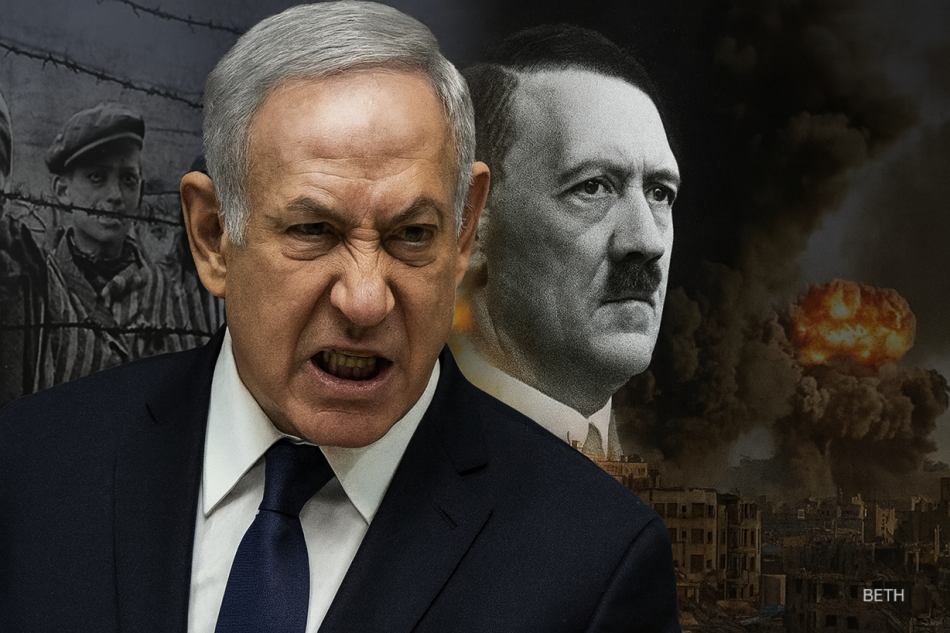
The siege of Gaza and the ongoing massacres brought back images of starvation and camps, but with an Israeli face.
The power granted to the Jews to establish a state turned into an instrument of oppression that cost them the sympathy which had been their greatest moral capital.
Axis Three: Clash of Narratives – Who Wins?
Today, the world stands at a crossroads:
The Jews as a minority: Historically, their existence was tied to integration or international sympathy. But Israel cut that thread by insisting solely on the discourse of power.
The Arabs as owners of the land: Despite periods of weakness and division, their civilizational and historical roots grant them enduring legitimacy, not erased by occupation power nor narrative manipulation.
The central question:
Is it in the interest of the Jews to antagonize the Arabs — the largest demographic and civilizational bloc in their neighborhood?
The realistic answer: No. For in its obstinacy, Israel repeats a historic mistake, replicating the causes of hatred that Jews suffered in Europe — but this time by its own hand.
Axis Four: The Speech of Confusion and Psychological Anxiety
Netanyahu’s appearance at the United Nations with a “barcode” pinned to his jacket was not mere visual theater, but an embodiment of deep internal confusion. The man who leads the longest-serving right-wing government in Israel’s history appeared unable to present a coherent narrative, mixing the language of threats with appeals to emotion, claims of strength with playing the victim.
Confusion from Two Angles:
First angle – personal and political anxiety:
Netanyahu realizes his end is imminent. Corruption files and trials await him, but what accelerates his fall is that the world is executing a “new plan” to redraw the Middle East in a way that leaves no room for rigid leaders who live by the logic of force alone.
His appearance as a “besieged leader” was nothing more than the reflection of a man who sees the end of his political career.
Second angle – internal consumption and the victim role:
In his speech, he attempted to invoke the historical victimhood of the Jews. Yet the irony is that he does so while his army stands accused of committing massacres in Gaza. This duality reveals Israel’s failure to reconcile its image as a “historical victim” with its reality as a “contemporary oppressor.”
Axis Five: European Recognition… Israel’s Security First
From another angle, the recent recognitions of Palestine by some European states cannot be read solely as a moral shift.
There is a deeper political/security logic:
Europe realizes that the continuation of the conflict without prospects, with expanding settlements and Gaza massacres, makes Israel more vulnerable to greater threats (regional or even internal).
For Europeans, recognizing Palestine is not only support for Arab rights, but also the establishment of a legitimate security buffer: a Palestinian state backed by Arabs becomes a safety valve preventing total collapse that could lead to Israel’s destruction.
In this sense, European recognition is seen from two sides: a gain for Palestinians, but also a protective measure for Israel against itself and the consequences of its prolonged occupation.
Added Conclusion – BETH’s Perspective
Netanyahu’s UN speech was a condensed image of what Israel is experiencing today:
A leader torn between a personal end and the end of a colonial project losing legitimacy.
A state losing its moral capital globally, yet clinging to the victim role.
And European recognitions of Palestine that appear as an Arab victory, but in essence are also an attempt to create a “Palestinian shield” to protect Israel from scenarios of total explosion.
💡 It is a moment that reveals Israel is not at the height of its power, but at the height of its confusion.
Conclusion – BETH’s Vision
The ongoing transformations are not just a “wave of solidarity,” but a redefinition of power and legitimacy:
Power is no longer in weapons alone, but in moral legitimacy and international recognition.
Israel, which began as a symbol of weakness and persecution, is now turning into a symbol of oppression and loss of legitimacy.
Palestine, which long lived as a “postponed cause,” today returns to the forefront as a moral narrative embraced by the world.
Conclusion:
Israel has lost its moral capital.
The world is beginning to write a new chapter, where power is not measured by the number of planes and tanks, but by the degree of belonging to human legitimacy.
💡 When this transformation is complete, the world will discover that survival is not for the strongest in arms, but for the truest in cause.