



24th Anniversary of the 9/11 Attacks: An In-Depth Analysis of the Event, Its Shifts, and Future Implications
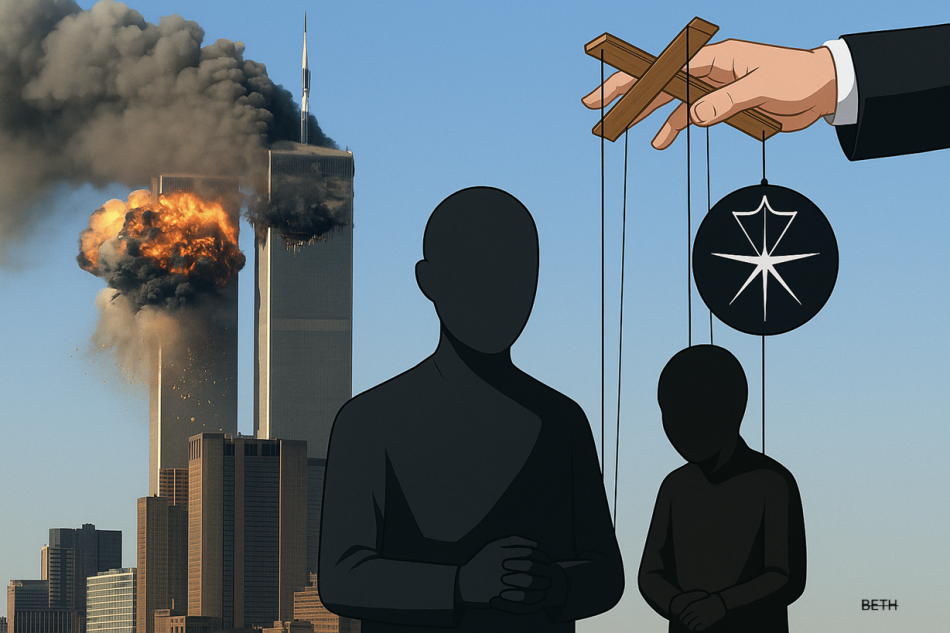
📰 Prepared and Analyzed by the Strategic Media Department – BETH Agency
Supervision – Abdullah Al-Omira
A Crime Without a Clear Perpetrator!
Twenty-four years after the attacks that reshaped the world, the big question remains unanswered: who was the real perpetrator?
The most circulated narrative remains trapped within the U.S. official account, coupled with repeated — and transparent — attempts to pin the blame on Saudi Arabia, despite the absence of conclusive evidence and the presence of shocking contradictions in Washington’s storyline.
The Rule of Criminal Investigation: “Follow the Beneficiary”
Every complex crime can be unraveled by identifying who benefited.
The United States: Gained a pretext to launch the “War on Terror,” occupy Afghanistan and Iraq, and redraw global influence.
Israel: Found a historic opportunity to reinforce the “Islamic terrorism” narrative and use it politically to tighten its grip on Palestine.
Iran: Benefited by seeing its biggest enemy (Saddam Hussein) toppled by the U.S., allowing it to expand its influence in Iraq and the region.
Arms and energy companies: Saw unprecedented profits as long wars unfolded.
The Role of Intelligence: A Forbidden Question?
From the very beginning, serious gaps emerged:
How did a small group manage to breach what was described as the world’s most powerful security system?
Where were the CIA and FBI, given later reports of prior knowledge of threats?
Why did a third tower (WTC7) collapse without being hit by any plane?
And why were Pentagon security camera recordings concealed?
These anomalies open the door to the theory of “proxy operations” or manipulation of intelligence, suggesting that certain agencies may have facilitated or exploited the attacks to justify pre-planned agendas.
Lobbies and the Targeting of Saudi Arabia
Every anniversary, lobbying groups in Washington revive the case against Riyadh.
Objective: Political and financial extortion.
Result: Deflect attention from the real beneficiaries.
Contradiction: Saudi Arabia has always been a key partner in counterterrorism, yet the guided narrative insists on blaming it.
The Missing Dimensions
Hidden files: Classified documents remain undisclosed, even after a quarter-century.
Expert testimonies: Western academic studies and books confirm major flaws in the official narrative.
Political timing: Every anniversary, the file resurfaces as a pressure card.
1 – Why is Saudi Arabia Always Accused?
Political extortion: U.S. lobbies use Saudi Arabia as an easy scapegoat to gain leverage.
A convenient equation: Blaming Riyadh diverts suspicion away from the true beneficiaries (intelligence, corporations, Israel, Iran).
Strategic weight: As a pivotal energy player, targeting Saudi Arabia serves as a pressure tool in global decision-making.
Why is it Easy to Accuse Saudi Arabia?
Central Position
Saudi Arabia is the heart of the Islamic world (holy sites, religious authority).
Any accusation carries massive weight globally and is easily weaponized by adversaries.
Symbolic Convenience
The presence of Saudi citizens among the attackers provided a ready-made façade to sell the accusation — without examining who funded, planned, and trained them.
Absence of Defensive Lobbies
Israel has AIPAC.
Iran has proxy networks and media voices.
Until recently, Saudi Arabia lacked equivalent lobbying power in the West.
Economic Leverage
Targeting Riyadh opens doors for Washington powerbrokers to extract concessions in arms, oil, and political deals.
Deliberate Conflation
Western media intentionally conflates Islam with extremism. As Saudi Arabia symbolizes Islam, it becomes the easiest target.
The “Useful Enemy”
Global politics often requires a scapegoat. Riyadh fills that role whenever needed.
2 – Shadow Soldiers: Proxy Execution
In major wars, groups or individuals are often used as expendable tools.
They are not decision-makers but manipulated executors, driven by ideology, deception, or funding.
This is the same “proxy war” model applied to crimes — individuals are exploited as the face, while the masterminds remain hidden.
3 – An Insult to U.S. Security and Justice
When segments of U.S. media persist in blaming Saudi Arabia despite weak evidence, it raises alarming questions:
Is the U.S. security apparatus truly incapable of uncovering the truth?
Or is there deliberate concealment?
This in itself is an implicit insult to the FBI, CIA, and the American judiciary — suggesting they are either incompetent or complicit.
4 – Who Benefits from Pitting Riyadh Against Washington?
Iran: Gains from any Saudi-U.S. rift, expanding its regional influence.
Israel: Reinforces its “Islamic terrorism” narrative for political gain.
Economic lobbies: Profit from political tensions via contracts and deals.
Washington insiders: Exploit the file as a bargaining chip when convenient.
5 – After a Quarter-Century: Where is the Truth?
The continued classification of key documents indicates the truth is too damaging for beneficiaries.
The longer the delay, the weaker the U.S. narrative becomes.
History shows that major crimes eventually surface — but delayed justice often normalizes impunity.
6 – How Can Saudi Arabia Flip the Script?
Strategic offense: Proactively call for full declassification of 9/11 documents.
Media coalition: Launch platforms highlighting contradictions in the U.S. narrative.
Political leverage: Frame Saudi Arabia as a victim of smear campaigns, not the culprit.
Table-turning: Internationally pose the question: Why is Riyadh still accused while the real perpetrators remain hidden after 25 years?
7 – The Role of Saudi and Arab Media
Smart confrontation: Avoid defensive tones; instead, spotlight Western contradictions.
Alternative narratives: Showcase Saudi Arabia as a frontline partner against terrorism.
Symbolic media: Use cartoons, documentaries, and neutral analyses to embarrass biased outlets.
Public engagement: Campaigns and hashtags that reframe the global debate: Who truly benefited?
🎯 BETH Conclusion
After 25 years, the truth remains buried while Saudi Arabia is scapegoated.
Yet, strategic intelligence demands turning this burden into an opportunity — exposing the real beneficiaries and presenting Saudi Arabia as a victim of manipulation, not a perpetrator.
The 9/11 attacks remain one of the most complex political crimes of modern history.
The full truth has not been revealed.
U.S. lobbies keep weaponizing the case against Riyadh.
The real beneficiaries remain behind the curtain.
The shock is not in the crime itself, but in the persistent erasure of the real actors — and in turning the victim into the accused.
Accusing Saudi Arabia is “easy” because of its religious symbolism, geopolitical position, and the absence of counter-lobbies. But today, Riyadh is stronger politically and in media presence.
It can flip the narrative by asking the global question: Who truly benefited from framing Saudi Arabia?
❓ The Forbidden Truth… What After 25 Years of Obscurity?
Scenario 1: A Breakthrough and the Truth Revealed
Weak indicators: Books, leaks, and documentaries question the official narrative.
But these remain limited, lacking the weight to break the system.
A real breakthrough would require a massive leak, a high-level confession, or political upheaval.
For now, it’s unlikely — full exposure would shatter trust in America’s deep state.
Scenario 2: The Broken Record Continues
More likely: the U.S. narrative persists.
Every anniversary → renewed accusations toward Saudi Arabia.
Every domestic crisis → file reused as a diversion.
Beneficiaries (arms, oil, Israel, Iran) keep the case alive.
BETH Strategic Interpretation
The truth is not missing — it is forbidden.
Keeping the “broken record” spinning serves too many interests, and keeps the door of extortion wide open.
Full disclosure would mean putting America’s entire post-2001 foreign policy on trial — something the establishment will never allow.
🎯 Final Word
No imminent political or media “revolution” will reveal the perpetrators.
But Saudi Arabia can trigger a strategic revolution by:
Demanding declassification.
Building global media platforms to raise hard questions.
Turning the case into a soft power weapon against those who seek to smear it.