



Dismantling the Proxies
Strategic Read – BETH Agency
Outlook: 6–18 Months
Central Question: Are Iran’s proxies on the way out?
Executive Summary
The “Axis of Resistance” network is facing multi-front attrition: direct military pressure (Gaza/South Lebanon/Yemen), logistical tightening, and domestic social polarization over the legitimacy of weapons outside state control. This does not signal an imminent collapse so much as a forced transformation—from offensive proxies to locally defensive ones adapting to risk-reduction.
Hezbollah remains the heaviest arm, yet is now constrained by a grinding war with Israel and high internal costs in Lebanon; Hamas has lost its governing environment in Gaza and shifted to a networked organization relying on pockets, tunnels, and external support; the Houthis are taking direct hits on logistics and military infrastructure after the fight was carried into Sanaa; al-Hashd al-Shaabi is undergoing legal redefinition that may either legalize its influence within the Iraqi state or restrict it—the equation is not settled.
The Muslim Brotherhood is not an Iranian proxy; historically, ties have been situational and transactional, especially via the Gaza (Hamas) channel or pragmatic coordination against shared rivals.
Speculation about attempts to penetrate identities/minorities (e.g., Druze in southern Syria/Lebanon, or leveraging Sufi labels in Egypt) remains weakly evidenced and fraught with blowback; Tehran’s sway in southern Syria runs primarily through regime networks and Hezbollah, while Druze in Sweida have maintained notable protest independence from Damascus and its allies.
The current Iran–Israel confrontation mixes mutual deterrence with a contest for regional influence, with the fire spreading to Yemen and the Red Sea—raising the cost to Iran’s network and creating regional windows to isolate it.
Roots (How did these groups emerge?)
Muslim Brotherhood (1928, Egypt): A Sunni reformist/political movement that later spawned multiple offshoots (including Hamas). Its relationship with Iran has been pragmatic and fluctuating—short of an outright “proxy.”
Hamas (1987): A Palestinian branch of the Brotherhood; Iranian support has waxed and waned, returning strongly in the past decade via funding, training, and arms.
Hezbollah (early 1980s): Formed under IRGC patronage during Lebanon’s civil war, building a “state-within-a-state” model.
Houthis (Ansar Allah): A Zaydi armed movement born from the Saada wars, later tied to Iran through weapons, expertise, and organized smuggling routes.
Al-Hashd al-Shaabi (2014): An umbrella of Iraqi factions mobilized against ISIS; it spans groups closely linked to Iran (e.g., Kata’ib, Asa’ib…) and others aligned with the state/Marja’iyya (Sistani). Today it is being pushed toward permanent regularization or gradual constraint.
Current Impact and Role
Hezbollah (Lebanon): Significant rocket arsenal, security–social networks, and political–economic leverage; now facing border attrition and shrinking domestic legitimacy amid economic collapse.
Hamas (Gaza/abroad): From “besieged governance” to decentralized combat networks; capabilities lean more on tunnels, UAVs, and external arming—while effective governing institutions have been lost.
Houthis (Yemen/Red Sea): A theatre of extension: missiles and drones threaten shipping and Israel’s depth; Israel’s direct strikes on Sanaa have raised the costs of tying Yemen to the Gaza equation.
Al-Hashd al-Shaabi (Iraq): Security–political–economic influence through the state; debates over “permanent regularization” could either broaden its formal legitimacy or bind it within the army’s hierarchy—outcome will shape the network’s trajectory in Baghdad.
Muslim Brotherhood: Politico-social influence varies across the Arab world; ties to Iran are better described as situational convergence, not organizational subordination.
Who benefits?
Iran as the funding/coordination hub; the Syrian regime; Iran-aligned Iraqi factions. Israel also benefits from a constant threat that justifies cross-border operations and defense coalitions. Smuggling networks and the gray economy profit from the economy of war.
Pathways of Erosion (Why is “decline” plausible?)
Multi-front attrition: Opening the Yemen–Red Sea theatres onto the Israel track flips the equation against the Houthis and raises Iran’s logistical costs.
Supply-chain squeeze: UN tracing of drone/missile components smuggled to the Houthis strains the “lifelines.”
Local mood shifts: Sweida’s Druze protests against Damascus and allies undercut the “protection narrative” Iran leverages in southern Syria.
Legal restructuring in Iraq: Integrating/regularizing the Hashd can either curb proxy warfare or formalize it—both outcomes restrict covert maneuvering.
Bottom line here: “Decline” is not a sudden collapse, but functional erosion that pushes these networks toward local defense roles—leaving gaps that smaller, more covert cells might try to fill.
Alternative Leveraging
Sufism in Egypt: No solid public evidence of direct Iranian use of Sufi currents as a proxy. Egypt’s religious–security environment makes such infiltration high-risk, low-reward; if anything emerged, it would likely be via social/charitable/cultural fronts, not politics—an assumption to monitor, not assert.
Druze (Lebanon/Syria/Israel): Tehran’s influence typically runs through Hezbollah/the Syrian regime, not via direct Druze capture. The 2008 Lebanese events marked coercive fault lines, while Sweida showed independent protest against Damascus. Any broad Iranian bet on “Druze identity” faces internal resistance and high regional sensitivity.
Iran & Israel: Why the Hostility Now?
Proxy-based deterrence: Israel views the arsenals of Hezbollah/Gaza/Yemen as strategic threats and responds with multi-theatre strikes (Syria/Yemen/Lebanon); Iran treats proxy deterrence as an insurance policy. The Yemen flare-up in August 2025 illustrates the widening contest.
Regional influence contest: Both seek maneuvering space from the Mediterranean to the Gulf—Israel via air/tech superiority and alliances; Iran via the proxy web and missile/UAV capabilities.
Domestic politics: The file is used in both Tel Aviv and Tehran to rally domestic fronts and justify security costs.
Major Powers & the Region – Where Does Saudi Arabia Stand?
United States: Proceeding with repositioning in Iraq through 2026 while sustaining deterrence against Iran-linked networks and securing sea lanes.
Russia/China: Moscow leverages its Syrian footprint and need for Iranian cooperation; Beijing prefers de-escalation and safeguarding trade corridors, having previously sponsored the Tehran–Riyadh rapprochement.
Saudi Arabia (the region’s leading great power): A dual approach—responsible de-escalation with Tehran alongside building a deterrence/defense umbrella and air–maritime partnerships to protect corridors; a pivotal diplomatic role on Gaza, Yemen, and Lebanon—aligned with Vision 2030 and market/corridor stability.
6–18 Month Scenarios
Managed Erosion (Likely): Continued attrition converts proxies to local defensive roles and curbs cross-border capacity; pinpoint strikes continue without full-scale war.
Constraining via Regularization (Iraq/Lebanon): Laws/deals fold parts of the networks into state institutions in exchange for heavy-weapons control—raising the political cost of external adventures.
Sudden Escalatory Spike (Less Likely): A major incident in Lebanon or the Red Sea triggers a wave of strikes; proxies are further drained, with risks of spillover.
Early-Warning Indicators
Pace of deep-strike operations (Syria/Yemen/Lebanon) and the nature of logistics targets.
Legal architecture governing al-Hashd al-Shaabi and its placement within state organs.
Smuggling routes for UAV/missile components via the Gulf of Aden/Oman.
Street sentiment in Sweida and its evolving relationship with Damascus/allies.
Integrated Takeaway
Proxies do not “vanish” at once; their cross-border functions erode when supply nodes are hit, local legitimacy fades, and they are re-regularized inside states. In this horizon, a window for regional re-shaping opens: Iran’s out-of-border reach contracts while a state–institutions–economy approach—led by Riyadh—advances, backed by smart deterrence and secure trade corridors. In this sense, “decline” means dismantling capability, not dissolving the entity.
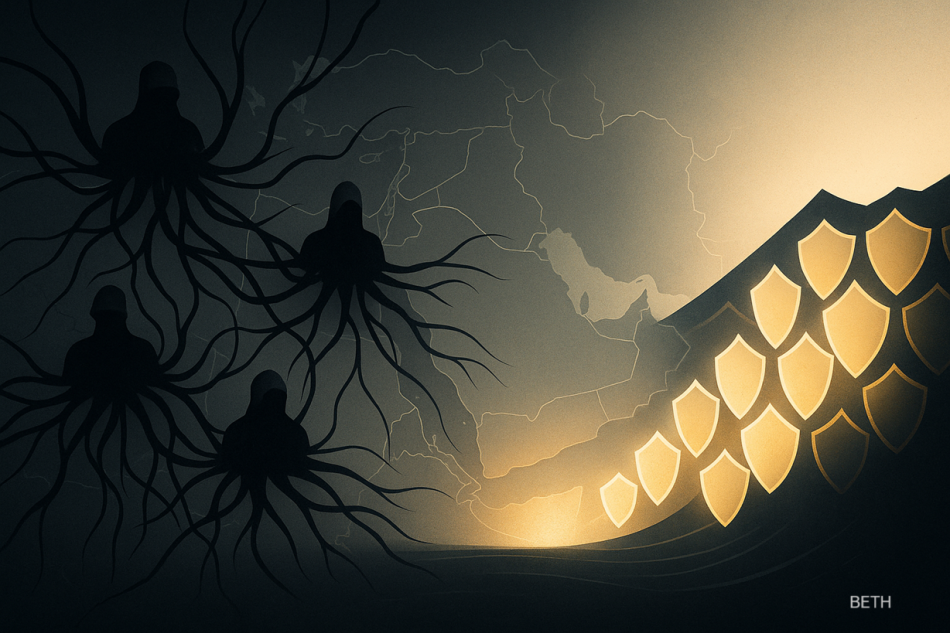
🖼️ Image: A symbolic depiction of proxy erosion and the rise of a cohesive regional shield that secures corridors and re-engineers stability.