


Israel… Between the Illusion of Power and the Reality of Arab Balance
Prepared and Analyzed by the Strategic Media Department – BETH News Agency
A question that often echoes in Arab and global discourse: How has Israel managed to endure, surrounded on all sides by Arab states whose individual power is steadily growing?
The answer may lie in one word: individualism.
This “individualism,” as some observers describe it, is one of the hidden pillars of Israel’s strength.
I. The Traditional Sources of Israeli Power
In a discussion among Arab and foreign journalists – including one Israeli – the Israeli participant said bluntly:
“Israel’s strength comes from Arab division.”
But that division is only the tip of the iceberg. The factors that have sustained Israel’s strategic advantage for decades can be summed up in six points:
Arab internal divisions: Rivalries and the tendency of each state to focus on its own issues.
Pursuit of narrow self-interests: Especially by economically weaker states seeking favor from major powers and financial institutions.
Absence of a unified, long-term Arab strategy.
Massive U.S. financial and logistical support.
Organized, well-funded Zionist lobbies entrenched in Western—particularly U.S.—decision-making circles.
Proficiency in media and propaganda, with a mastery of inflating its own image.
II. Israeli Awareness of Future Shifts
Inside Israel, there is growing recognition that these advantages are not eternal. With the emergence of a new Arab generation—more aware, more connected, and more outward-looking—the traditional equation is becoming less secure.
This generation increasingly sees Israeli power as more illusory than solid. The vulnerability of this perceived strength became evident when a relatively weak Iran managed to launch several missiles at Israel, sparking the question:
What if the Arabs—collectively—directed their missiles, tanks, and armies toward Israel?
III. The Equation That Worries the West
History has shown that the West, and the United States in particular, cannot act effectively in the region without Arab cooperation—especially given that Arab states have generally pursued peace.
But the scenario that truly unsettles both Israel and the West is:
What if the “Arab giant” moved in unison, coordinating its currently fragmented parts?
Or even more drastically: What if the fractured Arab world united under a strong, single banner?
Such a development would erode Israel’s relative advantage and flip the balance of power in the region.
IV. From Tyranny of Power to the Necessity of Peace
Today, Israel is a power that builds and strategizes—but with a double-edged goal: bolstering itself and deterring its adversaries. Yet every power built on dominance carries within it the seeds of its own decline.
The pivotal questions are:
Will Israel persist in its overreach until it collapses from within?
Or will it choose political transformation before reaching the point of no return?
At that juncture, the West’s position will be decisive: to back Israel in a redefined framework based on genuine peace, or to witness it enter a phase of strategic erosion.
BETH Analysis:
For decades, Israel has leveraged Arab division and Western alliances to craft the image of an “invincible” state. Today, that image faces unprecedented challenges from shifting internal and regional dynamics.
The emergence—even partial—of a unified Arab will could upend the balance, transforming Israel from a dominant force into one compelled to accept a new equilibrium… a balance that may impose peace, not as a choice, but as a reality it can no longer ignore.
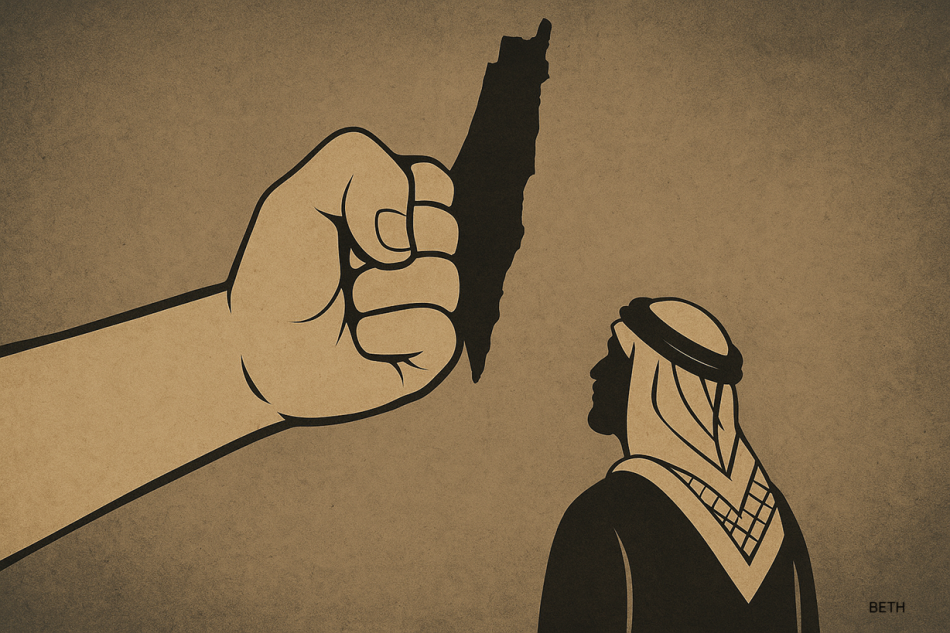
Symbolic Analysis of the Image
The image distills the Arab–Israeli conflict into three essential elements:
The clenched fist gripping the map of Palestine/Israel
Represents the power holding the reins, not only in a military sense but also in terms of political control and dominance over the on-ground reality.
This grip can be read in two ways: either as a force of deterrence or as a force of tyranny exercising pressure and monopoly.
The Arab figure facing the scene
Symbolizes the Arab position of observation and contemplation, aware of the scene but yet to decide how to respond to this grip.
The silence and indirect confrontation imply that Arabs recognize the balance of power, yet also understand that the equation could shift if the will and direction change.
Colors and artistic style
The dark earthy background and minimalistic style suggest that this is not a new issue but one deeply rooted in history.
The sharp contrasts and shadows convey a sense of stasis, as if the conflict has been frozen for decades, awaiting the moment of change.
Symbolic Conclusion:
The image suggests that the “grip” is not eternal, and that the “Arab observer” may either remain a spectator or choose the right moment to change the equation. This aligns with the core of the report: that Israel’s power is not absolute and may, in the future, face a unified Arab will capable of imposing a new balance.